

102
5 Biopolymer Chitosan Membranes Prepared from Fishery Waste …
A rise in pH beyond this level will deprotonate the functional groups on the adsorbent
and act as negative.
Consequently, the adsorbent surface is charged negatively at pH > pH PZC , positively charged at pH < pH PZC and neutrally at pH = pH PZC . The CS and XCS pH PZC
was lower than the solution pH which supported adsorption as the surface is charged
negatively.
5.4 Adsorption Capacity
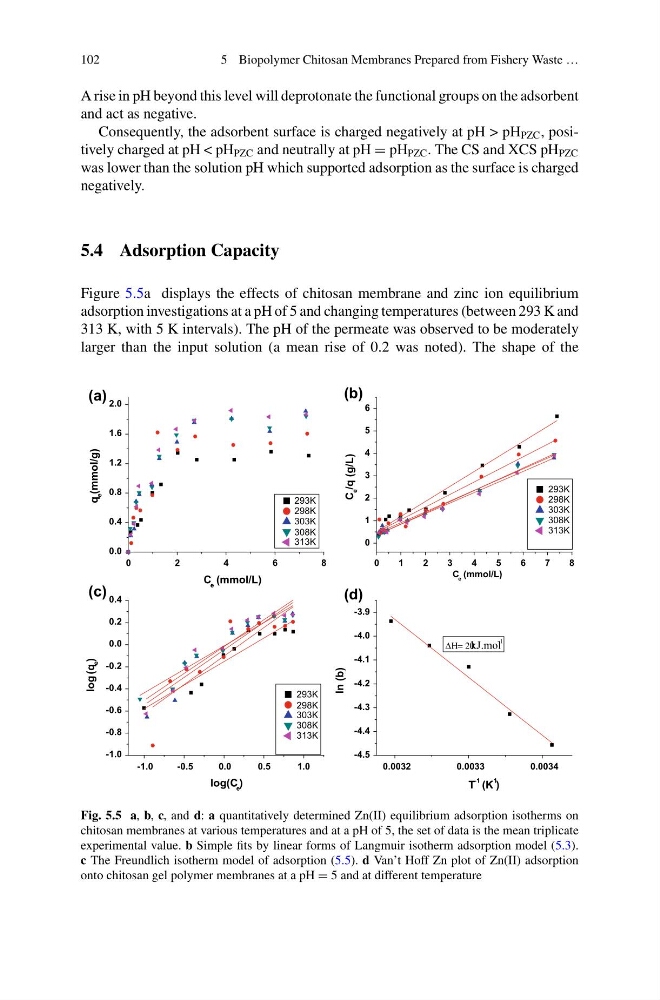
Figure 5.5a displays the effects of chitosan membrane and zinc ion equilibrium
adsorption investigations at a pH of 5 and changing temperatures (between 293 K and
313 K, with 5 K intervals). The pH of the permeate was observed to be moderately
larger than the input solution (a mean rise of 0.2 was noted). The shape of the
0
2
4
6
8
0.0
0.4
0.8
1.2
1.6
2.0
0
1
2
3
4
5
6
7
8
0
1
2
3
4
5
6
-1.0
-0.5
0.0
0.5
1.0
-1.0
-0.8
-0.6
-0.4
-0.2
0.0
0.2
0.4
0.0032
0.0033
0.0034
-4.5
-4.4
-4.3
-4.2
-4.1
-4.0
-3.9
293K
298K
303K
308K
313K
q
e
(mmol/g)
C e (mmol/L)
293K
298K
303K
308K
313K
C
e
/q (g/L)
C e (mmol/L)
(c)
(d)
293K
298K
303K
308K
313K
log (q
e
)
log (C e )
(a)
(b)
T
-1 (K
-1
)
ΔΗ= 20 kJ.mol
-1
ln (b)
Fig. 5.5 a, b, c, and d: a quantitatively determined Zn(II) equilibrium adsorption isotherms on
chitosan membranes at various temperatures and at a pH of 5, the set of data is the mean triplicate
experimental value. b Simple fits by linear forms of Langmuir isotherm adsorption model (5.3).
c The Freundlich isotherm model of adsorption (5.5). d Van’t Hoff Zn plot of Zn(II) adsorption
onto chitosan gel polymer membranes at a pH = 5 and at different temperature
5 Biopolymer Chitosan Membranes Prepared from Fishery Waste …
A rise in pH beyond this level will deprotonate the functional groups on the adsorbent
and act as negative.
Consequently, the adsorbent surface is charged negatively at pH > pH PZC , positively charged at pH < pH PZC and neutrally at pH = pH PZC . The CS and XCS pH PZC
was lower than the solution pH which supported adsorption as the surface is charged
negatively.
5.4 Adsorption Capacity
Figure 5.5a displays the effects of chitosan membrane and zinc ion equilibrium
adsorption investigations at a pH of 5 and changing temperatures (between 293 K and
313 K, with 5 K intervals). The pH of the permeate was observed to be moderately
larger than the input solution (a mean rise of 0.2 was noted). The shape of the
0
2
4
6
8
0.0
0.4
0.8
1.2
1.6
2.0
0
1
2
3
4
5
6
7
8
0
1
2
3
4
5
6
-1.0
-0.5
0.0
0.5
1.0
-1.0
-0.8
-0.6
-0.4
-0.2
0.0
0.2
0.4
0.0032
0.0033
0.0034
-4.5
-4.4
-4.3
-4.2
-4.1
-4.0
-3.9
293K
298K
303K
308K
313K
q
e
(mmol/g)
C e (mmol/L)
293K
298K
303K
308K
313K
C
e
/q (g/L)
C e (mmol/L)
(c)
(d)
293K
298K
303K
308K
313K
log (q
e
)
log (C e )
(a)
(b)
T
-1 (K
-1
)
ΔΗ= 20 kJ.mol
-1
ln (b)
Fig. 5.5 a, b, c, and d: a quantitatively determined Zn(II) equilibrium adsorption isotherms on
chitosan membranes at various temperatures and at a pH of 5, the set of data is the mean triplicate
experimental value. b Simple fits by linear forms of Langmuir isotherm adsorption model (5.3).
c The Freundlich isotherm model of adsorption (5.5). d Van’t Hoff Zn plot of Zn(II) adsorption
onto chitosan gel polymer membranes at a pH = 5 and at different temperature