

58
precipitation through the year from equal distribution and values close to zero indicates very little or no periodic variation in precipitation.
3.3.4 Innovative Trend Analysis
In this method (ITA- Sen 2012) firstly the given time series data is divided into two
equal sub-series and arrange every sub-series into ascending order independently. In
the second step, plot the sub-series against each other, then the first half of the subseries on the horizontal axis and second half on the vertical axis, and hereafter,
acquire the scatter template. In the third step, draw the 1 : 1 (45
°
) straight line, representing no trend (trendless) in time series data. If the scatter points are accumulated above or below the 1 : 1 (45
°
) straight line, it means there is an increasing or
decreasing trend in the hydro-meteorological time series (Sen 2012).
The indicator of trend is calculated by dividing the average difference to the
average of the first half of the sub-series as the change detection depends on the first
half of the sub-series. The indicator is multiplied by 10 to reach the same scale for
allowing direct comparison as that of the analysis of Mann-Kendall (MK) and Sen’s
slope estimator at 90% confidence level (Ahmad et al. 2018). Thus, the indicator of
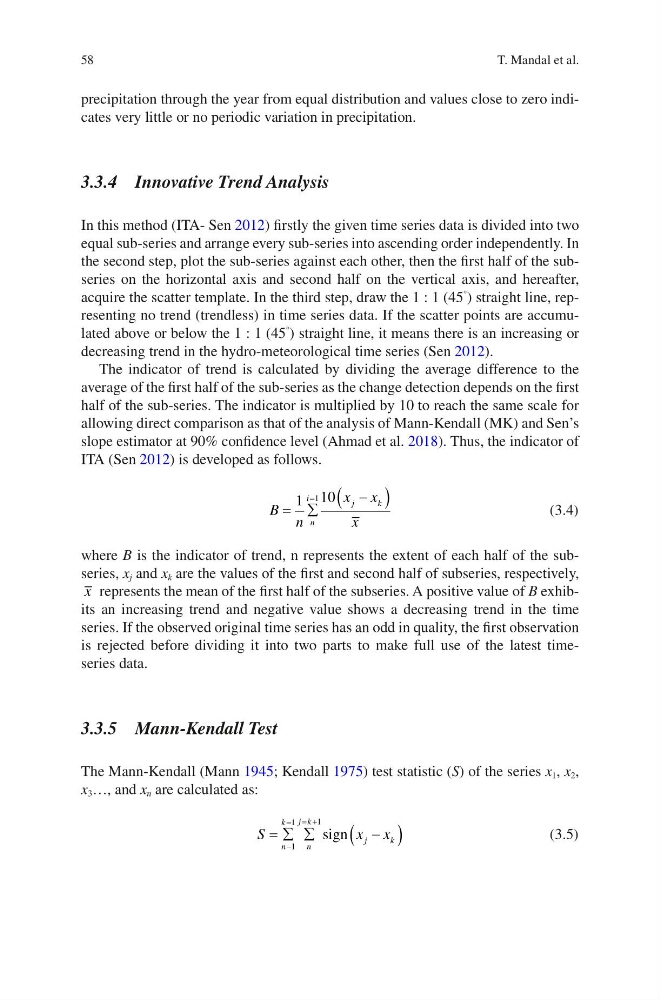
ITA (Sen 2012) is developed as follows.
B n
x x
x
n
i
j
k
¦
1 10
1
(3.4)
where B is the indicator of trend, n represents the extent of each half of the subseries, x j and x k are the values of the first and second half of subseries, respectively,
x represents the mean of the first half of the subseries. A positive value of B exhibits an increasing trend and negative value shows a decreasing trend in the time
series. If the observed original time series has an odd in quality, the first observation
is rejected before dividing it into two parts to make full use of the latest timeseries data.
3.3.5 Mann-Kendall Test
The Mann-Kendall (Mann 1945; Kendall 1975) test statistic (S) of the series x 1 , x 2 ,
x 3 …, and x n are calculated as:
S
x x
n
k
n
j k
j
k
¦ ¦
1
1
1
sign
(3.5)
T. Mandal et al.
precipitation through the year from equal distribution and values close to zero indicates very little or no periodic variation in precipitation.
3.3.4 Innovative Trend Analysis
In this method (ITA- Sen 2012) firstly the given time series data is divided into two
equal sub-series and arrange every sub-series into ascending order independently. In
the second step, plot the sub-series against each other, then the first half of the subseries on the horizontal axis and second half on the vertical axis, and hereafter,
acquire the scatter template. In the third step, draw the 1 : 1 (45
°
) straight line, representing no trend (trendless) in time series data. If the scatter points are accumulated above or below the 1 : 1 (45
°
) straight line, it means there is an increasing or
decreasing trend in the hydro-meteorological time series (Sen 2012).
The indicator of trend is calculated by dividing the average difference to the
average of the first half of the sub-series as the change detection depends on the first
half of the sub-series. The indicator is multiplied by 10 to reach the same scale for
allowing direct comparison as that of the analysis of Mann-Kendall (MK) and Sen’s
slope estimator at 90% confidence level (Ahmad et al. 2018). Thus, the indicator of
ITA (Sen 2012) is developed as follows.
B n
x x
x
n
i
j
k
¦
1 10
1
(3.4)
where B is the indicator of trend, n represents the extent of each half of the subseries, x j and x k are the values of the first and second half of subseries, respectively,
x represents the mean of the first half of the subseries. A positive value of B exhibits an increasing trend and negative value shows a decreasing trend in the time
series. If the observed original time series has an odd in quality, the first observation
is rejected before dividing it into two parts to make full use of the latest timeseries data.
3.3.5 Mann-Kendall Test
The Mann-Kendall (Mann 1945; Kendall 1975) test statistic (S) of the series x 1 , x 2 ,
x 3 …, and x n are calculated as:
S
x x
n
k
n
j k
j
k
¦ ¦
1
1
1
sign
(3.5)
T. Mandal et al.