

33
2.6 Loss of Wetland
Wetlands are often considered as ‘Earth Kidneys’ as it absorbs wastes such as nitrogen, phosphorous, etc., from water (EPA, US 2014). The definition of wetlands
according to Ramsar Convention of Wetlands in 1971 is ‘wetlands are areas of
marsh, fen, peatland or water, whether natural or artificial, permanent or temporary, with water that is static or flowing, fresh, brackish or salt, including areas of
marine water the depth of which at low tide does not exceed six metres’.
Wetlands are the most important part of environment. The importances of the
wetlands are:
a. Wetland supports variety of species of microbes, plants, insects, amphibians,
reptiles, birds, fish and mammals as part of wetland ecosystem
b. Coastal wetlands protects the shoreline against the wave action and storm surges
c. Wetland reduces the intensity of the flood
d. Wetland absorbs the pollutants from the water and improves the water quality
e. Wetland provides a wide variety of natural products which include fish, blueberries, cranberries, timber and wild rice
f. Wetland supports a large part of fish production in the world
To celebrate the importance of wetland, 2
nd
February is designated as the World’s
Wetland Day. According to National Wetland Atlas 2011, prepared by the Space
Application Centre, Ahmedabad there are 201,503 wetlands in India. The total wetland area based on Ramsar classification is about 7.6Mha and if open water, aquatic
vegetation (submerged, floating and emergent) and surrounding hydric soils are also
taken into account the total wetland area is estimated to be 15.26 MHa which covers
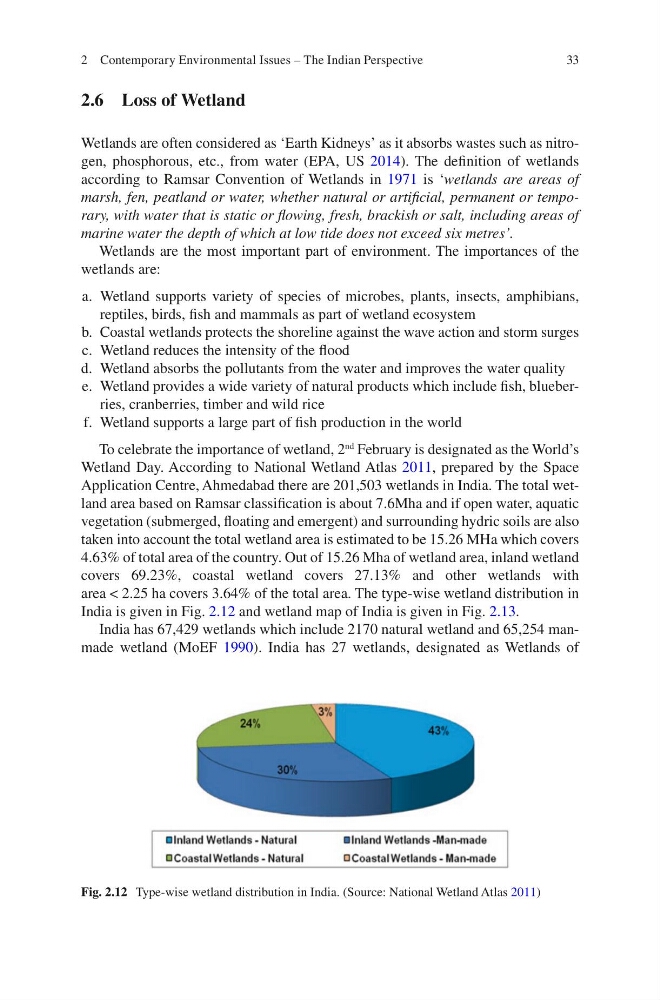
4.63% of total area of the country. Out of 15.26 Mha of wetland area, inland wetland
covers 69.23%, coastal wetland covers 27.13% and other wetlands with
area < 2.25 ha covers 3.64% of the total area. The type-wise wetland distribution in
India is given in Fig. 2.12 and wetland map of India is given in Fig. 2.13.
India has 67,429 wetlands which include 2170 natural wetland and 65,254 manmade wetland (MoEF 1990). India has 27 wetlands, designated as Wetlands of
Fig. 2.12 Type-wise wetland distribution in India. (Source: National Wetland Atlas 2011)
2 Contemporary Environmental Issues – The Indian Perspective
2.6 Loss of Wetland
Wetlands are often considered as ‘Earth Kidneys’ as it absorbs wastes such as nitrogen, phosphorous, etc., from water (EPA, US 2014). The definition of wetlands
according to Ramsar Convention of Wetlands in 1971 is ‘wetlands are areas of
marsh, fen, peatland or water, whether natural or artificial, permanent or temporary, with water that is static or flowing, fresh, brackish or salt, including areas of
marine water the depth of which at low tide does not exceed six metres’.
Wetlands are the most important part of environment. The importances of the
wetlands are:
a. Wetland supports variety of species of microbes, plants, insects, amphibians,
reptiles, birds, fish and mammals as part of wetland ecosystem
b. Coastal wetlands protects the shoreline against the wave action and storm surges
c. Wetland reduces the intensity of the flood
d. Wetland absorbs the pollutants from the water and improves the water quality
e. Wetland provides a wide variety of natural products which include fish, blueberries, cranberries, timber and wild rice
f. Wetland supports a large part of fish production in the world
To celebrate the importance of wetland, 2
nd
February is designated as the World’s
Wetland Day. According to National Wetland Atlas 2011, prepared by the Space
Application Centre, Ahmedabad there are 201,503 wetlands in India. The total wetland area based on Ramsar classification is about 7.6Mha and if open water, aquatic
vegetation (submerged, floating and emergent) and surrounding hydric soils are also
taken into account the total wetland area is estimated to be 15.26 MHa which covers
4.63% of total area of the country. Out of 15.26 Mha of wetland area, inland wetland
covers 69.23%, coastal wetland covers 27.13% and other wetlands with
area < 2.25 ha covers 3.64% of the total area. The type-wise wetland distribution in
India is given in Fig. 2.12 and wetland map of India is given in Fig. 2.13.
India has 67,429 wetlands which include 2170 natural wetland and 65,254 manmade wetland (MoEF 1990). India has 27 wetlands, designated as Wetlands of
Fig. 2.12 Type-wise wetland distribution in India. (Source: National Wetland Atlas 2011)
2 Contemporary Environmental Issues – The Indian Perspective