

284
have designed some interesting structures (dong-bandh) to manage the running
water for their benefit. Before constructing the check dam and canal network, they
always keep in mind two important aspects – (a) the source of the dong (upper end
of the canal) must be located at a higher elevation than that of the areas around to
which water will be drained, and (b) as the river water disappears in the bhabor zone
of the foothill belt in winter, check dam has to be raised at a place immediately
before the water reaches the highly porous bhabor zone.
Although the velocity of river water changes sharply at this juncture between the
Siwalik mountain and the foothill plain due to the break of slope, still the river
retains its high speed in this zone. From the mountainous area, large boulders,
stones, tree branches and other eroded materials are bought down by the rivers to
deposit here in the border area. Moreover, there is notable seasonal variation in the
amount of water discharge. Whenever heavy rainfall occurs continuously for a few
days during the monsoon season, the water discharge of rivers gets raised abruptly,
and sometimes shifting of channel also takes place. Again, during the winter season,
the rivers become almost dry. Therefore, the construction of dams and canals in
such a physically unstable environment is very difficult.
The local people of the area may not have any modern or formal engineering
knowledge, but they have practical knowledge about the geologic and geomorphic
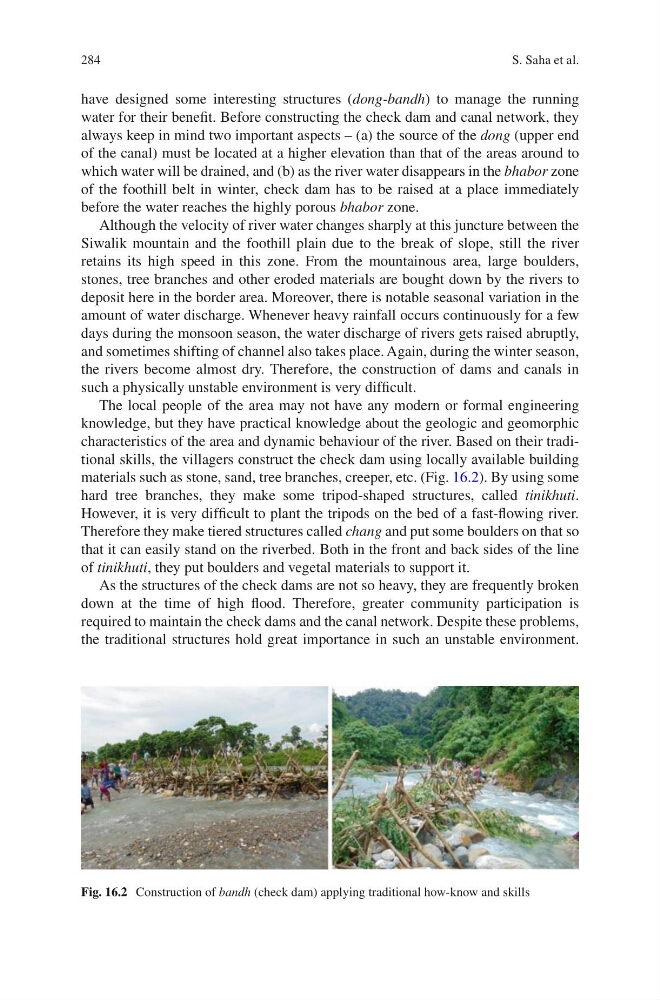
characteristics of the area and dynamic behaviour of the river. Based on their traditional skills, the villagers construct the check dam using locally available building
materials such as stone, sand, tree branches, creeper, etc. (Fig. 16.2). By using some
hard tree branches, they make some tripod-shaped structures, called tinikhuti.
However, it is very difficult to plant the tripods on the bed of a fast-flowing river.
Therefore they make tiered structures called chang and put some boulders on that so
that it can easily stand on the riverbed. Both in the front and back sides of the line
of tinikhuti, they put boulders and vegetal materials to support it.
As the structures of the check dams are not so heavy, they are frequently broken
down at the time of high flood. Therefore, greater community participation is
required to maintain the check dams and the canal network. Despite these problems,
the traditional structures hold great importance in such an unstable environment.
Fig. 16.2 Construction of bandh (check dam) applying traditional how-know and skills
S. Saha et al.
have designed some interesting structures (dong-bandh) to manage the running
water for their benefit. Before constructing the check dam and canal network, they
always keep in mind two important aspects – (a) the source of the dong (upper end
of the canal) must be located at a higher elevation than that of the areas around to
which water will be drained, and (b) as the river water disappears in the bhabor zone
of the foothill belt in winter, check dam has to be raised at a place immediately
before the water reaches the highly porous bhabor zone.
Although the velocity of river water changes sharply at this juncture between the
Siwalik mountain and the foothill plain due to the break of slope, still the river
retains its high speed in this zone. From the mountainous area, large boulders,
stones, tree branches and other eroded materials are bought down by the rivers to
deposit here in the border area. Moreover, there is notable seasonal variation in the
amount of water discharge. Whenever heavy rainfall occurs continuously for a few
days during the monsoon season, the water discharge of rivers gets raised abruptly,
and sometimes shifting of channel also takes place. Again, during the winter season,
the rivers become almost dry. Therefore, the construction of dams and canals in
such a physically unstable environment is very difficult.
The local people of the area may not have any modern or formal engineering
knowledge, but they have practical knowledge about the geologic and geomorphic
characteristics of the area and dynamic behaviour of the river. Based on their traditional skills, the villagers construct the check dam using locally available building
materials such as stone, sand, tree branches, creeper, etc. (Fig. 16.2). By using some
hard tree branches, they make some tripod-shaped structures, called tinikhuti.
However, it is very difficult to plant the tripods on the bed of a fast-flowing river.
Therefore they make tiered structures called chang and put some boulders on that so
that it can easily stand on the riverbed. Both in the front and back sides of the line
of tinikhuti, they put boulders and vegetal materials to support it.
As the structures of the check dams are not so heavy, they are frequently broken
down at the time of high flood. Therefore, greater community participation is
required to maintain the check dams and the canal network. Despite these problems,
the traditional structures hold great importance in such an unstable environment.
Fig. 16.2 Construction of bandh (check dam) applying traditional how-know and skills
S. Saha et al.