

282
16.4 Evolution of the Water Management System
Traditional water management systems followed by the indigenous communities in
different agro-ecological settings of the world were developed by the peasants with
their traditional knowledge, local resource base and community efforts (Bekele and
Tilahun 2006; Parajuli 1998). Despite some physical constrains, these communitymanaged irrigation systems have been functioning smoothly for centuries.
Traditionally evolved technology, social norms, customary laws and indigenous
management systems are the main factors behind the robustness and sustainability
of such irrigation systems (Ostrom 1990; Poudel 2000).
Although the Himalayan foothill belt, particularly the bhabar area within Assam,
receives heavy rainfall during monsoon, due to porous geologic structure, sharp fall
of gradient, heavy deposition of coarse sediments, sub-surface flow of river and
rainwater, the groundwater level generally remains at a higher depth. Water bodies
like wetland are also almost absent in the area. Therefore, the people living in this
area have been facing water scarcity problem which becomes very serious during
the winter (Devi 2018).
It is noteworthy that this foothill zone had not been suitable for human habitation
till the recent past and was covered by thick forests. But the growing pressure of
population in other parts of the state forced some people to come and settle down in
the Himalayan foothill areas. Human habitation in this area started during the early
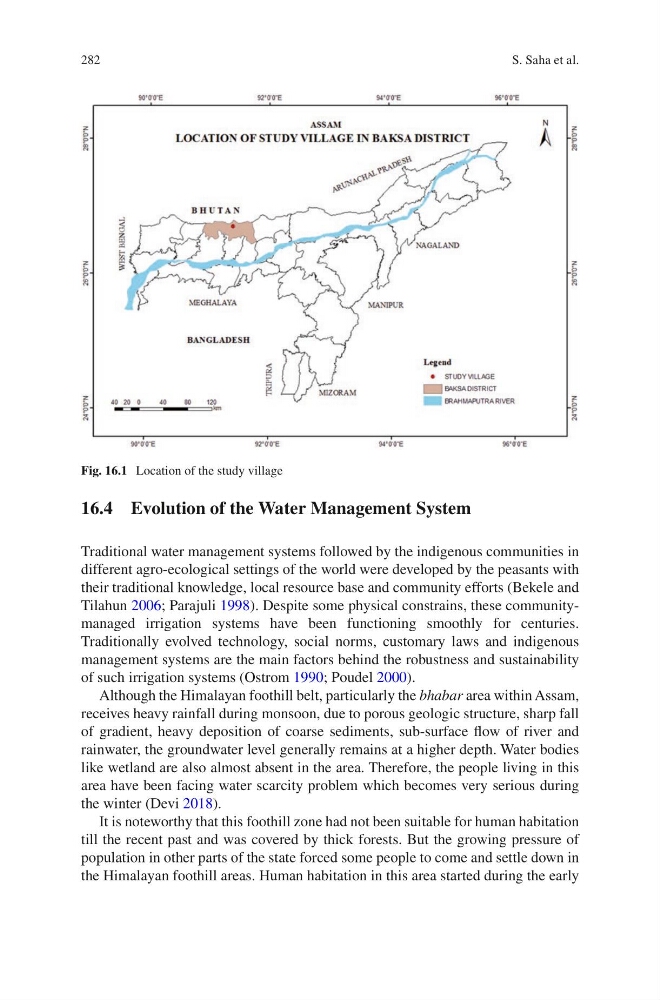
Fig. 16.1 Location of the study village
S. Saha et al.
16.4 Evolution of the Water Management System
Traditional water management systems followed by the indigenous communities in
different agro-ecological settings of the world were developed by the peasants with
their traditional knowledge, local resource base and community efforts (Bekele and
Tilahun 2006; Parajuli 1998). Despite some physical constrains, these communitymanaged irrigation systems have been functioning smoothly for centuries.
Traditionally evolved technology, social norms, customary laws and indigenous
management systems are the main factors behind the robustness and sustainability
of such irrigation systems (Ostrom 1990; Poudel 2000).
Although the Himalayan foothill belt, particularly the bhabar area within Assam,
receives heavy rainfall during monsoon, due to porous geologic structure, sharp fall
of gradient, heavy deposition of coarse sediments, sub-surface flow of river and
rainwater, the groundwater level generally remains at a higher depth. Water bodies
like wetland are also almost absent in the area. Therefore, the people living in this
area have been facing water scarcity problem which becomes very serious during
the winter (Devi 2018).
It is noteworthy that this foothill zone had not been suitable for human habitation
till the recent past and was covered by thick forests. But the growing pressure of
population in other parts of the state forced some people to come and settle down in
the Himalayan foothill areas. Human habitation in this area started during the early
Fig. 16.1 Location of the study village
S. Saha et al.