

218
From the above discussions, it can be inferred that psychologically, higher the
environmental challenges more will be the tendency of the inhabitants to look for
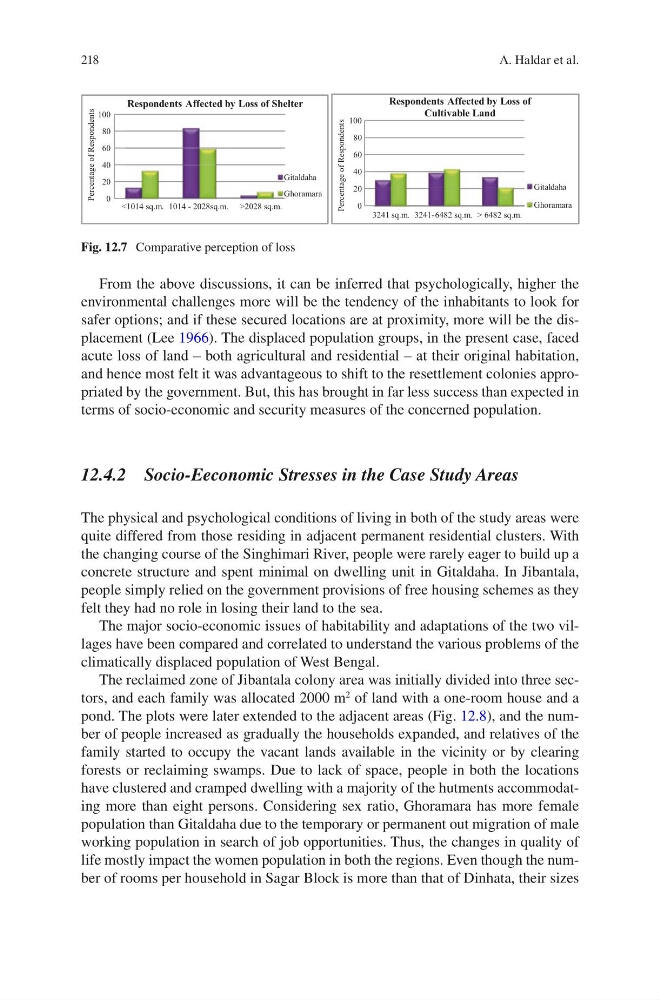
safer options; and if these secured locations are at proximity, more will be the displacement (Lee 1966). The displaced population groups, in the present case, faced
acute loss of land – both agricultural and residential – at their original habitation,
and hence most felt it was advantageous to shift to the resettlement colonies appropriated by the government. But, this has brought in far less success than expected in
terms of socio-economic and security measures of the concerned population.
12.4.2 Socio-Eeconomic Stresses in the Case Study Areas
The physical and psychological conditions of living in both of the study areas were
quite differed from those residing in adjacent permanent residential clusters. With
the changing course of the Singhimari River, people were rarely eager to build up a
concrete structure and spent minimal on dwelling unit in Gitaldaha. In Jibantala,
people simply relied on the government provisions of free housing schemes as they
felt they had no role in losing their land to the sea.
The major socio-economic issues of habitability and adaptations of the two villages have been compared and correlated to understand the various problems of the
climatically displaced population of West Bengal.
The reclaimed zone of Jibantala colony area was initially divided into three sectors, and each family was allocated 2000 m
2
of land with a one-room house and a
pond. The plots were later extended to the adjacent areas (Fig. 12.8), and the number of people increased as gradually the households expanded, and relatives of the
family started to occupy the vacant lands available in the vicinity or by clearing
forests or reclaiming swamps. Due to lack of space, people in both the locations
have clustered and cramped dwelling with a majority of the hutments accommodating more than eight persons. Considering sex ratio, Ghoramara has more female
population than Gitaldaha due to the temporary or permanent out migration of male
working population in search of job opportunities. Thus, the changes in quality of
life mostly impact the women population in both the regions. Even though the number of rooms per household in Sagar Block is more than that of Dinhata, their sizes
0
20
40
60
80
100
<1014 sq.m. 1014 - 2028sq.m. >2028 sq.m.
Percentage of Respondents
Respondents Affected by Loss of Shelter
Gitaldaha
Ghoramara
0
20
40
60
80
100
3241 sq.m. 3241- 6482 sq.m. > 6482 sq.m.
Percentage of Respondents
Respondents Affected by Loss of
Cultivable Land
Gitaldaha
Ghoramara
Fig. 12.7 Comparative perception of loss
A. Haldar et al.
From the above discussions, it can be inferred that psychologically, higher the
environmental challenges more will be the tendency of the inhabitants to look for
safer options; and if these secured locations are at proximity, more will be the displacement (Lee 1966). The displaced population groups, in the present case, faced
acute loss of land – both agricultural and residential – at their original habitation,
and hence most felt it was advantageous to shift to the resettlement colonies appropriated by the government. But, this has brought in far less success than expected in
terms of socio-economic and security measures of the concerned population.
12.4.2 Socio-Eeconomic Stresses in the Case Study Areas
The physical and psychological conditions of living in both of the study areas were
quite differed from those residing in adjacent permanent residential clusters. With
the changing course of the Singhimari River, people were rarely eager to build up a
concrete structure and spent minimal on dwelling unit in Gitaldaha. In Jibantala,
people simply relied on the government provisions of free housing schemes as they
felt they had no role in losing their land to the sea.
The major socio-economic issues of habitability and adaptations of the two villages have been compared and correlated to understand the various problems of the
climatically displaced population of West Bengal.
The reclaimed zone of Jibantala colony area was initially divided into three sectors, and each family was allocated 2000 m
2
of land with a one-room house and a
pond. The plots were later extended to the adjacent areas (Fig. 12.8), and the number of people increased as gradually the households expanded, and relatives of the
family started to occupy the vacant lands available in the vicinity or by clearing
forests or reclaiming swamps. Due to lack of space, people in both the locations
have clustered and cramped dwelling with a majority of the hutments accommodating more than eight persons. Considering sex ratio, Ghoramara has more female
population than Gitaldaha due to the temporary or permanent out migration of male
working population in search of job opportunities. Thus, the changes in quality of
life mostly impact the women population in both the regions. Even though the number of rooms per household in Sagar Block is more than that of Dinhata, their sizes
0
20
40
60
80
100
<1014 sq.m. 1014 - 2028sq.m. >2028 sq.m.
Percentage of Respondents
Respondents Affected by Loss of Shelter
Gitaldaha
Ghoramara
0
20
40
60
80
100
3241 sq.m. 3241- 6482 sq.m. > 6482 sq.m.
Percentage of Respondents
Respondents Affected by Loss of
Cultivable Land
Gitaldaha
Ghoramara
Fig. 12.7 Comparative perception of loss
A. Haldar et al.