

158
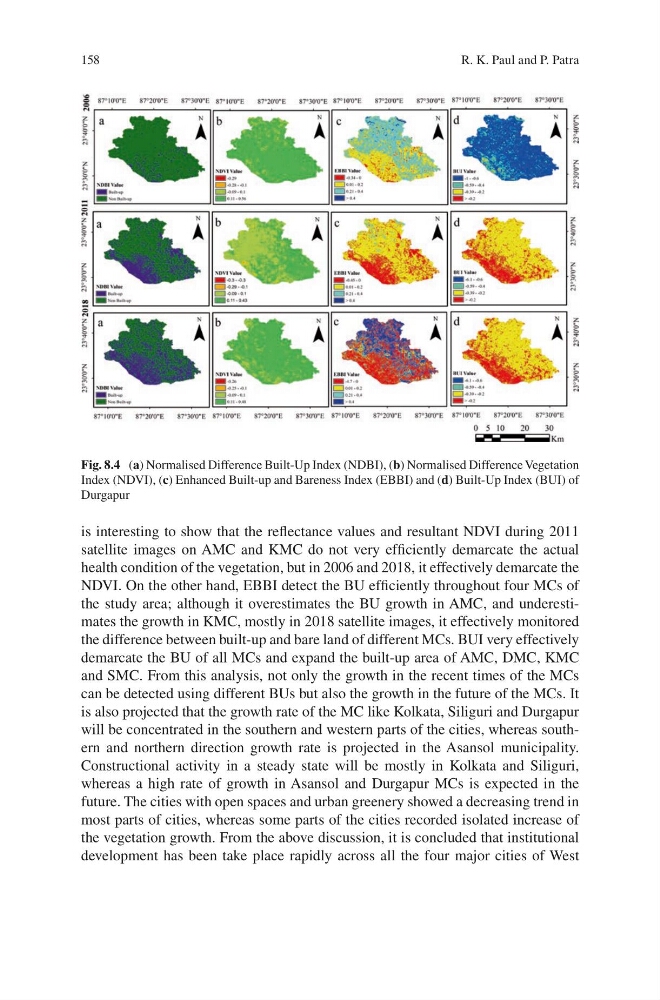
is interesting to show that the reflectance values and resultant NDVI during 2011
satellite images on AMC and KMC do not very efficiently demarcate the actual
health condition of the vegetation, but in 2006 and 2018, it effectively demarcate the
NDVI. On the other hand, EBBI detect the BU efficiently throughout four MCs of
the study area; although it overestimates the BU growth in AMC, and underestimates the growth in KMC, mostly in 2018 satellite images, it effectively monitored
the difference between built-up and bare land of different MCs. BUI very effectively
demarcate the BU of all MCs and expand the built-up area of AMC, DMC, KMC
and SMC. From this analysis, not only the growth in the recent times of the MCs
can be detected using different BUs but also the growth in the future of the MCs. It
is also projected that the growth rate of the MC like Kolkata, Siliguri and Durgapur
will be concentrated in the southern and western parts of the cities, whereas southern and northern direction growth rate is projected in the Asansol municipality.
Constructional activity in a steady state will be mostly in Kolkata and Siliguri,
whereas a high rate of growth in Asansol and Durgapur MCs is expected in the
future. The cities with open spaces and urban greenery showed a decreasing trend in
most parts of cities, whereas some parts of the cities recorded isolated increase of
the vegetation growth. From the above discussion, it is concluded that institutional
development has been take place rapidly across all the four major cities of West
Fig. 8.4 (a) Normalised Difference Built-Up Index (NDBI), (b) Normalised Difference Vegetation
Index (NDVI), (c) Enhanced Built-up and Bareness Index (EBBI) and (d) Built-Up Index (BUI) of
Durgapur
R. K. Paul and P. Patra
is interesting to show that the reflectance values and resultant NDVI during 2011
satellite images on AMC and KMC do not very efficiently demarcate the actual
health condition of the vegetation, but in 2006 and 2018, it effectively demarcate the
NDVI. On the other hand, EBBI detect the BU efficiently throughout four MCs of
the study area; although it overestimates the BU growth in AMC, and underestimates the growth in KMC, mostly in 2018 satellite images, it effectively monitored
the difference between built-up and bare land of different MCs. BUI very effectively
demarcate the BU of all MCs and expand the built-up area of AMC, DMC, KMC
and SMC. From this analysis, not only the growth in the recent times of the MCs
can be detected using different BUs but also the growth in the future of the MCs. It
is also projected that the growth rate of the MC like Kolkata, Siliguri and Durgapur
will be concentrated in the southern and western parts of the cities, whereas southern and northern direction growth rate is projected in the Asansol municipality.
Constructional activity in a steady state will be mostly in Kolkata and Siliguri,
whereas a high rate of growth in Asansol and Durgapur MCs is expected in the
future. The cities with open spaces and urban greenery showed a decreasing trend in
most parts of cities, whereas some parts of the cities recorded isolated increase of
the vegetation growth. From the above discussion, it is concluded that institutional
development has been take place rapidly across all the four major cities of West
Fig. 8.4 (a) Normalised Difference Built-Up Index (NDBI), (b) Normalised Difference Vegetation
Index (NDVI), (c) Enhanced Built-up and Bareness Index (EBBI) and (d) Built-Up Index (BUI) of
Durgapur
R. K. Paul and P. Patra