

range of activists, impeding the kind of vigorous monitoring and reporting that can
draw attention to and help curb human rights abuses. 2 Although the prime minister
decreed in 2007 that journalists should not face prison for ‘‘for reasons related to
their work,’’ current media laws allow for the imprisonment of journalists and suspension of publication for publishing ‘‘materials that cause confusion among the
public.’’ The government monitors press content, and journalists routinely exercise
self-censorship. 3
Though the emirate of Dubai has established itself as a regional and international
hub for media in which there is a media zone authority that allows 100 percent foreign
ownership and offers tax breaks, the Internet is filtered in this hub, as ONI test results
show, and there are reports of other forms of censorship. 4 For example, Dubai authorities interrupted the broadcast of two Pakistani television stations, Geo News and Ary
One World, in November 2007. Geo News said the decision resulted from constant
pressure by Pervez Musharraf, then president of Pakistan, who had at the time implemented a state of emergency in Pakistan. 5 Dubai later allowed the two stations to
resume broadcasting following negotiations with the Pakistani government and Dubai
Media City. 6
Internet in the UAE
According to a World Economic Forum report, the UAE continues to lead the Arab
world in the adoption of information and communication technology (ICT) 7 and is
expected to spend about USD 3.3 billion on ICT hardware for schools, hospitals, and
other civil projects for the period 2008–2011. 8
According to the Internet Telecommunication Union, Internet penetration in the
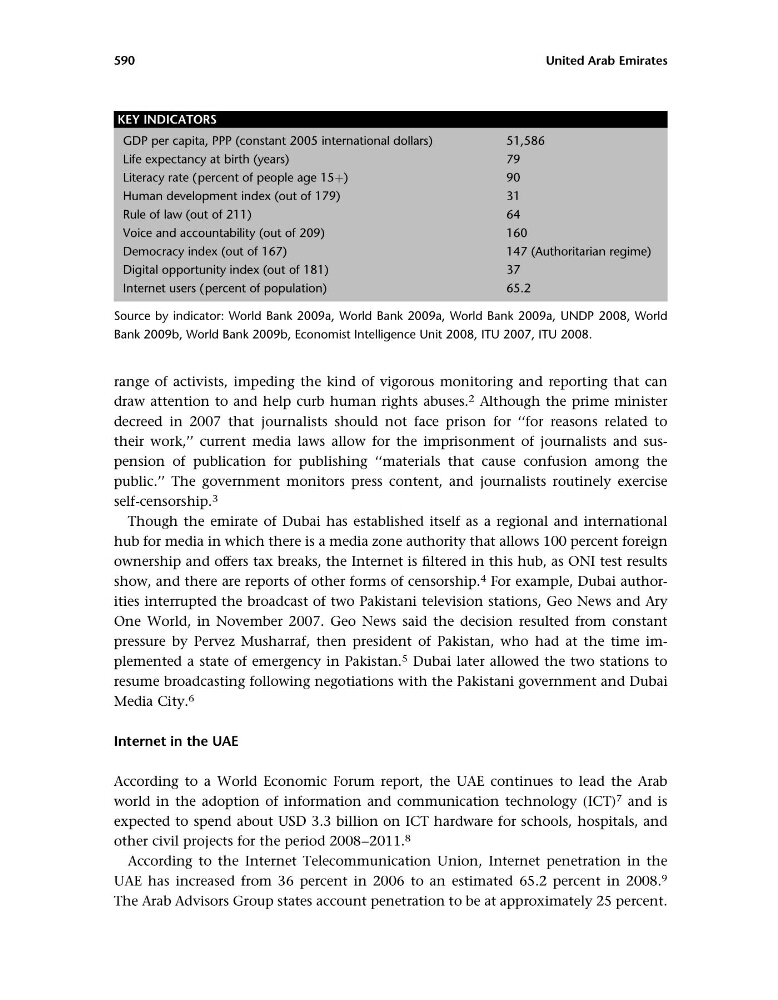
UAE has increased from 36 percent in 2006 to an estimated 65.2 percent in 2008. 9
The Arab Advisors Group states account penetration to be at approximately 25 percent.
KEY INDICATORS
GDP per capita, PPP (constant 2005 international dollars)
51,586
Life expectancy at birth (years)
79
Literacy rate (percent of people age 15þ)9 0
Human development index (out of 179)
31
Rule of law (out of 211)
64
Voice and accountability (out of 209)
160
Democracy index (out of 167)
147 (Authoritarian regime)
Digital opportunity index (out of 181)
37
Internet users (percent of population)
65.2
Source by indicator: World Bank 2009a, World Bank 2009a, World Bank 2009a, UNDP 2008, World
Bank 2009b, World Bank 2009b, Economist Intelligence Unit 2008, ITU 2007, ITU 2008.
590
United Arab Emirates