

The kingdom’s four television networks—including news channel Al-Ikhbaria—and its
radio stations are operated by the state-owned Broadcasting Service of the Kingdom of
Saudi Arabia (BSKSA), which is chaired by the Saudi minister of culture and information. 3 Private television and radio stations are prohibited on Saudi soil. 4 However, the
minister of culture and information said in May 2009 that an official committee had
been formed to study the draft privatization project of Saudi television and the Saudi
News Agency, and that the Ministry of Culture and Information was considering granting a number of radio licenses. 5
Blogging has grown as a medium for expression in Saudi Arabia, with an estimated
2,000 bloggers in 2006, half of whom are women. 6 In 2005, the government tried to
ban Blogger, the platform most often used by Saudi bloggers. 7 However, after a few
days the ban was lifted, with the censors choosing to block specific content hosted on
the platform instead. 8
In November 2008, Saudi activists launched for the first time a daring move to support a human rights campaign online and called for a two-day public hunger strike to
protest the detention without charges of human rights activists. The campaign was
highly publicized and received coverage from international media. 9
In early 2009, Saudi Arabia was ranked by the Committee to Protect Journalists as
one of the ten worst countries in which to be a blogger, citing the widespread selfcensorship and local calls by influential clerics for harsh punishment for online writers
who post content deemed heretical. 10
Internet in Saudi Arabia
Since its creation in 1998, the state-run Saudi Telecom Company (STC) had been the
sole provider of telecom services. However, in an effort to join the World Trade Organization (WTO), the government opened the telecommunication sector to competition
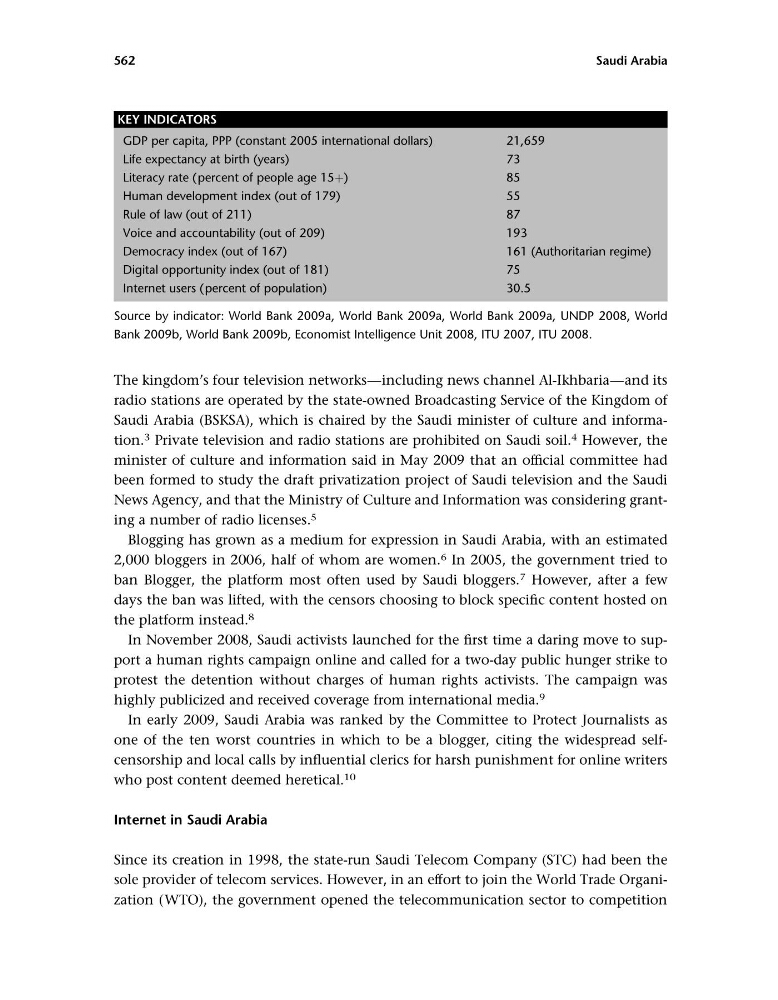
KEY INDICATORS
GDP per capita, PPP (constant 2005 international dollars)
21,659
Life expectancy at birth (years)
73
Literacy rate (percent of people age 15þ)8 5
Human development index (out of 179)
55
Rule of law (out of 211)
87
Voice and accountability (out of 209)
193
Democracy index (out of 167)
161 (Authoritarian regime)
Digital opportunity index (out of 181)
75
Internet users (percent of population)
30.5
Source by indicator: World Bank 2009a, World Bank 2009a, World Bank 2009a, UNDP 2008, World
Bank 2009b, World Bank 2009b, Economist Intelligence Unit 2008, ITU 2007, ITU 2008.
562
Saudi Arabia