

over a broad range of topics, including religion, immorality, social harmony, and politics. In comparison to the well-developed state controls over print media, radio, and
television, the Internet initially offered a relatively unfettered medium for communication in Iran, allowing independent media and opposition voices to flourish. 1 The Internet also has provided Iranian expatriates a platform for publishing opinions in
opposition to the government, such as pro-secular and reformist political viewpoints,
outside the reach of standard offline strategies for enforcing speech restrictions. The
growing popularity of the Internet has led to increasing government scrutiny. Dissenting voices online, including human rights activists, bloggers, and online media outlets,
have became the target of government regulatory action and are subject to arrest,
imprisonment, and torture. 2 Internet control mechanisms have continued to grow in
scope and scale to address this digital challenge to information control in Iran. Regulators have invested in more sophisticated technical control mechanisms, and new regulatory agencies have been created to identify and block expression deemed offensive.
The presidential elections in 2009 led to an increase in online political organizing,
which provided a further impetus for increasingly contentious controls on the Web
sites used by legitimate opposition contenders.
Efforts to control online speech by the Iranian government have relied primarily on
large-scale Internet filtering and the threat of targeted legal action. The declaration of a
spokesman from the Revolutionary Guard to launch 10,000 blogs written by members
of the Basij, a volunteer Iranian paramilitary force under the authority of the Iranian
Revolutionary Guards, hints at the adoption of a different strategy for shaping online
information: a government-backed war of words on the Internet. 3 This is similar conceptually to the government information dissemination strategies seen in just a small
number of countries—for example, the Fifty Cent Party in China, where workers are reportedly paid for producing progovernment content, and in Russia, where pro-Kremlin
bloggers are suspected of receiving government support. 4
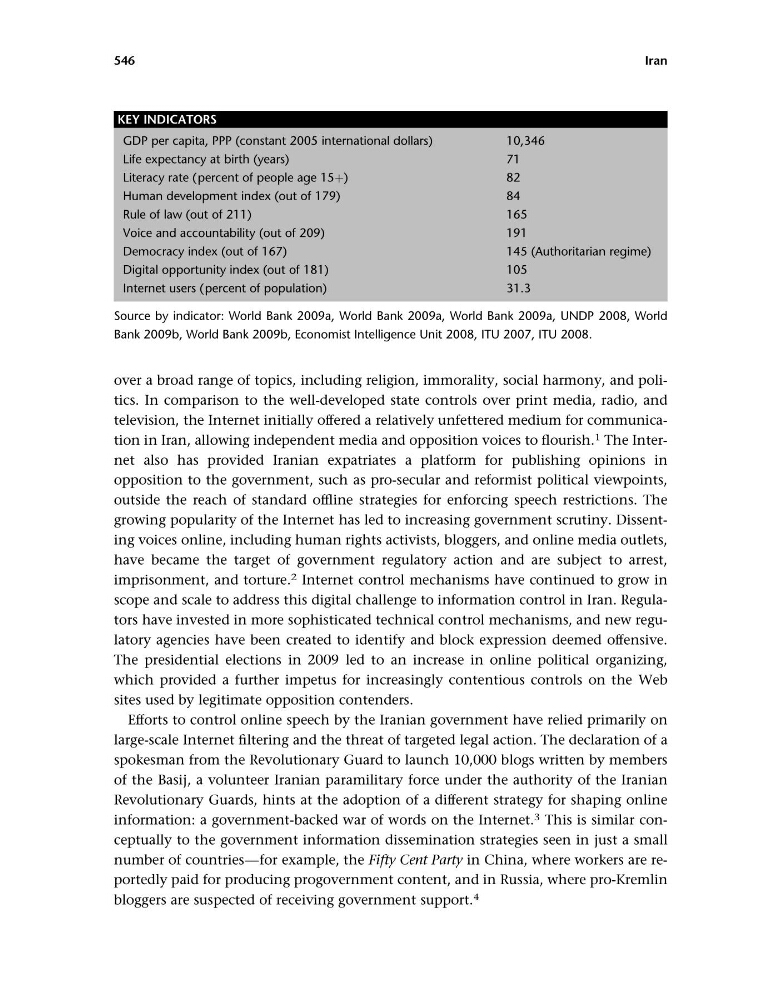
KEY INDICATORS
GDP per capita, PPP (constant 2005 international dollars)
10,346
Life expectancy at birth (years)
71
Literacy rate (percent of people age 15þ)8 2
Human development index (out of 179)
84
Rule of law (out of 211)
165
Voice and accountability (out of 209)
191
Democracy index (out of 167)
145 (Authoritarian regime)
Digital opportunity index (out of 181)
105
Internet users (percent of population)
31.3
Source by indicator: World Bank 2009a, World Bank 2009a, World Bank 2009a, UNDP 2008, World
Bank 2009b, World Bank 2009b, Economist Intelligence Unit 2008, ITU 2007, ITU 2008.
546
Iran