

uninterrupted application of emergency laws has led to the emergence of a parallel legal system, one that is unchecked by ordinary judicial bodies. 2 Despite this, journalists
now openly criticize the regime’s policies, and both private and opposition media have
started to break taboos despite judicial, bureaucratic, and economic pressure against
them. 3
Egypt was listed by the Committee to Protect Journalists as one of the top ten worst
countries to be a blogger, because the authorities monitor Internet activity on a regular
basis and have detained a large number of active bloggers (more than 100 in 2008
alone) for open-ended periods. 4 Nevertheless, Egyptian bloggers and online activists
have managed to utilize the power of the Internet to organize street protests and to
expose human rights violations in Egypt. For example, two government officials were
arrested and imprisoned in November 2007 for torturing prisoners after video clips of
their actions were posted on the Internet by online activists. 5
Internet in Egypt
Egypt has become a leading Internet market in Africa in terms of users, international
bandwidth, and services offered. Also, unlike in many Arab countries, the international
bandwidth market and VoIP telephony have been liberalized, and more than 200
Internet and data service providers operate in Egypt, making ADSL services among the
least expensive in Africa. 6 The ICT sector continues to grow—Egypt’s spending on
information and communication technology (ICT) reached USD 9.8 billion in 2008
and is expected to rise to USD 13.5 billion by 2011. 7
As part of the Egyptian government’s ambitious program to expand access to ICT, an
agreement to spread personal computers to every home was signed in August 2008
among the Ministry of Communications and Information Technology (MCIT), the
National Telecommunications Regulatory Authority (NTRA), the Egyptian National
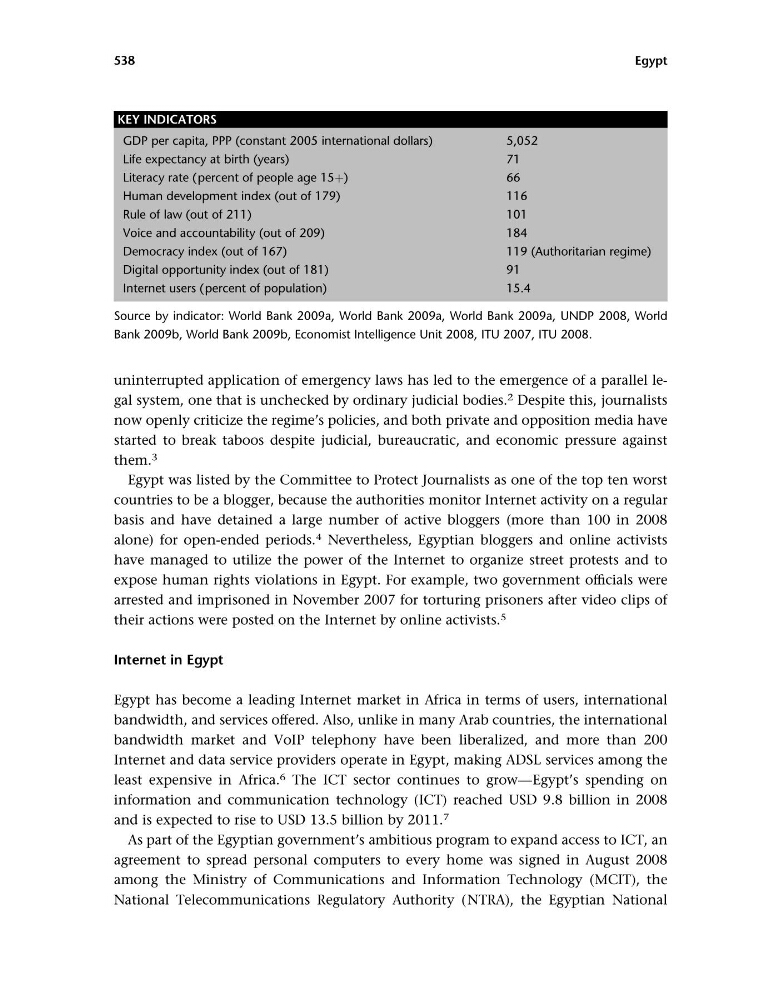
KEY INDICATORS
GDP per capita, PPP (constant 2005 international dollars)
5,052
Life expectancy at birth (years)
71
Literacy rate (percent of people age 15þ)6 6
Human development index (out of 179)
116
Rule of law (out of 211)
101
Voice and accountability (out of 209)
184
Democracy index (out of 167)
119 (Authoritarian regime)
Digital opportunity index (out of 181)
91
Internet users (percent of population)
15.4
Source by indicator: World Bank 2009a, World Bank 2009a, World Bank 2009a, UNDP 2008, World
Bank 2009b, World Bank 2009b, Economist Intelligence Unit 2008, ITU 2007, ITU 2008.
538
Egypt