

vibrant democracies in Asia. Its citizens enjoy universal suffrage and broad constitutional freedoms, and they choose their leaders in free and fair multiparty elections.
South Korean foreign relations remain dominated by the state’s relationship with the
Democratic People’s Republic of Korea (or North Korea), with which South Korea has
technically been at war since the two sides fought to a stalemate in 1953. Since that
time, the South Korean government has often been intolerant of dissident views and
those espousing communism or supporting North Korea; publicly praising North Korea
has been, and remains, illegal. Human rights groups charge that, since its enactment in
1948, thousands of South Koreans have been arrested under the state’s anticommunist
National Security Law (NSL). Those arrested over the years have included students,
publishers, trade unionists, political activists, professors, and Internet users, many
peacefully expressing their political views. 1 While prosecutions under the NSL have
decreased significantly since the transition to democracy, there have been a few recent
high-profile investigations using the NSL. 2 As of 2004, Amnesty International reported
that 14 people were in prison under the law. 3
Internet in South Korea
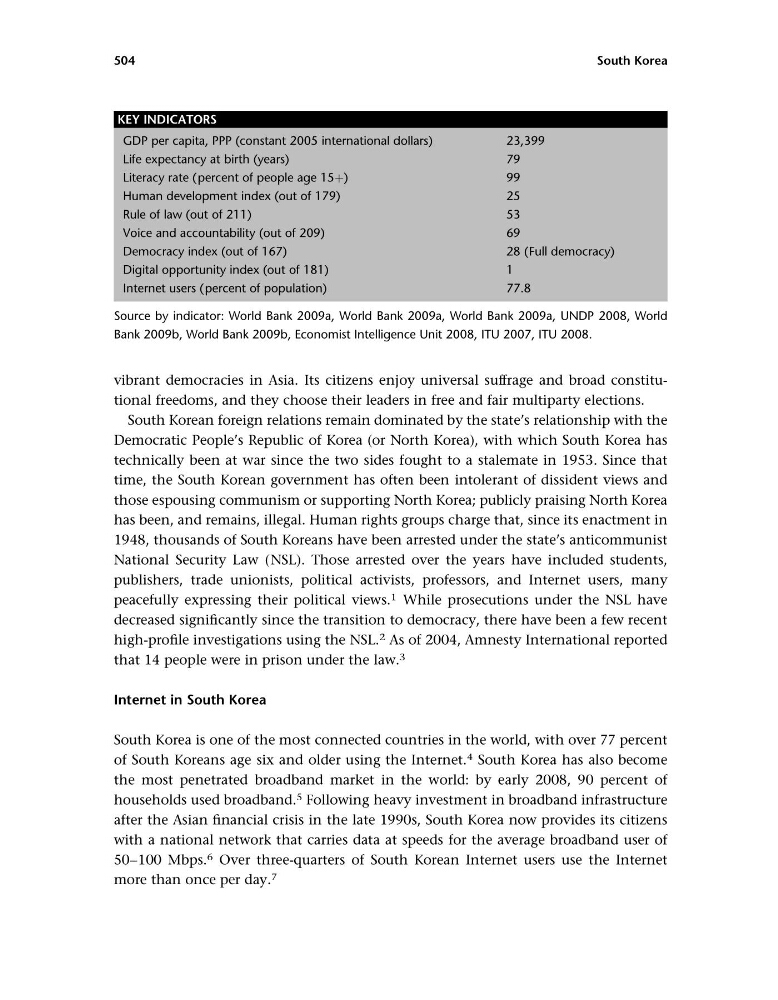
South Korea is one of the most connected countries in the world, with over 77 percent
of South Koreans age six and older using the Internet. 4 South Korea has also become
the most penetrated broadband market in the world: by early 2008, 90 percent of
households used broadband. 5 Following heavy investment in broadband infrastructure
after the Asian financial crisis in the late 1990s, South Korea now provides its citizens
with a national network that carries data at speeds for the average broadband user of
50–100 Mbps. 6 Over three-quarters of South Korean Internet users use the Internet
more than once per day. 7
KEY INDICATORS
GDP per capita, PPP (constant 2005 international dollars)
23,399
Life expectancy at birth (years)
79
Literacy rate (percent of people age 15þ)9 9
Human development index (out of 179)
25
Rule of law (out of 211)
53
Voice and accountability (out of 209)
69
Democracy index (out of 167)
28 (Full democracy)
Digital opportunity index (out of 181)
1
Internet users (percent of population)
77.8
Source by indicator: World Bank 2009a, World Bank 2009a, World Bank 2009a, UNDP 2008, World
Bank 2009b, World Bank 2009b, Economist Intelligence Unit 2008, ITU 2007, ITU 2008.
504
South Korea