

In October 2007, Musharraf won an indirect, widely boycotted presidential election
held while his two major political opponents were in exile. Leading the court challenge
over Musharraf’s eligibility to run while still serving as army chief was Chief Justice
Ifthikar Muhammad Chaudhry, who had himself been suspended by Musharraf in
March 2007 and reinstated in July 2007, after a ‘‘Lawyer’s Movement’’ instigated court
boycotts and massive rallies around the country. 1 Musharraf responded by suspending
the constitution and placing the country under a state of emergency on November 3,
the second since his bloodless coup in 1999. 2 While waiting for the court’s decision,
Musharraf’s government shut down all privately owned television stations and other
independent media outlets, arrested lawyers and about 60 senior judges, and jammed
cell phone and Internet connections. 3
Under growing international pressure, Musharraf resigned from his army position
in late November and was sworn in for his second term as president, finally lifting
the emergency on December 15. However, in August 2008 the two main governing
parties agreed to launch impeachment proceedings, and Musharraf resigned under
pressure. 4 In September 2008, Asif Ali Zardari, the husband of assassinated Pakistan
Peoples Party (PPP) leader Benazir Bhutto, was elected Pakistan’s new president by
legislators. 5
A vibrant civil society movement working against Internet censorship continues to
operate in Pakistan and monitors developments in filtering. 6 International human
rights groups have reported on the persecution of journalists at the hands of the Pakistani military intelligence agency and extremist groups, while advocacy groups such as
the Pakistan Federal Union of Journalists continue to call for investigations into attacks
against journalists, which are often unresolved. 7 According to the Committee to Protect Journalists, at least five journalists were killed in connection with their work in
2008, several of them in the conflict-torn regions of Northwest Frontier Province and
Swat. 8 Six journalists and media workers were killed in 2007. 9
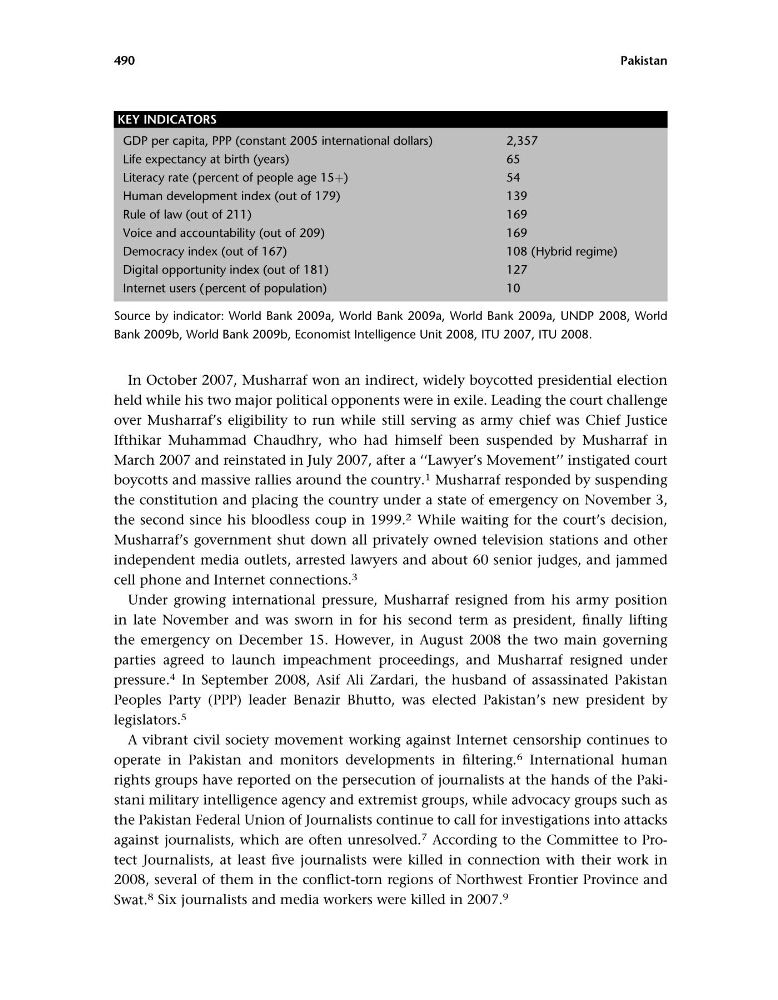
KEY INDICATORS
GDP per capita, PPP (constant 2005 international dollars)
2,357
Life expectancy at birth (years)
65
Literacy rate (percent of people age 15þ)5 4
Human development index (out of 179)
139
Rule of law (out of 211)
169
Voice and accountability (out of 209)
169
Democracy index (out of 167)
108 (Hybrid regime)
Digital opportunity index (out of 181)
127
Internet users (percent of population)
10
Source by indicator: World Bank 2009a, World Bank 2009a, World Bank 2009a, UNDP 2008, World
Bank 2009b, World Bank 2009b, Economist Intelligence Unit 2008, ITU 2007, ITU 2008.
490
Pakistan