

rapidly responded with arrests and a violent crackdown against thousands of monks
and rioting Tibetans. 2 A corresponding clampdown on reporting from the region and
other Tibetan-populated areas in western China left media with a dearth of reliable information; official accounts and dispatches released by Tibetan exile organizations put
issues like the actual death toll in question. The crackdown in Tibet galvanized protests
both in support of and opposed to China’s policies toward its religious and ethnic
minorities, especially as symbolized in the Olympic torch making its way in an elaborate tour around the world. The conflicts that erupted in cities as distant as Paris 3 and
Seoul in March and April contributed to a so-called transnational Chinese backlash
against Western media portrayals of China, culminating in an ‘‘anti-CNN’’ movement
and a call for a boycott against the French supermarket chain Carrefour. 4
On May 12, 2008, a 7.9-magnitude earthquake, with its epicenter in Wenchuan
county, Sichuan province, killed around 90,000 people and injured hundreds of thousands, leveling more than 5 million buildings and leaving millions homeless. 5 During
the massive relief efforts and national mobilization of volunteers and monetary contributions immediately following the quake, media were allowed to operate with unprecedented openness, with official state outlets such as China Central Television winning
notice and praise for presenting timely and uncanned news. However, within a few
weeks authorities began to encircle and regulate the story—for example, by issuing
more bans on coverage of certain topics and requiring registration of reporters. It took
authorities repeated efforts to quash coverage of one of the most potent and enduring
controversies: the tragic deaths of thousands of schoolchildren and teachers attributed
to shoddy school construction, along with the implication that government officials
were responsible. 6 Authorities did not release an official statistic of the number of
schoolchildren who died until almost a year after the quake, and some claimed that
the official figure of 5,335 was too low, compared to Reuters’ estimate of 9,000 deaths,
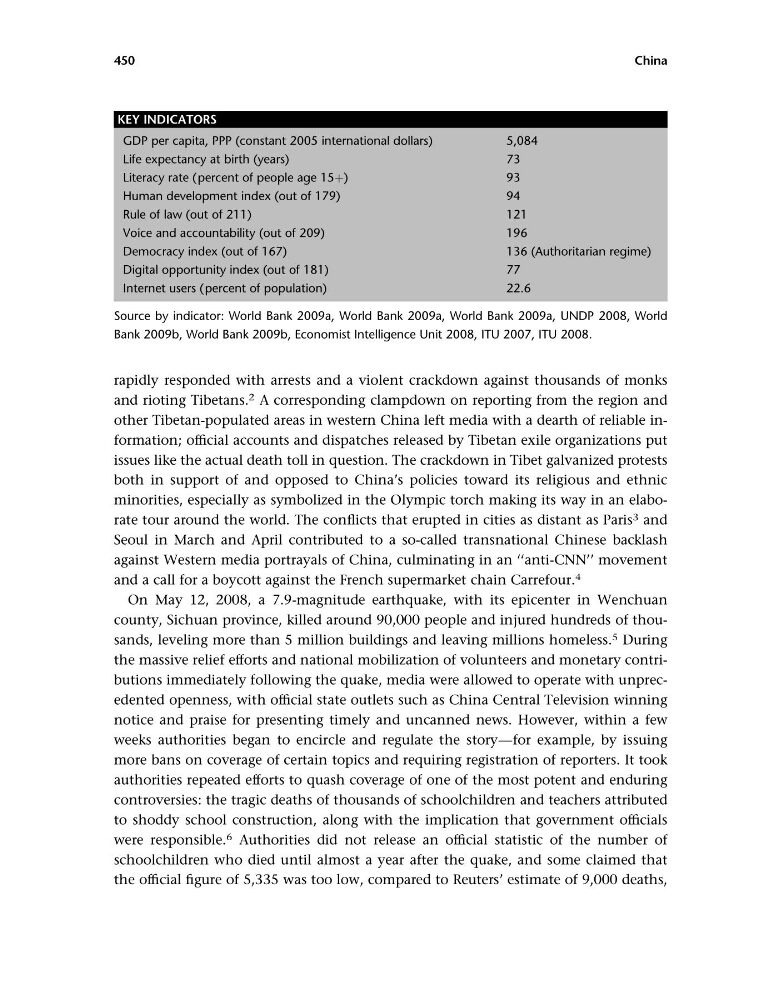
KEY INDICATORS
GDP per capita, PPP (constant 2005 international dollars)
5,084
Life expectancy at birth (years)
73
Literacy rate (percent of people age 15þ)9 3
Human development index (out of 179)
94
Rule of law (out of 211)
121
Voice and accountability (out of 209)
196
Democracy index (out of 167)
136 (Authoritarian regime)
Digital opportunity index (out of 181)
77
Internet users (percent of population)
22.6
Source by indicator: World Bank 2009a, World Bank 2009a, World Bank 2009a, UNDP 2008, World
Bank 2009b, World Bank 2009b, Economist Intelligence Unit 2008, ITU 2007, ITU 2008.
450
China
and rioting Tibetans. 2 A corresponding clampdown on reporting from the region and
other Tibetan-populated areas in western China left media with a dearth of reliable information; official accounts and dispatches released by Tibetan exile organizations put
issues like the actual death toll in question. The crackdown in Tibet galvanized protests
both in support of and opposed to China’s policies toward its religious and ethnic
minorities, especially as symbolized in the Olympic torch making its way in an elaborate tour around the world. The conflicts that erupted in cities as distant as Paris 3 and
Seoul in March and April contributed to a so-called transnational Chinese backlash
against Western media portrayals of China, culminating in an ‘‘anti-CNN’’ movement
and a call for a boycott against the French supermarket chain Carrefour. 4
On May 12, 2008, a 7.9-magnitude earthquake, with its epicenter in Wenchuan
county, Sichuan province, killed around 90,000 people and injured hundreds of thousands, leveling more than 5 million buildings and leaving millions homeless. 5 During
the massive relief efforts and national mobilization of volunteers and monetary contributions immediately following the quake, media were allowed to operate with unprecedented openness, with official state outlets such as China Central Television winning
notice and praise for presenting timely and uncanned news. However, within a few
weeks authorities began to encircle and regulate the story—for example, by issuing
more bans on coverage of certain topics and requiring registration of reporters. It took
authorities repeated efforts to quash coverage of one of the most potent and enduring
controversies: the tragic deaths of thousands of schoolchildren and teachers attributed
to shoddy school construction, along with the implication that government officials
were responsible. 6 Authorities did not release an official statistic of the number of
schoolchildren who died until almost a year after the quake, and some claimed that
the official figure of 5,335 was too low, compared to Reuters’ estimate of 9,000 deaths,
KEY INDICATORS
GDP per capita, PPP (constant 2005 international dollars)
5,084
Life expectancy at birth (years)
73
Literacy rate (percent of people age 15þ)9 3
Human development index (out of 179)
94
Rule of law (out of 211)
121
Voice and accountability (out of 209)
196
Democracy index (out of 167)
136 (Authoritarian regime)
Digital opportunity index (out of 181)
77
Internet users (percent of population)
22.6
Source by indicator: World Bank 2009a, World Bank 2009a, World Bank 2009a, UNDP 2008, World
Bank 2009b, World Bank 2009b, Economist Intelligence Unit 2008, ITU 2007, ITU 2008.
450
China