

70 percent of their monthly income on food alone, 2 making the fuel price hikes amid
chronic inflation—which reached 30 percent in 2006 and 2007—untenable. 3 Over the
next month, leadership of the protests passed from the former student leaders and a
number of female activists to Buddhist monks, with participation swelling to an estimated crowd of 150,000 protesters on September 23. 4 Throughout the crisis, citizen
journalists and bloggers continued to feed raw, graphic footage and eyewitness
accounts to the outside world over the Internet. The violent crackdown that began on
September 26 ultimately left up to 200 dead, 5 including a Japanese journalist whose
shooting was caught on video. 6 Burmese security forces raided monasteries, detaining
and disrobing thousands of monks, and despite claims in official state media that only
91 people remained in detention as of December 2007, Human Rights Watch claimed
the number to be in the hundreds. 7
On May 2 and 3, 2008, Cyclone Nargis hit lower Burma and devastated Rangoon and
much of the Irrawaddy River delta, with more than 138,000 dead or missing and millions in need of food, water, shelter, and medical care. 8 After initially blocking aid for
two critical weeks, the junta accepted relief efforts coordinated through the Tripartite
Core Group—the military junta, the United Nations (UN), and the Association of
Southeast Asian Nations (ASEAN)—and has been cautiously credited with exhibiting
greater openness since. 9 However, a year later, half a million people were still living in
temporary shelters, over 200,000 lacked local supplies of drinking water, and villagers
were still coping with chronic food shortages and the slow resumption of farming and
fishing. 10 A recovery program requiring USD 690 million through 2011 had raised only
USD 466 million in commitments at the end of 2008. 11
On the heels of the release of Burma’s longest-serving political prisoner, Win Tin, a
79-year-old journalist freed as part of an amnesty granted to 9,000 inmates, 12 around
300 individuals were sentenced to harsh prison terms for political crimes between
October and December 2008. 13 Most were tried by police prosecutors and convicted by
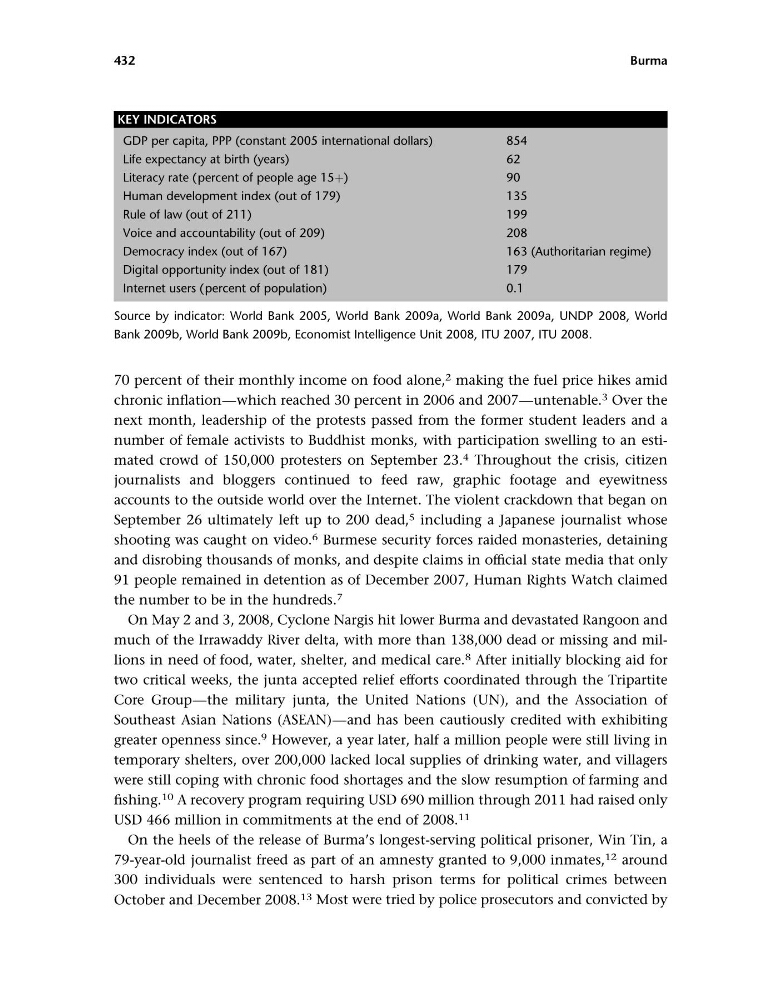
KEY INDICATORS
GDP per capita, PPP (constant 2005 international dollars)
854
Life expectancy at birth (years)
62
Literacy rate (percent of people age 15þ)9 0
Human development index (out of 179)
135
Rule of law (out of 211)
199
Voice and accountability (out of 209)
208
Democracy index (out of 167)
163 (Authoritarian regime)
Digital opportunity index (out of 181)
179
Internet users (percent of population)
0.1
Source by indicator: World Bank 2005, World Bank 2009a, World Bank 2009a, UNDP 2008, World
Bank 2009b, World Bank 2009b, Economist Intelligence Unit 2008, ITU 2007, ITU 2008.
432
Burma
chronic inflation—which reached 30 percent in 2006 and 2007—untenable. 3 Over the
next month, leadership of the protests passed from the former student leaders and a
number of female activists to Buddhist monks, with participation swelling to an estimated crowd of 150,000 protesters on September 23. 4 Throughout the crisis, citizen
journalists and bloggers continued to feed raw, graphic footage and eyewitness
accounts to the outside world over the Internet. The violent crackdown that began on
September 26 ultimately left up to 200 dead, 5 including a Japanese journalist whose
shooting was caught on video. 6 Burmese security forces raided monasteries, detaining
and disrobing thousands of monks, and despite claims in official state media that only
91 people remained in detention as of December 2007, Human Rights Watch claimed
the number to be in the hundreds. 7
On May 2 and 3, 2008, Cyclone Nargis hit lower Burma and devastated Rangoon and
much of the Irrawaddy River delta, with more than 138,000 dead or missing and millions in need of food, water, shelter, and medical care. 8 After initially blocking aid for
two critical weeks, the junta accepted relief efforts coordinated through the Tripartite
Core Group—the military junta, the United Nations (UN), and the Association of
Southeast Asian Nations (ASEAN)—and has been cautiously credited with exhibiting
greater openness since. 9 However, a year later, half a million people were still living in
temporary shelters, over 200,000 lacked local supplies of drinking water, and villagers
were still coping with chronic food shortages and the slow resumption of farming and
fishing. 10 A recovery program requiring USD 690 million through 2011 had raised only
USD 466 million in commitments at the end of 2008. 11
On the heels of the release of Burma’s longest-serving political prisoner, Win Tin, a
79-year-old journalist freed as part of an amnesty granted to 9,000 inmates, 12 around
300 individuals were sentenced to harsh prison terms for political crimes between
October and December 2008. 13 Most were tried by police prosecutors and convicted by
KEY INDICATORS
GDP per capita, PPP (constant 2005 international dollars)
854
Life expectancy at birth (years)
62
Literacy rate (percent of people age 15þ)9 0
Human development index (out of 179)
135
Rule of law (out of 211)
199
Voice and accountability (out of 209)
208
Democracy index (out of 167)
163 (Authoritarian regime)
Digital opportunity index (out of 181)
179
Internet users (percent of population)
0.1
Source by indicator: World Bank 2005, World Bank 2009a, World Bank 2009a, UNDP 2008, World
Bank 2009b, World Bank 2009b, Economist Intelligence Unit 2008, ITU 2007, ITU 2008.
432
Burma