

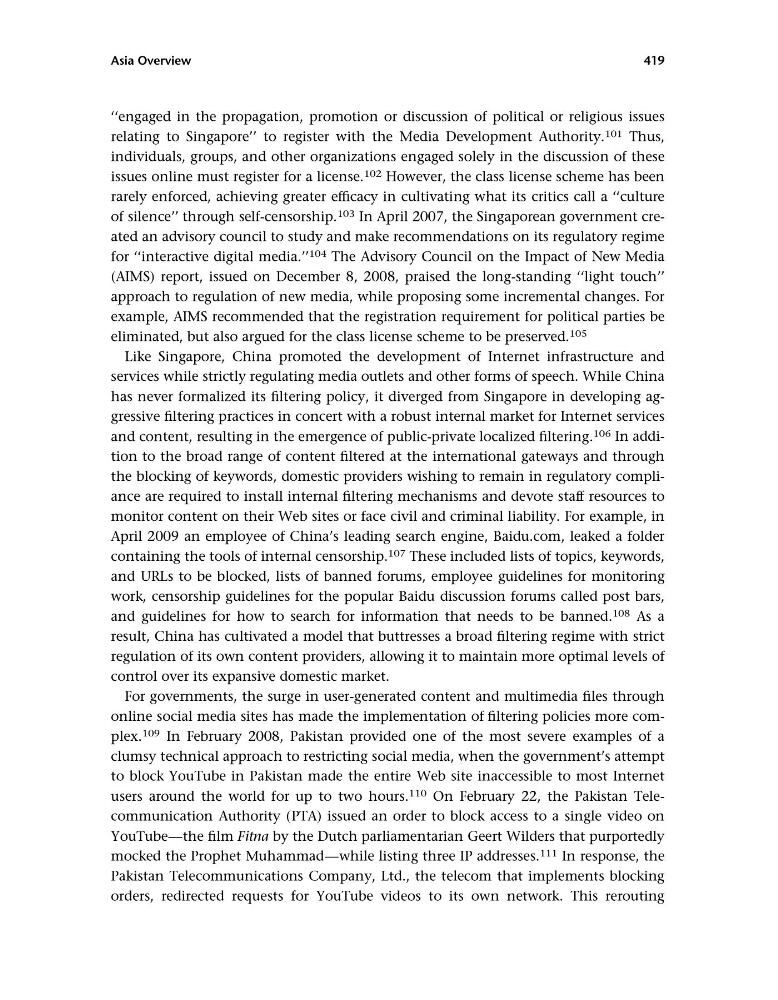
‘‘engaged in the propagation, promotion or discussion of political or religious issues
relating to Singapore’’ to register with the Media Development Authority. 101 Thus,
individuals, groups, and other organizations engaged solely in the discussion of these
issues online must register for a license. 102 However, the class license scheme has been
rarely enforced, achieving greater efficacy in cultivating what its critics call a ‘‘culture
of silence’’ through self-censorship. 103 In April 2007, the Singaporean government created an advisory council to study and make recommendations on its regulatory regime
for ‘‘interactive digital media.’’ 104 The Advisory Council on the Impact of New Media
(AIMS) report, issued on December 8, 2008, praised the long-standing ‘‘light touch’’
approach to regulation of new media, while proposing some incremental changes. For
example, AIMS recommended that the registration requirement for political parties be
eliminated, but also argued for the class license scheme to be preserved. 105
Like Singapore, China promoted the development of Internet infrastructure and
services while strictly regulating media outlets and other forms of speech. While China
has never formalized its filtering policy, it diverged from Singapore in developing aggressive filtering practices in concert with a robust internal market for Internet services
and content, resulting in the emergence of public-private localized filtering. 106 In addition to the broad range of content filtered at the international gateways and through
the blocking of keywords, domestic providers wishing to remain in regulatory compliance are required to install internal filtering mechanisms and devote staff resources to
monitor content on their Web sites or face civil and criminal liability. For example, in
April 2009 an employee of China’s leading search engine, Baidu.com, leaked a folder
containing the tools of internal censorship. 107 These included lists of topics, keywords,
and URLs to be blocked, lists of banned forums, employee guidelines for monitoring
work, censorship guidelines for the popular Baidu discussion forums called post bars,
and guidelines for how to search for information that needs to be banned. 108 As a
result, China has cultivated a model that buttresses a broad filtering regime with strict
regulation of its own content providers, allowing it to maintain more optimal levels of
control over its expansive domestic market.
For governments, the surge in user-generated content and multimedia files through
online social media sites has made the implementation of filtering policies more complex. 109 In February 2008, Pakistan provided one of the most severe examples of a
clumsy technical approach to restricting social media, when the government’s attempt
to block YouTube in Pakistan made the entire Web site inaccessible to most Internet
users around the world for up to two hours. 110 On February 22, the Pakistan Telecommunication Authority (PTA) issued an order to block access to a single video on
YouTube—the film Fitna by the Dutch parliamentarian Geert Wilders that purportedly
mocked the Prophet Muhammad—while listing three IP addresses. 111 In response, the
Pakistan Telecommunications Company, Ltd., the telecom that implements blocking
orders, redirected requests for YouTube videos to its own network. This rerouting
Asia Overview
419
relating to Singapore’’ to register with the Media Development Authority. 101 Thus,
individuals, groups, and other organizations engaged solely in the discussion of these
issues online must register for a license. 102 However, the class license scheme has been
rarely enforced, achieving greater efficacy in cultivating what its critics call a ‘‘culture
of silence’’ through self-censorship. 103 In April 2007, the Singaporean government created an advisory council to study and make recommendations on its regulatory regime
for ‘‘interactive digital media.’’ 104 The Advisory Council on the Impact of New Media
(AIMS) report, issued on December 8, 2008, praised the long-standing ‘‘light touch’’
approach to regulation of new media, while proposing some incremental changes. For
example, AIMS recommended that the registration requirement for political parties be
eliminated, but also argued for the class license scheme to be preserved. 105
Like Singapore, China promoted the development of Internet infrastructure and
services while strictly regulating media outlets and other forms of speech. While China
has never formalized its filtering policy, it diverged from Singapore in developing aggressive filtering practices in concert with a robust internal market for Internet services
and content, resulting in the emergence of public-private localized filtering. 106 In addition to the broad range of content filtered at the international gateways and through
the blocking of keywords, domestic providers wishing to remain in regulatory compliance are required to install internal filtering mechanisms and devote staff resources to
monitor content on their Web sites or face civil and criminal liability. For example, in
April 2009 an employee of China’s leading search engine, Baidu.com, leaked a folder
containing the tools of internal censorship. 107 These included lists of topics, keywords,
and URLs to be blocked, lists of banned forums, employee guidelines for monitoring
work, censorship guidelines for the popular Baidu discussion forums called post bars,
and guidelines for how to search for information that needs to be banned. 108 As a
result, China has cultivated a model that buttresses a broad filtering regime with strict
regulation of its own content providers, allowing it to maintain more optimal levels of
control over its expansive domestic market.
For governments, the surge in user-generated content and multimedia files through
online social media sites has made the implementation of filtering policies more complex. 109 In February 2008, Pakistan provided one of the most severe examples of a
clumsy technical approach to restricting social media, when the government’s attempt
to block YouTube in Pakistan made the entire Web site inaccessible to most Internet
users around the world for up to two hours. 110 On February 22, the Pakistan Telecommunication Authority (PTA) issued an order to block access to a single video on
YouTube—the film Fitna by the Dutch parliamentarian Geert Wilders that purportedly
mocked the Prophet Muhammad—while listing three IP addresses. 111 In response, the
Pakistan Telecommunications Company, Ltd., the telecom that implements blocking
orders, redirected requests for YouTube videos to its own network. This rerouting
Asia Overview
419