

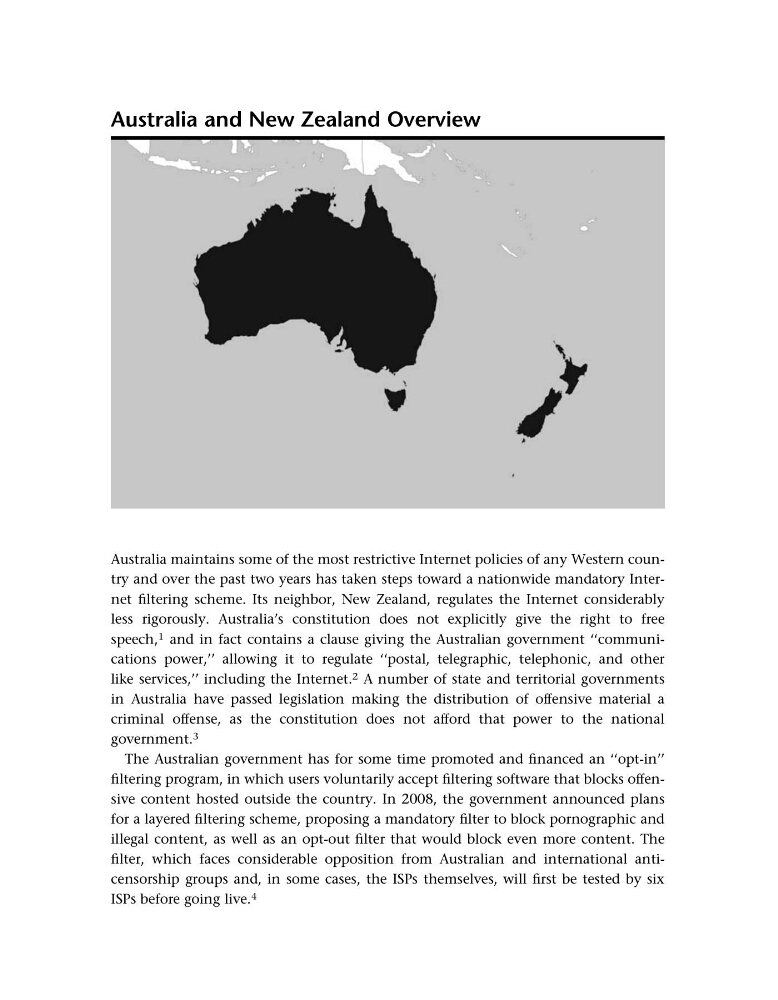
Australia and New Zealand Overview
Australia maintains some of the most restrictive Internet policies of any Western country and over the past two years has taken steps toward a nationwide mandatory Internet filtering scheme. Its neighbor, New Zealand, regulates the Internet considerably
less rigorously. Australia’s constitution does not explicitly give the right to free
speech, 1 and in fact contains a clause giving the Australian government ‘‘communications power,’’ allowing it to regulate ‘‘postal, telegraphic, telephonic, and other
like services,’’ including the Internet. 2 A number of state and territorial governments
in Australia have passed legislation making the distribution of offensive material a
criminal offense, as the constitution does not afford that power to the national
government. 3
The Australian government has for some time promoted and financed an ‘‘opt-in’’
filtering program, in which users voluntarily accept filtering software that blocks offensive content hosted outside the country. In 2008, the government announced plans
for a layered filtering scheme, proposing a mandatory filter to block pornographic and
illegal content, as well as an opt-out filter that would block even more content. The
filter, which faces considerable opposition from Australian and international anticensorship groups and, in some cases, the ISPs themselves, will first be tested by six
ISPs before going live. 4
Australia maintains some of the most restrictive Internet policies of any Western country and over the past two years has taken steps toward a nationwide mandatory Internet filtering scheme. Its neighbor, New Zealand, regulates the Internet considerably
less rigorously. Australia’s constitution does not explicitly give the right to free
speech, 1 and in fact contains a clause giving the Australian government ‘‘communications power,’’ allowing it to regulate ‘‘postal, telegraphic, telephonic, and other
like services,’’ including the Internet. 2 A number of state and territorial governments
in Australia have passed legislation making the distribution of offensive material a
criminal offense, as the constitution does not afford that power to the national
government. 3
The Australian government has for some time promoted and financed an ‘‘opt-in’’
filtering program, in which users voluntarily accept filtering software that blocks offensive content hosted outside the country. In 2008, the government announced plans
for a layered filtering scheme, proposing a mandatory filter to block pornographic and
illegal content, as well as an opt-out filter that would block even more content. The
filter, which faces considerable opposition from Australian and international anticensorship groups and, in some cases, the ISPs themselves, will first be tested by six
ISPs before going live. 4