

The U.K. has a vast media network, led by the British Broadcasting Corporation
(BBC), a publicly funded institution, 3 with a mandate to remain independent. 4 Other
media institutions in the U.K. also enjoy journalistic freedom and represent a broad
spectrum of political ideas. 5 Despite the officially recognized journalistic freedom,
there have been reports of journalists being jailed or detained for divulging state
secrets. 6 The U.K. is a strong supporter of fundamental human rights and freedoms,
including freedom of expression. 7 However, recent developments in U.K. antiterrorism
laws, in particular the Terrorism Act (2000) and subsequent legislation in 2005 and
2006, have drawn harsh criticism. Advocacy groups claim that new provisions focused
on expanding police powers and allowing communication providers to retain personal
data for the purpose of ‘‘protecting national security or preventing or detecting crime
that relates to national security’’ 8 are contrary to basic human rights principles. 9
Internet in the United Kingdom
Residents of the U.K. currently form the fifth-largest broadband subscriber population
in the world. 10 In the U.K., 61 percent of households had Internet access in 2007, with
84 percent of those having a broadband connection. 11 The sector regulator reports that
broadband technology is available for practically every U.K. citizen to connect to the
Internet. 12 In 2006, 63 percent of adults in the U.K. were estimated to have accessed
the Internet within a three-month period. 13 Internet usage is more widespread among
the younger generations, with over 90 percent of people aged 16 to 24 accessing the
Internet in a three-month period, and only 24 percent of those aged over 65 accessing
it during the same period. 14 Most of the users access the Internet from their home
location (87 percent). 15 As a result of affordability and enhanced market competition,
mobile penetration is very high. 16 However, the percentage of people accessing the
Internet with their handsets is surprisingly small (only 3 percent in 2007). 17
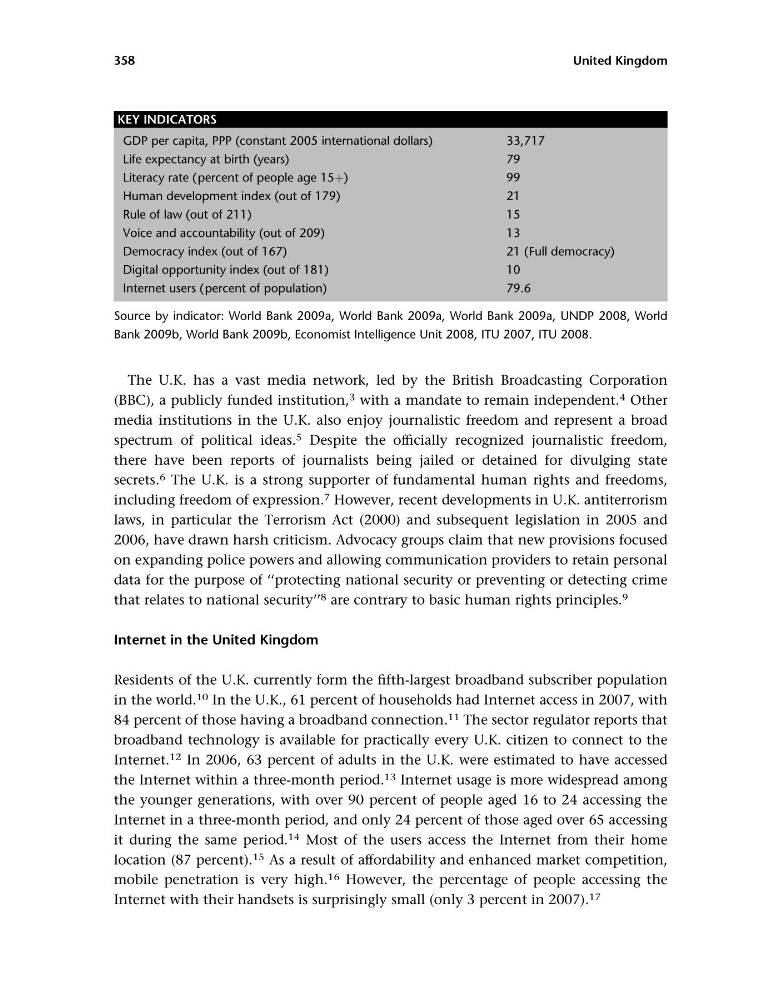
KEY INDICATORS
GDP per capita, PPP (constant 2005 international dollars)
33,717
Life expectancy at birth (years)
79
Literacy rate (percent of people age 15þ)9 9
Human development index (out of 179)
21
Rule of law (out of 211)
15
Voice and accountability (out of 209)
13
Democracy index (out of 167)
21 (Full democracy)
Digital opportunity index (out of 181)
10
Internet users (percent of population)
79.6
Source by indicator: World Bank 2009a, World Bank 2009a, World Bank 2009a, UNDP 2008, World
Bank 2009b, World Bank 2009b, Economist Intelligence Unit 2008, ITU 2007, ITU 2008.
358
United Kingdom
(BBC), a publicly funded institution, 3 with a mandate to remain independent. 4 Other
media institutions in the U.K. also enjoy journalistic freedom and represent a broad
spectrum of political ideas. 5 Despite the officially recognized journalistic freedom,
there have been reports of journalists being jailed or detained for divulging state
secrets. 6 The U.K. is a strong supporter of fundamental human rights and freedoms,
including freedom of expression. 7 However, recent developments in U.K. antiterrorism
laws, in particular the Terrorism Act (2000) and subsequent legislation in 2005 and
2006, have drawn harsh criticism. Advocacy groups claim that new provisions focused
on expanding police powers and allowing communication providers to retain personal
data for the purpose of ‘‘protecting national security or preventing or detecting crime
that relates to national security’’ 8 are contrary to basic human rights principles. 9
Internet in the United Kingdom
Residents of the U.K. currently form the fifth-largest broadband subscriber population
in the world. 10 In the U.K., 61 percent of households had Internet access in 2007, with
84 percent of those having a broadband connection. 11 The sector regulator reports that
broadband technology is available for practically every U.K. citizen to connect to the
Internet. 12 In 2006, 63 percent of adults in the U.K. were estimated to have accessed
the Internet within a three-month period. 13 Internet usage is more widespread among
the younger generations, with over 90 percent of people aged 16 to 24 accessing the
Internet in a three-month period, and only 24 percent of those aged over 65 accessing
it during the same period. 14 Most of the users access the Internet from their home
location (87 percent). 15 As a result of affordability and enhanced market competition,
mobile penetration is very high. 16 However, the percentage of people accessing the
Internet with their handsets is surprisingly small (only 3 percent in 2007). 17
KEY INDICATORS
GDP per capita, PPP (constant 2005 international dollars)
33,717
Life expectancy at birth (years)
79
Literacy rate (percent of people age 15þ)9 9
Human development index (out of 179)
21
Rule of law (out of 211)
15
Voice and accountability (out of 209)
13
Democracy index (out of 167)
21 (Full democracy)
Digital opportunity index (out of 181)
10
Internet users (percent of population)
79.6
Source by indicator: World Bank 2009a, World Bank 2009a, World Bank 2009a, UNDP 2008, World
Bank 2009b, World Bank 2009b, Economist Intelligence Unit 2008, ITU 2007, ITU 2008.
358
United Kingdom