

set to rise—dramatically. By official predictions, Russia’s Internet population is set to
double to over 80 million users by 2012. 5
Paradoxically, the very Russianness of the RUNET may have contributed to hiding
this ‘‘cyber revolution.’’ Unlike much of the Internet, which remains dominated by
English and dependent on popular applications and services that are provided by U.S.based companies (such as Google, Yahoo, and Hotmail), RUNET is a self-contained linguistic and cultural environment with well developed and highly popular search
engines, Web portals, social network sites, and free e-mail services. These sites and services are modeled on services available in the United States and the English-speaking
world but are completely separate, independent, and only available in Russian. 6 In a
recent ranking of Internet search engines, the Russian Web portal Yandex was one of
only three non-English portals to make the top ten, and was only beaten out by a Baidu
(China) and NHK (Korea), both of which have much larger absolute user base. 7 Within
RUNET, Russian search engines dominate with Yandex (often called the Google of
Russia), beating out Google with 70 percent of the market (Google has between 18
and 20 percent). 8
The RUNET is also increasingly central to politics. Elections across the CIS are now
fought online, as the Internet has eclipsed all the mass media in terms of its reach,
readership, and especially in the degree of free speech and opportunity to mobilize
that it provides. By 2008, Yandex could claim a readership larger than that of the
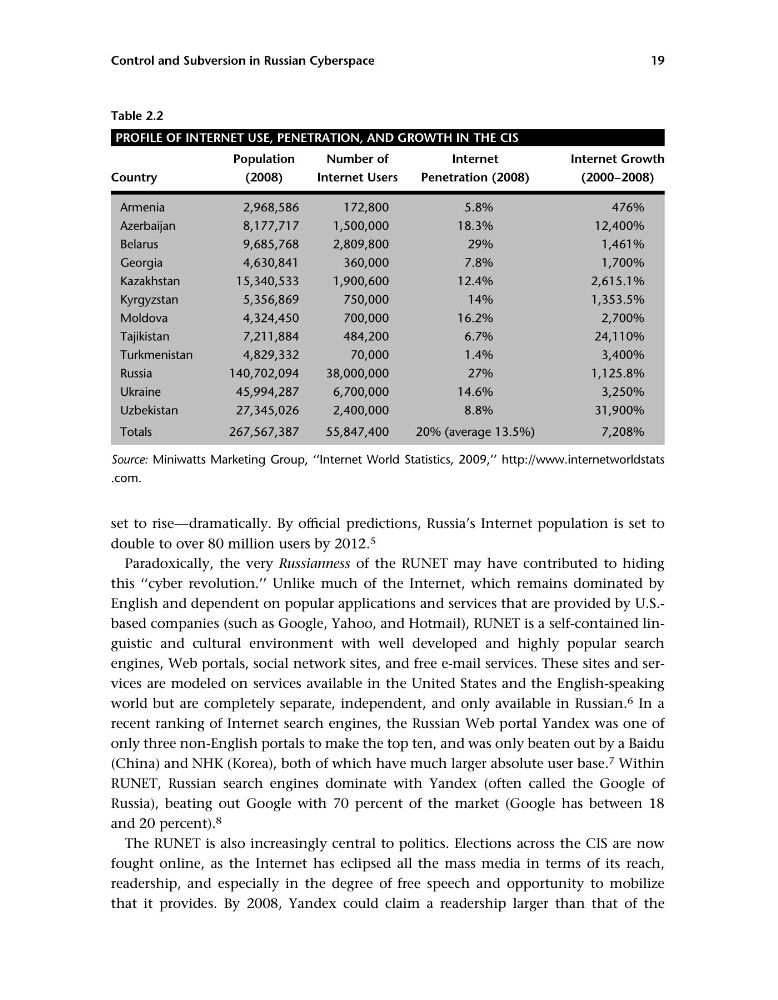
Table 2.2
PROFILE OF INTERNET USE, PENETRATION, AND GROWTH IN THE CIS
Country
Population
(2008)
Number of
Internet Users
Internet
Penetration (2008)
Internet Growth
(2000–2008)
Armenia
2,968,586
172,800
5.8%
476%
Azerbaijan
8,177,717
1,500,000
18.3%
12,400%
Belarus
9,685,768
2,809,800
29%
1,461%
Georgia
4,630,841
360,000
7.8%
1,700%
Kazakhstan
15,340,533
1,900,600
12.4%
2,615.1%
Kyrgyzstan
5,356,869
750,000
14%
1,353.5%
Moldova
4,324,450
700,000
16.2%
2,700%
Tajikistan
7,211,884
484,200
6.7%
24,110%
Turkmenistan
4,829,332
70,000
1.4%
3,400%
Russia
140,702,094
38,000,000
27%
1,125.8%
Ukraine
45,994,287
6,700,000
14.6%
3,250%
Uzbekistan
27,345,026
2,400,000
8.8%
31,900%
Totals
267,567,387
55,847,400
20% (average 13.5%)
7,208%
Source: Miniwatts Marketing Group, ‘‘Internet World Statistics, 2009,’’ http://www.internetworldstats
.com.
Control and Subversion in Russian Cyberspace
19
double to over 80 million users by 2012. 5
Paradoxically, the very Russianness of the RUNET may have contributed to hiding
this ‘‘cyber revolution.’’ Unlike much of the Internet, which remains dominated by
English and dependent on popular applications and services that are provided by U.S.based companies (such as Google, Yahoo, and Hotmail), RUNET is a self-contained linguistic and cultural environment with well developed and highly popular search
engines, Web portals, social network sites, and free e-mail services. These sites and services are modeled on services available in the United States and the English-speaking
world but are completely separate, independent, and only available in Russian. 6 In a
recent ranking of Internet search engines, the Russian Web portal Yandex was one of
only three non-English portals to make the top ten, and was only beaten out by a Baidu
(China) and NHK (Korea), both of which have much larger absolute user base. 7 Within
RUNET, Russian search engines dominate with Yandex (often called the Google of
Russia), beating out Google with 70 percent of the market (Google has between 18
and 20 percent). 8
The RUNET is also increasingly central to politics. Elections across the CIS are now
fought online, as the Internet has eclipsed all the mass media in terms of its reach,
readership, and especially in the degree of free speech and opportunity to mobilize
that it provides. By 2008, Yandex could claim a readership larger than that of the
Table 2.2
PROFILE OF INTERNET USE, PENETRATION, AND GROWTH IN THE CIS
Country
Population
(2008)
Number of
Internet Users
Internet
Penetration (2008)
Internet Growth
(2000–2008)
Armenia
2,968,586
172,800
5.8%
476%
Azerbaijan
8,177,717
1,500,000
18.3%
12,400%
Belarus
9,685,768
2,809,800
29%
1,461%
Georgia
4,630,841
360,000
7.8%
1,700%
Kazakhstan
15,340,533
1,900,600
12.4%
2,615.1%
Kyrgyzstan
5,356,869
750,000
14%
1,353.5%
Moldova
4,324,450
700,000
16.2%
2,700%
Tajikistan
7,211,884
484,200
6.7%
24,110%
Turkmenistan
4,829,332
70,000
1.4%
3,400%
Russia
140,702,094
38,000,000
27%
1,125.8%
Ukraine
45,994,287
6,700,000
14.6%
3,250%
Uzbekistan
27,345,026
2,400,000
8.8%
31,900%
Totals
267,567,387
55,847,400
20% (average 13.5%)
7,208%
Source: Miniwatts Marketing Group, ‘‘Internet World Statistics, 2009,’’ http://www.internetworldstats
.com.
Control and Subversion in Russian Cyberspace
19