

has developed a long history of involvement in politics, and as a result the government
remains dependent upon it to maintain a balance between religious and secular institutions.
Since Turkey’s establishment as a secular republic, the nation has become increasingly integrated with the West through membership in such organizations as the
Council of Europe, NATO, the Organization for Economic Cooperation and Development, the Organization for Security and Cooperation in Europe, and the G-20 major
economies. Free expression of opinion in Turkey is guaranteed by Article 10 of the European Convention on Human Rights and Fundamental Freedoms, ratified by Turkey
in 1954, and by various provisions of the International Covenant on Civil and Political
Rights, signed by Turkey in 2000.
Despite Turkey’s commitment to free expression and freedom of information, the
Penal Code broadly restricts such freedoms by criminalizing speech that insults the
Turkish nation, Turkish government institutions, and Turkish ethnicity. A number of
other legal acts shape the information available on the Internet by allowing state institutions to apply widely filtering and blocking mechanisms in order to prevent illegal
information online.
Internet in Turkey
Turkey’s Internet market is growing quickly. Internet penetration was at 7.5 percent in
2004, but increased to 33.1 percent by 2008. The Internet subscribers (i.e., the actual
number of dial-up, leased line, and fixed broadband Internet subscribers) were just
7.89 per 100 inhabitants for 2008. 2 Overall, the market witnessed considerable growth
propelled by the increase in the number of broadband subscribers during 2006, with
ADSL being the predominant broadband access technology. 3
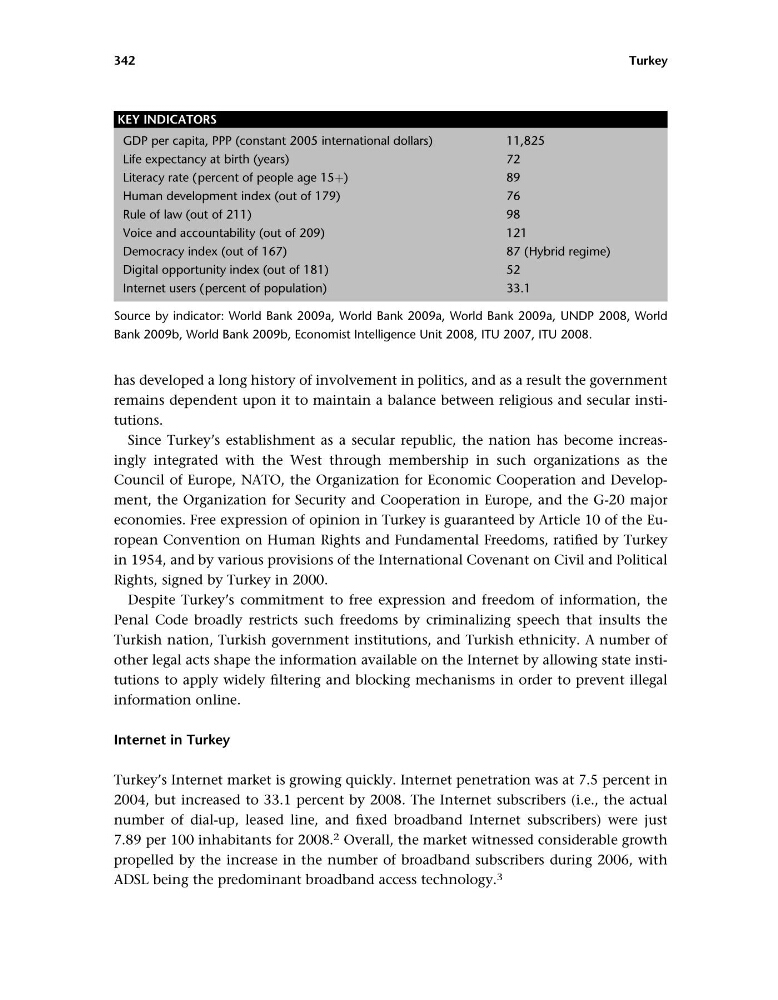
KEY INDICATORS
GDP per capita, PPP (constant 2005 international dollars)
11,825
Life expectancy at birth (years)
72
Literacy rate (percent of people age 15þ)8 9
Human development index (out of 179)
76
Rule of law (out of 211)
98
Voice and accountability (out of 209)
121
Democracy index (out of 167)
87 (Hybrid regime)
Digital opportunity index (out of 181)
52
Internet users (percent of population)
33.1
Source by indicator: World Bank 2009a, World Bank 2009a, World Bank 2009a, UNDP 2008, World
Bank 2009b, World Bank 2009b, Economist Intelligence Unit 2008, ITU 2007, ITU 2008.
342
Turkey
remains dependent upon it to maintain a balance between religious and secular institutions.
Since Turkey’s establishment as a secular republic, the nation has become increasingly integrated with the West through membership in such organizations as the
Council of Europe, NATO, the Organization for Economic Cooperation and Development, the Organization for Security and Cooperation in Europe, and the G-20 major
economies. Free expression of opinion in Turkey is guaranteed by Article 10 of the European Convention on Human Rights and Fundamental Freedoms, ratified by Turkey
in 1954, and by various provisions of the International Covenant on Civil and Political
Rights, signed by Turkey in 2000.
Despite Turkey’s commitment to free expression and freedom of information, the
Penal Code broadly restricts such freedoms by criminalizing speech that insults the
Turkish nation, Turkish government institutions, and Turkish ethnicity. A number of
other legal acts shape the information available on the Internet by allowing state institutions to apply widely filtering and blocking mechanisms in order to prevent illegal
information online.
Internet in Turkey
Turkey’s Internet market is growing quickly. Internet penetration was at 7.5 percent in
2004, but increased to 33.1 percent by 2008. The Internet subscribers (i.e., the actual
number of dial-up, leased line, and fixed broadband Internet subscribers) were just
7.89 per 100 inhabitants for 2008. 2 Overall, the market witnessed considerable growth
propelled by the increase in the number of broadband subscribers during 2006, with
ADSL being the predominant broadband access technology. 3
KEY INDICATORS
GDP per capita, PPP (constant 2005 international dollars)
11,825
Life expectancy at birth (years)
72
Literacy rate (percent of people age 15þ)8 9
Human development index (out of 179)
76
Rule of law (out of 211)
98
Voice and accountability (out of 209)
121
Democracy index (out of 167)
87 (Hybrid regime)
Digital opportunity index (out of 181)
52
Internet users (percent of population)
33.1
Source by indicator: World Bank 2009a, World Bank 2009a, World Bank 2009a, UNDP 2008, World
Bank 2009b, World Bank 2009b, Economist Intelligence Unit 2008, ITU 2007, ITU 2008.
342
Turkey