

Nordic Countries
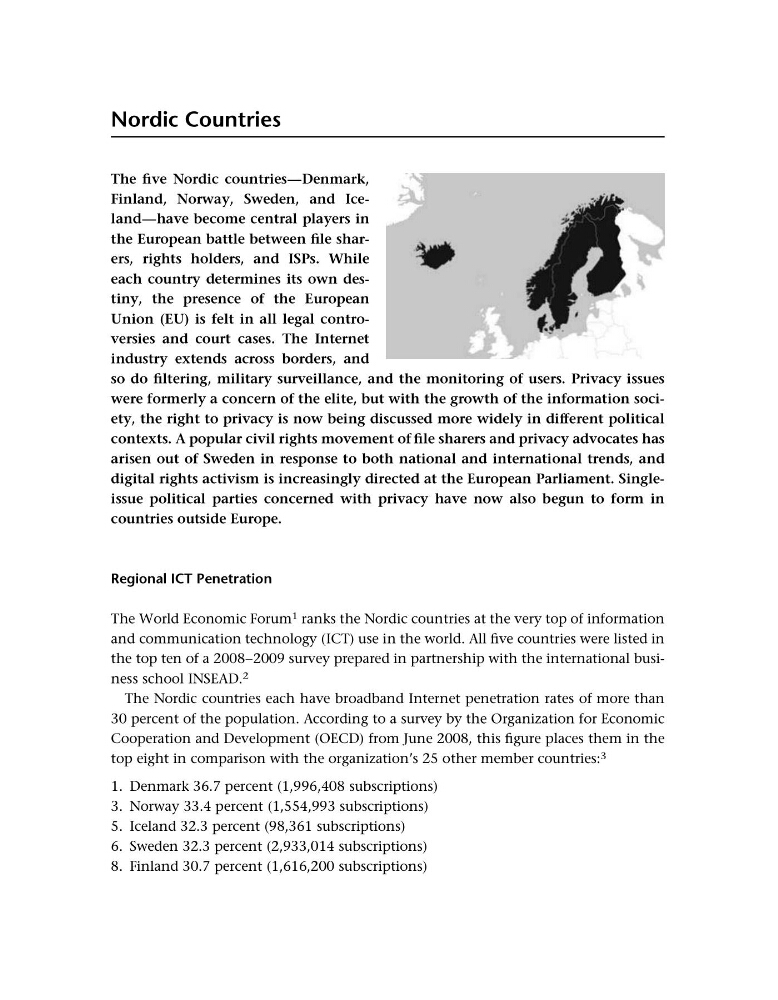
The five Nordic countries—Denmark,
Finland, Norway, Sweden, and Iceland—have become central players in
the European battle between file sharers, rights holders, and ISPs. While
each country determines its own destiny, the presence of the European
Union (EU) is felt in all legal controversies and court cases. The Internet
industry extends across borders, and
so do filtering, military surveillance, and the monitoring of users. Privacy issues
were formerly a concern of the elite, but with the growth of the information society, the right to privacy is now being discussed more widely in different political
contexts. A popular civil rights movement of file sharers and privacy advocates has
arisen out of Sweden in response to both national and international trends, and
digital rights activism is increasingly directed at the European Parliament. Singleissue political parties concerned with privacy have now also begun to form in
countries outside Europe.
Regional ICT Penetration
The World Economic Forum 1 ranks the Nordic countries at the very top of information
and communication technology (ICT) use in the world. All five countries were listed in
the top ten of a 2008–2009 survey prepared in partnership with the international business school INSEAD. 2
The Nordic countries each have broadband Internet penetration rates of more than
30 percent of the population. According to a survey by the Organization for Economic
Cooperation and Development (OECD) from June 2008, this figure places them in the
top eight in comparison with the organization’s 25 other member countries: 3
1. Denmark 36.7 percent (1,996,408 subscriptions)
3. Norway 33.4 percent (1,554,993 subscriptions)
5. Iceland 32.3 percent (98,361 subscriptions)
6. Sweden 32.3 percent (2,933,014 subscriptions)
8. Finland 30.7 percent (1,616,200 subscriptions)
The five Nordic countries—Denmark,
Finland, Norway, Sweden, and Iceland—have become central players in
the European battle between file sharers, rights holders, and ISPs. While
each country determines its own destiny, the presence of the European
Union (EU) is felt in all legal controversies and court cases. The Internet
industry extends across borders, and
so do filtering, military surveillance, and the monitoring of users. Privacy issues
were formerly a concern of the elite, but with the growth of the information society, the right to privacy is now being discussed more widely in different political
contexts. A popular civil rights movement of file sharers and privacy advocates has
arisen out of Sweden in response to both national and international trends, and
digital rights activism is increasingly directed at the European Parliament. Singleissue political parties concerned with privacy have now also begun to form in
countries outside Europe.
Regional ICT Penetration
The World Economic Forum 1 ranks the Nordic countries at the very top of information
and communication technology (ICT) use in the world. All five countries were listed in
the top ten of a 2008–2009 survey prepared in partnership with the international business school INSEAD. 2
The Nordic countries each have broadband Internet penetration rates of more than
30 percent of the population. According to a survey by the Organization for Economic
Cooperation and Development (OECD) from June 2008, this figure places them in the
top eight in comparison with the organization’s 25 other member countries: 3
1. Denmark 36.7 percent (1,996,408 subscriptions)
3. Norway 33.4 percent (1,554,993 subscriptions)
5. Iceland 32.3 percent (98,361 subscriptions)
6. Sweden 32.3 percent (2,933,014 subscriptions)
8. Finland 30.7 percent (1,616,200 subscriptions)