

was consolidated among centrist parties. This concentration of power led to widespread corruption, and after the fall of communism the judicial branch launched a
massive investigation that left no major parties untouched and involved more than
one-third of the members of parliament. 1
Corruption continues to be an issue and has influenced control over the media,
particularly television. Prime Minister Silvio Berlusconi, who has held office for three
separate terms since 1994, has come under scrutiny multiple times for corruption,
including during the passage of a broadcasting law in 2004 that lifted ownership limits
for national broadcast channels. Berlusconi now owns three of Italy’s seven national
television networks and several national newspapers. 2 In April 2006, he violated electoral law three times by exceeding his allotted media time when he broadcast long
interviews on his own channels during the parliamentary election campaign. 3
Internet in Italy
Internet penetration in Italy stood at approximately 49 percent in 2008. 4 According
to the first national study of Internet and computer usage, published in 2007, about
33 percent of children under age eleven, 75 percent of adolescents and adult women,
and more than 80 percent of adult men access the Internet each month. 5 As of 2006,
47 percent of households had a home computer, and 40 percent of households had
Internet access. 6
The passage of Law No. 58, Disposizionia per la Riforma del Settore delle Telecomunicazioni (Rules for the Reform of the Telecommunications Industry), in January 1992 was
the beginning of the privatization of Italy’s telecommunications industry. 7 Previously,
most telecom services had been provided by a collection of companies managed by the
Istituto per la Ricostruzione Industriale/Societa Italiana L Esercizio Telecom (Institute for
Industrial Reconstruction/Italian Telecommunications Society, IRI-STET) group, part
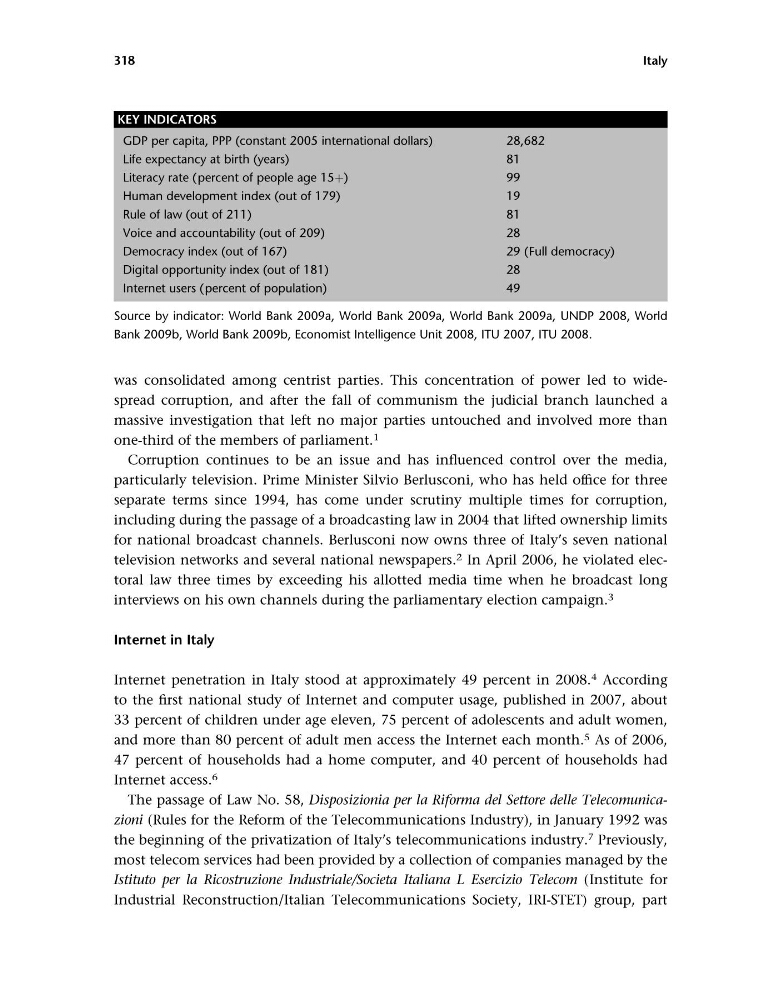
KEY INDICATORS
GDP per capita, PPP (constant 2005 international dollars)
28,682
Life expectancy at birth (years)
81
Literacy rate (percent of people age 15þ)9 9
Human development index (out of 179)
19
Rule of law (out of 211)
81
Voice and accountability (out of 209)
28
Democracy index (out of 167)
29 (Full democracy)
Digital opportunity index (out of 181)
28
Internet users (percent of population)
49
Source by indicator: World Bank 2009a, World Bank 2009a, World Bank 2009a, UNDP 2008, World
Bank 2009b, World Bank 2009b, Economist Intelligence Unit 2008, ITU 2007, ITU 2008.
318
Italy
massive investigation that left no major parties untouched and involved more than
one-third of the members of parliament. 1
Corruption continues to be an issue and has influenced control over the media,
particularly television. Prime Minister Silvio Berlusconi, who has held office for three
separate terms since 1994, has come under scrutiny multiple times for corruption,
including during the passage of a broadcasting law in 2004 that lifted ownership limits
for national broadcast channels. Berlusconi now owns three of Italy’s seven national
television networks and several national newspapers. 2 In April 2006, he violated electoral law three times by exceeding his allotted media time when he broadcast long
interviews on his own channels during the parliamentary election campaign. 3
Internet in Italy
Internet penetration in Italy stood at approximately 49 percent in 2008. 4 According
to the first national study of Internet and computer usage, published in 2007, about
33 percent of children under age eleven, 75 percent of adolescents and adult women,
and more than 80 percent of adult men access the Internet each month. 5 As of 2006,
47 percent of households had a home computer, and 40 percent of households had
Internet access. 6
The passage of Law No. 58, Disposizionia per la Riforma del Settore delle Telecomunicazioni (Rules for the Reform of the Telecommunications Industry), in January 1992 was
the beginning of the privatization of Italy’s telecommunications industry. 7 Previously,
most telecom services had been provided by a collection of companies managed by the
Istituto per la Ricostruzione Industriale/Societa Italiana L Esercizio Telecom (Institute for
Industrial Reconstruction/Italian Telecommunications Society, IRI-STET) group, part
KEY INDICATORS
GDP per capita, PPP (constant 2005 international dollars)
28,682
Life expectancy at birth (years)
81
Literacy rate (percent of people age 15þ)9 9
Human development index (out of 179)
19
Rule of law (out of 211)
81
Voice and accountability (out of 209)
28
Democracy index (out of 167)
29 (Full democracy)
Digital opportunity index (out of 181)
28
Internet users (percent of population)
49
Source by indicator: World Bank 2009a, World Bank 2009a, World Bank 2009a, UNDP 2008, World
Bank 2009b, World Bank 2009b, Economist Intelligence Unit 2008, ITU 2007, ITU 2008.
318
Italy