

1990, East Germany joined the Federal Republic of Germany. Since that time, reconciling economic differences has shaped German policy.
In 1949, West Germany adopted its ‘‘Basic Law’’ (Grundgesetz)—similar to a constitution—which provides for freedom of expression; however, the Basic Law also restricts
expression that is ‘‘offensive, injurious, or indecent.’’ 1 Germany maintains a blacklist
of books, comic books, magazines, videotapes, and music, the so-called Index. The list,
originally intended to shield youth from pornographic material, has been expanded
to include other items; in particular, materials that make light of Germany’s history
and those which promote neo-Nazism or deny the Holocaust have been blacklisted. 2
Volksverhetzung, defined in Germany as ‘‘incitement of hatred against a minority under
certain conditions,’’ is also strictly prohibited and punishable with up to five years’
imprisonment. 3
Internet in Germany
The Internet is a central part of the German economy. Over the past ten years, fierce
competition has led to low prices and fueled Internet access. In 2008, Internet penetration stood at approximately 76 percent. 4 Germany’s primary ISPs are T-Online (47
percent market share), United Internet (15 percent), AOL (12 percent), and Arcor
(7 percent). 5
T-Online is a spin-off of Deutsche Telekom. Deutsche Telekom is the former staterun telecom, hence its high market share. Today, T-Online provides Internet services
and software, while Deutsche Telekom maintains the physical connection. Deutsche
Telekom still owns the majority of the physical network, including 90 percent of all
existing broadband connections.
Broadband access in Germany has increased in recent years, from 200,000 in 2000 to
14.7 million in 2006. Because the service is inexpensive, this number is expected to rise
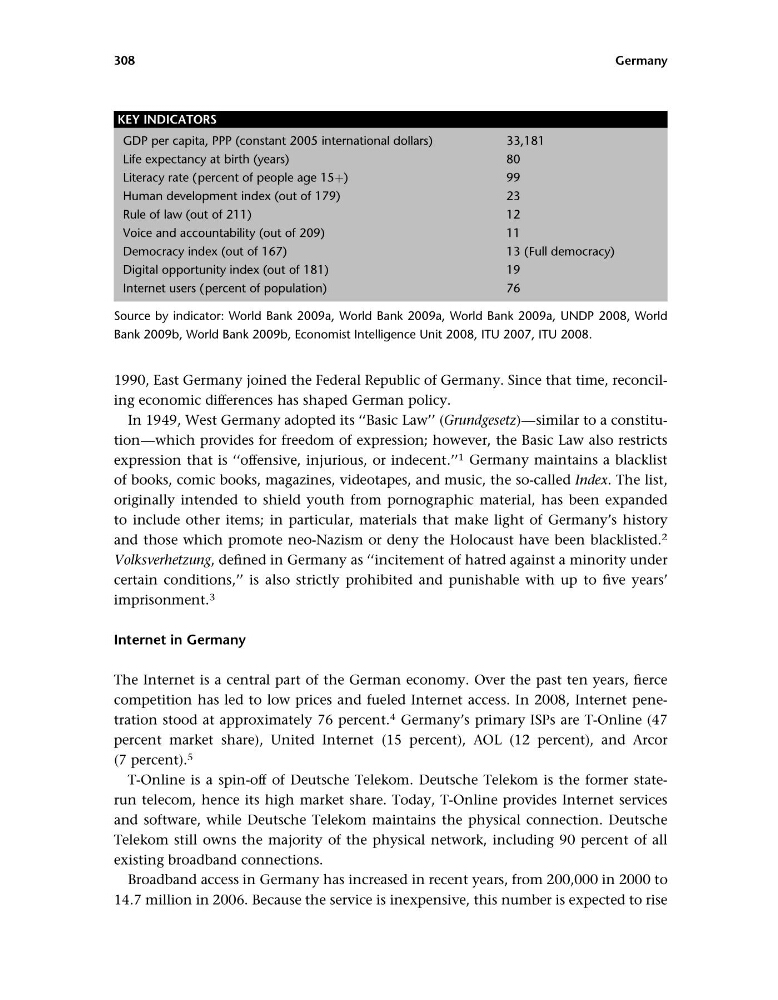
KEY INDICATORS
GDP per capita, PPP (constant 2005 international dollars)
33,181
Life expectancy at birth (years)
80
Literacy rate (percent of people age 15þ)9 9
Human development index (out of 179)
23
Rule of law (out of 211)
12
Voice and accountability (out of 209)
11
Democracy index (out of 167)
13 (Full democracy)
Digital opportunity index (out of 181)
19
Internet users (percent of population)
76
Source by indicator: World Bank 2009a, World Bank 2009a, World Bank 2009a, UNDP 2008, World
Bank 2009b, World Bank 2009b, Economist Intelligence Unit 2008, ITU 2007, ITU 2008.
308
Germany
In 1949, West Germany adopted its ‘‘Basic Law’’ (Grundgesetz)—similar to a constitution—which provides for freedom of expression; however, the Basic Law also restricts
expression that is ‘‘offensive, injurious, or indecent.’’ 1 Germany maintains a blacklist
of books, comic books, magazines, videotapes, and music, the so-called Index. The list,
originally intended to shield youth from pornographic material, has been expanded
to include other items; in particular, materials that make light of Germany’s history
and those which promote neo-Nazism or deny the Holocaust have been blacklisted. 2
Volksverhetzung, defined in Germany as ‘‘incitement of hatred against a minority under
certain conditions,’’ is also strictly prohibited and punishable with up to five years’
imprisonment. 3
Internet in Germany
The Internet is a central part of the German economy. Over the past ten years, fierce
competition has led to low prices and fueled Internet access. In 2008, Internet penetration stood at approximately 76 percent. 4 Germany’s primary ISPs are T-Online (47
percent market share), United Internet (15 percent), AOL (12 percent), and Arcor
(7 percent). 5
T-Online is a spin-off of Deutsche Telekom. Deutsche Telekom is the former staterun telecom, hence its high market share. Today, T-Online provides Internet services
and software, while Deutsche Telekom maintains the physical connection. Deutsche
Telekom still owns the majority of the physical network, including 90 percent of all
existing broadband connections.
Broadband access in Germany has increased in recent years, from 200,000 in 2000 to
14.7 million in 2006. Because the service is inexpensive, this number is expected to rise
KEY INDICATORS
GDP per capita, PPP (constant 2005 international dollars)
33,181
Life expectancy at birth (years)
80
Literacy rate (percent of people age 15þ)9 9
Human development index (out of 179)
23
Rule of law (out of 211)
12
Voice and accountability (out of 209)
11
Democracy index (out of 167)
13 (Full democracy)
Digital opportunity index (out of 181)
19
Internet users (percent of population)
76
Source by indicator: World Bank 2009a, World Bank 2009a, World Bank 2009a, UNDP 2008, World
Bank 2009b, World Bank 2009b, Economist Intelligence Unit 2008, ITU 2007, ITU 2008.
308
Germany