

has sought to reform universities and special pension regimes and to modernize immigration and economic policies. 3
The French government operates under a traditionally highly centralized decisionmaking process. Each of France’s departments is headed by a prefect appointed by the
central government. Although the process of decentralization began in the early 1980s,
with regional councils directly elected for the first time in 1986, it has continued at a
very slow pace. 4
As established in the 1789 De ´claration des Droits de l’Homme et du Citoyen (Declaration
of the Rights of Man and of the Citizen), France adheres to the principle of laı ¨cite ´,o r
government secularism. Although approximately 85 percent of the French population
is Roman Catholic, Europe’s largest Muslim and Jewish populations reside in France,
comprising 10 and 1 percent of the population, respectively. 5 Notably, as a result of
such staunch secularism, France has banned women and girls from wearing the Islamic
headscarf in schools, an act which has resulted in criticism from some civil rights
groups. 6
France is a liberal democracy that guarantees freedom of the press and freedom of
speech. 7 Article 11 of the 1789 Declaration stipulates that ‘‘the free communication
of thoughts and of opinions is one of the most precious rights of man: any citizen
thus may speak, write, print freely, save [unless it is necessary] to respond to the abuse
of this liberty, in the cases determined by the law.’’ 8 In addition, the European Convention on Human Rights, which France signed in 1950, promotes free speech in
Article 10. 9
Freedom of speech is recognized as a constitutional right to be respected by citizens
as well as by the government during the process of passing new French legislation.
Indeed, a distinctive feature of the French judicial system is that the Constitutional
Council protects basic rights against potential violations by new laws, and the Council
of State protects basic rights when they might be violated by actions of the state. The
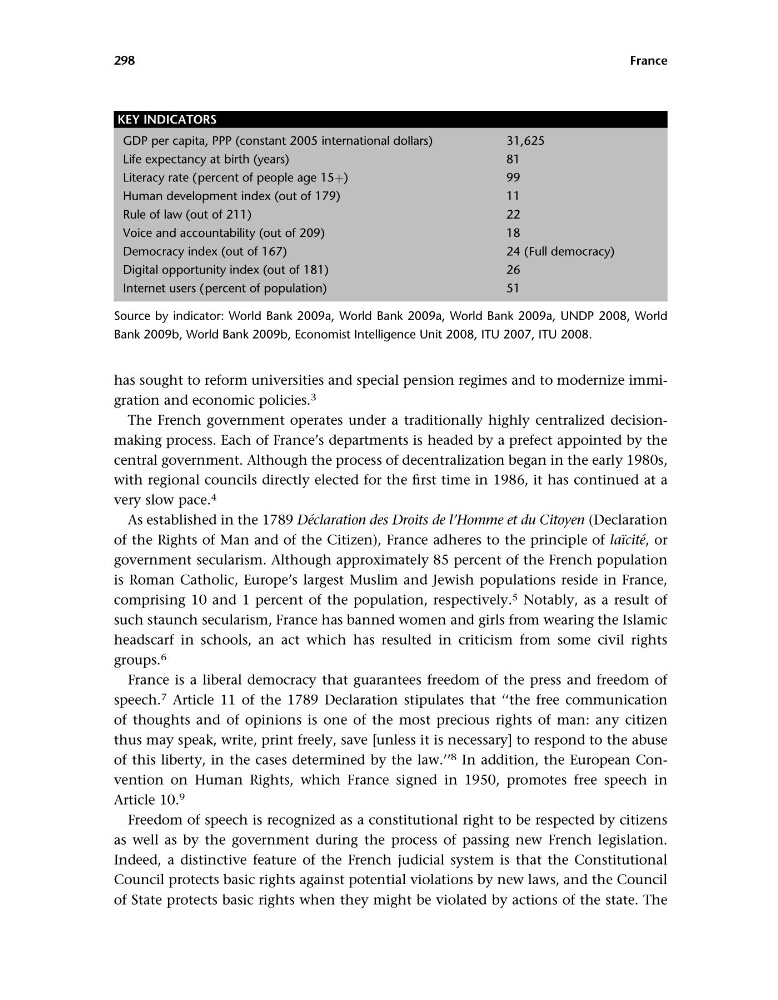
KEY INDICATORS
GDP per capita, PPP (constant 2005 international dollars)
31,625
Life expectancy at birth (years)
81
Literacy rate (percent of people age 15þ)9 9
Human development index (out of 179)
11
Rule of law (out of 211)
22
Voice and accountability (out of 209)
18
Democracy index (out of 167)
24 (Full democracy)
Digital opportunity index (out of 181)
26
Internet users (percent of population)
51
Source by indicator: World Bank 2009a, World Bank 2009a, World Bank 2009a, UNDP 2008, World
Bank 2009b, World Bank 2009b, Economist Intelligence Unit 2008, ITU 2007, ITU 2008.
298
France
The French government operates under a traditionally highly centralized decisionmaking process. Each of France’s departments is headed by a prefect appointed by the
central government. Although the process of decentralization began in the early 1980s,
with regional councils directly elected for the first time in 1986, it has continued at a
very slow pace. 4
As established in the 1789 De ´claration des Droits de l’Homme et du Citoyen (Declaration
of the Rights of Man and of the Citizen), France adheres to the principle of laı ¨cite ´,o r
government secularism. Although approximately 85 percent of the French population
is Roman Catholic, Europe’s largest Muslim and Jewish populations reside in France,
comprising 10 and 1 percent of the population, respectively. 5 Notably, as a result of
such staunch secularism, France has banned women and girls from wearing the Islamic
headscarf in schools, an act which has resulted in criticism from some civil rights
groups. 6
France is a liberal democracy that guarantees freedom of the press and freedom of
speech. 7 Article 11 of the 1789 Declaration stipulates that ‘‘the free communication
of thoughts and of opinions is one of the most precious rights of man: any citizen
thus may speak, write, print freely, save [unless it is necessary] to respond to the abuse
of this liberty, in the cases determined by the law.’’ 8 In addition, the European Convention on Human Rights, which France signed in 1950, promotes free speech in
Article 10. 9
Freedom of speech is recognized as a constitutional right to be respected by citizens
as well as by the government during the process of passing new French legislation.
Indeed, a distinctive feature of the French judicial system is that the Constitutional
Council protects basic rights against potential violations by new laws, and the Council
of State protects basic rights when they might be violated by actions of the state. The
KEY INDICATORS
GDP per capita, PPP (constant 2005 international dollars)
31,625
Life expectancy at birth (years)
81
Literacy rate (percent of people age 15þ)9 9
Human development index (out of 179)
11
Rule of law (out of 211)
22
Voice and accountability (out of 209)
18
Democracy index (out of 167)
24 (Full democracy)
Digital opportunity index (out of 181)
26
Internet users (percent of population)
51
Source by indicator: World Bank 2009a, World Bank 2009a, World Bank 2009a, UNDP 2008, World
Bank 2009b, World Bank 2009b, Economist Intelligence Unit 2008, ITU 2007, ITU 2008.
298
France