

Europe Overview
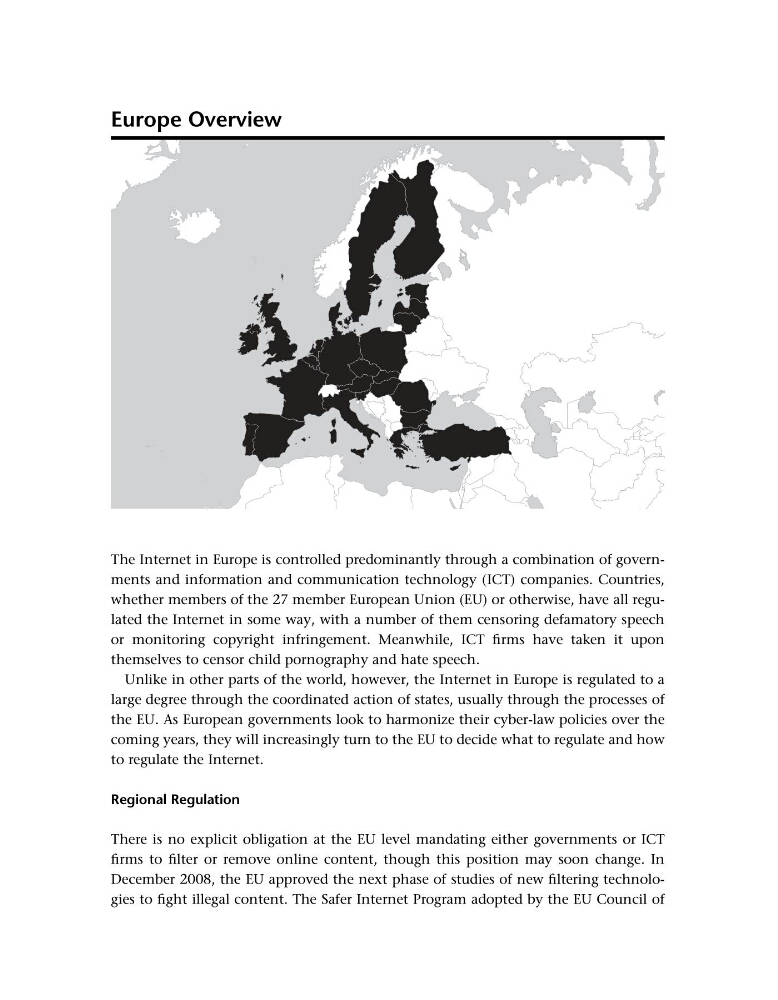
The Internet in Europe is controlled predominantly through a combination of governments and information and communication technology (ICT) companies. Countries,
whether members of the 27 member European Union (EU) or otherwise, have all regulated the Internet in some way, with a number of them censoring defamatory speech
or monitoring copyright infringement. Meanwhile, ICT firms have taken it upon
themselves to censor child pornography and hate speech.
Unlike in other parts of the world, however, the Internet in Europe is regulated to a
large degree through the coordinated action of states, usually through the processes of
the EU. As European governments look to harmonize their cyber-law policies over the
coming years, they will increasingly turn to the EU to decide what to regulate and how
to regulate the Internet.
Regional Regulation
There is no explicit obligation at the EU level mandating either governments or ICT
firms to filter or remove online content, though this position may soon change. In
December 2008, the EU approved the next phase of studies of new filtering technologies to fight illegal content. The Safer Internet Program adopted by the EU Council of
The Internet in Europe is controlled predominantly through a combination of governments and information and communication technology (ICT) companies. Countries,
whether members of the 27 member European Union (EU) or otherwise, have all regulated the Internet in some way, with a number of them censoring defamatory speech
or monitoring copyright infringement. Meanwhile, ICT firms have taken it upon
themselves to censor child pornography and hate speech.
Unlike in other parts of the world, however, the Internet in Europe is regulated to a
large degree through the coordinated action of states, usually through the processes of
the EU. As European governments look to harmonize their cyber-law policies over the
coming years, they will increasingly turn to the EU to decide what to regulate and how
to regulate the Internet.
Regional Regulation
There is no explicit obligation at the EU level mandating either governments or ICT
firms to filter or remove online content, though this position may soon change. In
December 2008, the EU approved the next phase of studies of new filtering technologies to fight illegal content. The Safer Internet Program adopted by the EU Council of