

in the telecommunications sector, although much remains to be done to promote a
favorable environment for developing the Internet, fostering e-commerce, and introducing e-governance. In 2008–2009, Ukraine moved up in the global ranking of the
Networked Readiness Index to 62nd from 75th place—a notable improvement. 1
In early 2000, the government invested in developing the country’s ICT infrastructure extensively, but more recently the government has deprioritized ICT development. This policy change explains the low position of Ukraine in two separate
rankings, both carried out by the World Economic Forum in 2009: ‘‘Government Prioritization of ICT’’ (ranked 110th out of 134 countries) and ‘‘Importance of ICT to
Government Vision of the Future’’ (ranked 114th). 2
The January 2005 Orange Revolution—when opposition groups successfully challenged the outcome of the November 2004 presidential elections that were allegedly
unfair—highlighted the latent political power resulting from the ‘‘convergence’’ of
information infrastructures (cell phones, Internet, and independent media) and political mobilization. The opposition made full use of these technologies to mobilize and
direct supporters in acts of civil disobedience, sit-ins, and general strikes. Although
the Internet did not play a determining role in the success of the Orange Revolution,
its use by the opposition helped to foster the perception that these technologies served
an important strategic role in organizing political opposition (which observers have
termed ‘‘hyper-democracy’’). 3 This perception, in turn, prompted neighboring authoritarian governments such as Belarus to crack down on Internet openness.
Following the Orange Revolution, Ukrainian society has become more aware of its
power to bring about political changes. Political parties and the government have
started using the Internet as an effective tool of political competition while employing
techniques such as online political games, unofficial voting, e-meetings, and blogs.
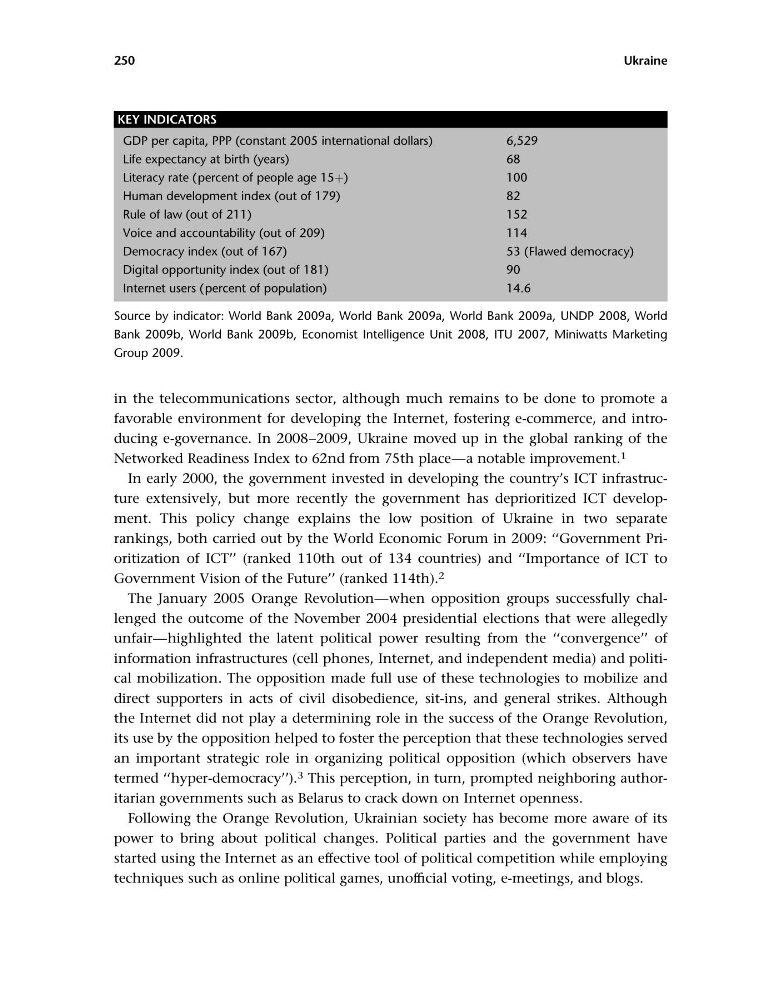
KEY INDICATORS
GDP per capita, PPP (constant 2005 international dollars)
6,529
Life expectancy at birth (years)
68
Literacy rate (percent of people age 15þ)
100
Human development index (out of 179)
82
Rule of law (out of 211)
152
Voice and accountability (out of 209)
114
Democracy index (out of 167)
53 (Flawed democracy)
Digital opportunity index (out of 181)
90
Internet users (percent of population)
14.6
Source by indicator: World Bank 2009a, World Bank 2009a, World Bank 2009a, UNDP 2008, World
Bank 2009b, World Bank 2009b, Economist Intelligence Unit 2008, ITU 2007, Miniwatts Marketing
Group 2009.
250
Ukraine
favorable environment for developing the Internet, fostering e-commerce, and introducing e-governance. In 2008–2009, Ukraine moved up in the global ranking of the
Networked Readiness Index to 62nd from 75th place—a notable improvement. 1
In early 2000, the government invested in developing the country’s ICT infrastructure extensively, but more recently the government has deprioritized ICT development. This policy change explains the low position of Ukraine in two separate
rankings, both carried out by the World Economic Forum in 2009: ‘‘Government Prioritization of ICT’’ (ranked 110th out of 134 countries) and ‘‘Importance of ICT to
Government Vision of the Future’’ (ranked 114th). 2
The January 2005 Orange Revolution—when opposition groups successfully challenged the outcome of the November 2004 presidential elections that were allegedly
unfair—highlighted the latent political power resulting from the ‘‘convergence’’ of
information infrastructures (cell phones, Internet, and independent media) and political mobilization. The opposition made full use of these technologies to mobilize and
direct supporters in acts of civil disobedience, sit-ins, and general strikes. Although
the Internet did not play a determining role in the success of the Orange Revolution,
its use by the opposition helped to foster the perception that these technologies served
an important strategic role in organizing political opposition (which observers have
termed ‘‘hyper-democracy’’). 3 This perception, in turn, prompted neighboring authoritarian governments such as Belarus to crack down on Internet openness.
Following the Orange Revolution, Ukrainian society has become more aware of its
power to bring about political changes. Political parties and the government have
started using the Internet as an effective tool of political competition while employing
techniques such as online political games, unofficial voting, e-meetings, and blogs.
KEY INDICATORS
GDP per capita, PPP (constant 2005 international dollars)
6,529
Life expectancy at birth (years)
68
Literacy rate (percent of people age 15þ)
100
Human development index (out of 179)
82
Rule of law (out of 211)
152
Voice and accountability (out of 209)
114
Democracy index (out of 167)
53 (Flawed democracy)
Digital opportunity index (out of 181)
90
Internet users (percent of population)
14.6
Source by indicator: World Bank 2009a, World Bank 2009a, World Bank 2009a, UNDP 2008, World
Bank 2009b, World Bank 2009b, Economist Intelligence Unit 2008, ITU 2007, Miniwatts Marketing
Group 2009.
250
Ukraine