

judicial representatives to create a situation of permanent instability in the society. 4
The death of Niyazov in December 2006 brought about a glimmer of hope for those
pining for reform. 5 In February 2007, Gurbanguly Berdymukhamedov won the country’s largely symbolic presidential elections. The post-Niyazov transition was surprisingly smooth, with Berdymukhamedov promptly securing support from the most
important behind-the-scenes players, whom he then removed once becoming president. During the time of Niyazov, the president headed both the legislative and judicial branches of the state. Berdymukhamedov pledged to introduce democratic
reforms and separation of powers. In September 2008, a new constitution entered into
force that dissolved the People’s Council (the highest representative body, which
included parliament and cabinet members) and divided its powers between the president and the new 125-member parliament.
During Niyazov’s rule, all opposition parties were banned. Dissenters were harassed
or exiled, and a small and weakened opposition existed either underground or abroad. 6
By contrast, the new constitution promotes multiparty politics, thus formally legalizing opposition. However, in the 2008 parliamentary elections, the Democratic Party—
the current ruling party—was the only one registered to participate. The leaders of the
main political opposition parties—the Social and Political Movement of Watan and
the Turkmenistan Republican Party—continue to reside abroad to avoid potential
repression.
The people of Turkmenistan were positive about some of the reforms promised by
Berdymukhamedov, including reinstating the recently abolished ten-year mandatory
period of education, reversing measures aimed at denying pensions for the elderly,
and guaranteeing Internet access to all. 7
The ethnic composition of the population is Turkmen (85 percent), Russian (7 percent), Uzbek (5 percent), and other minorities (3 percent). 8 The largest percentage of
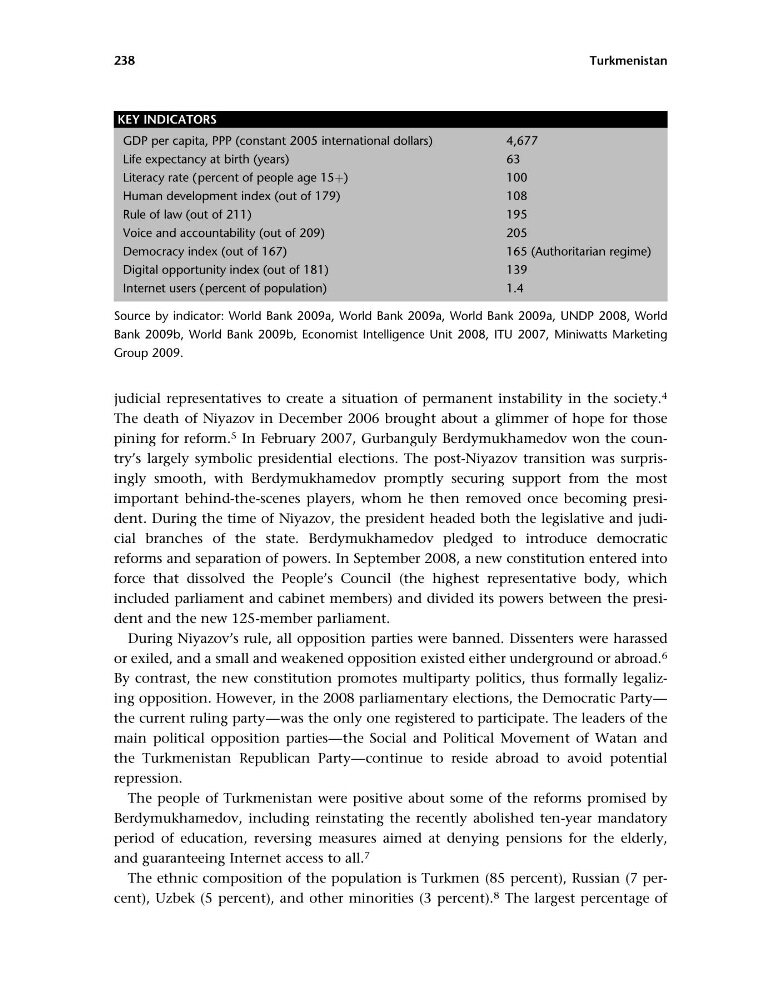
KEY INDICATORS
GDP per capita, PPP (constant 2005 international dollars)
4,677
Life expectancy at birth (years)
63
Literacy rate (percent of people age 15þ)
100
Human development index (out of 179)
108
Rule of law (out of 211)
195
Voice and accountability (out of 209)
205
Democracy index (out of 167)
165 (Authoritarian regime)
Digital opportunity index (out of 181)
139
Internet users (percent of population)
1.4
Source by indicator: World Bank 2009a, World Bank 2009a, World Bank 2009a, UNDP 2008, World
Bank 2009b, World Bank 2009b, Economist Intelligence Unit 2008, ITU 2007, Miniwatts Marketing
Group 2009.
238
Turkmenistan
The death of Niyazov in December 2006 brought about a glimmer of hope for those
pining for reform. 5 In February 2007, Gurbanguly Berdymukhamedov won the country’s largely symbolic presidential elections. The post-Niyazov transition was surprisingly smooth, with Berdymukhamedov promptly securing support from the most
important behind-the-scenes players, whom he then removed once becoming president. During the time of Niyazov, the president headed both the legislative and judicial branches of the state. Berdymukhamedov pledged to introduce democratic
reforms and separation of powers. In September 2008, a new constitution entered into
force that dissolved the People’s Council (the highest representative body, which
included parliament and cabinet members) and divided its powers between the president and the new 125-member parliament.
During Niyazov’s rule, all opposition parties were banned. Dissenters were harassed
or exiled, and a small and weakened opposition existed either underground or abroad. 6
By contrast, the new constitution promotes multiparty politics, thus formally legalizing opposition. However, in the 2008 parliamentary elections, the Democratic Party—
the current ruling party—was the only one registered to participate. The leaders of the
main political opposition parties—the Social and Political Movement of Watan and
the Turkmenistan Republican Party—continue to reside abroad to avoid potential
repression.
The people of Turkmenistan were positive about some of the reforms promised by
Berdymukhamedov, including reinstating the recently abolished ten-year mandatory
period of education, reversing measures aimed at denying pensions for the elderly,
and guaranteeing Internet access to all. 7
The ethnic composition of the population is Turkmen (85 percent), Russian (7 percent), Uzbek (5 percent), and other minorities (3 percent). 8 The largest percentage of
KEY INDICATORS
GDP per capita, PPP (constant 2005 international dollars)
4,677
Life expectancy at birth (years)
63
Literacy rate (percent of people age 15þ)
100
Human development index (out of 179)
108
Rule of law (out of 211)
195
Voice and accountability (out of 209)
205
Democracy index (out of 167)
165 (Authoritarian regime)
Digital opportunity index (out of 181)
139
Internet users (percent of population)
1.4
Source by indicator: World Bank 2009a, World Bank 2009a, World Bank 2009a, UNDP 2008, World
Bank 2009b, World Bank 2009b, Economist Intelligence Unit 2008, ITU 2007, Miniwatts Marketing
Group 2009.
238
Turkmenistan