

authority. 1 Putin abolished the principle of electing regional heads by regional parliaments and channeled a number of legal and institutional reforms that demonstrate a
gradual tendency to reintroduce a more centralized form of governance over its subjects. These shifts have been felt in all sectors of public life.
Putin’s administration after eight years in power brought Russia back to the international scene as a strong global player, and this success has inspired a wave of nationalism fueled by government policies. Putin enjoyed high approval ratings in Russia up
to 87 percent ( July 2006) 2 largely because of the improved economic indicators of the
country. The economy has performed well under his watch, especially in comparison
to the period between 1991 and 1999. It has been growing steadily, bolstered by high
global energy prices. The growing popularity for Putin, however, was coupled with a
significant drop in political rights and civil liberties. 3 Putin’s administration effectively
silenced the opposition, cracked down on antigovernment protests, reimposed control
over the media, and concentrated power in the presidency. The policy line introduced
by Putin remains largely unchallenged during the first year of Dmitri Medvedev’s presidency. Putin and his supporters refer to the current system of governance in Russia as
‘‘sovereign democracy.’’ International observers disagree, describing the established
system of government as an increasingly authoritarian state, albeit one that is supported ‘‘with the consent of the governed.’’ 4
As President, Putin strengthened state control over major outlets, focusing especially
on media owned at the time by Russian oligarchs. As a sanction for unpaid debts, Putin
took away owners’ shares in television channels and placed the media under state control. This action sharply influenced the flow of information and the management of
the outlets. Major federal television channels are either directly or indirectly controlled
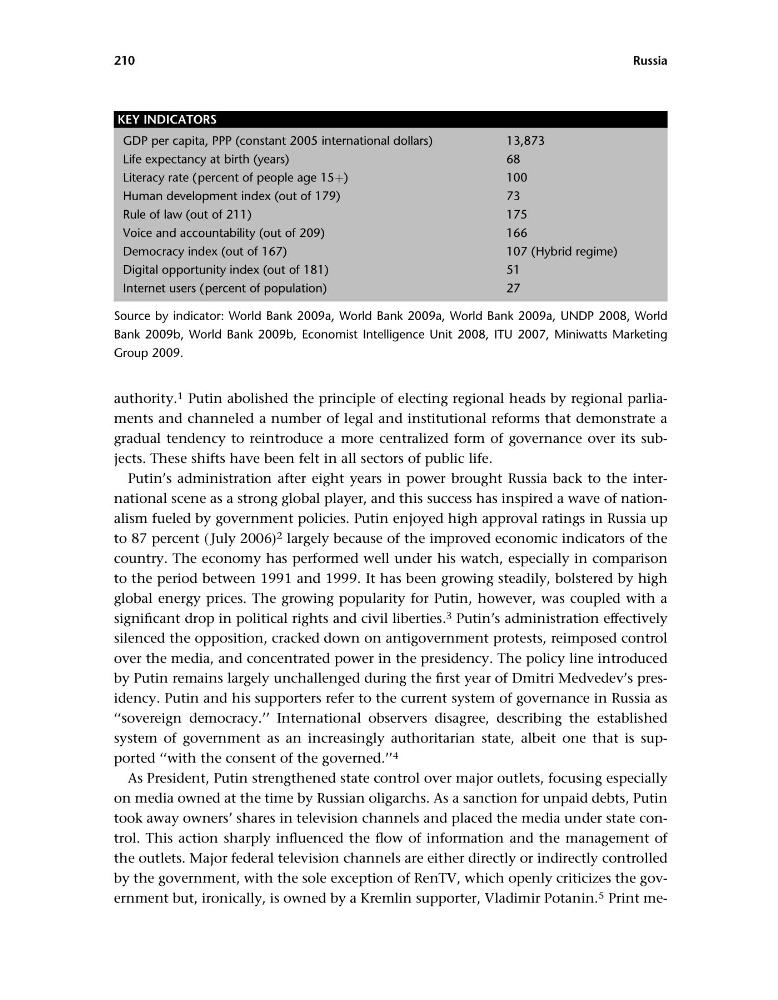
by the government, with the sole exception of RenTV, which openly criticizes the government but, ironically, is owned by a Kremlin supporter, Vladimir Potanin. 5 Print meKEY INDICATORS
GDP per capita, PPP (constant 2005 international dollars)
13,873
Life expectancy at birth (years)
68
Literacy rate (percent of people age 15þ)
100
Human development index (out of 179)
73
Rule of law (out of 211)
175
Voice and accountability (out of 209)
166
Democracy index (out of 167)
107 (Hybrid regime)
Digital opportunity index (out of 181)
51
Internet users (percent of population)
27
Source by indicator: World Bank 2009a, World Bank 2009a, World Bank 2009a, UNDP 2008, World
Bank 2009b, World Bank 2009b, Economist Intelligence Unit 2008, ITU 2007, Miniwatts Marketing
Group 2009.
210
Russia
gradual tendency to reintroduce a more centralized form of governance over its subjects. These shifts have been felt in all sectors of public life.
Putin’s administration after eight years in power brought Russia back to the international scene as a strong global player, and this success has inspired a wave of nationalism fueled by government policies. Putin enjoyed high approval ratings in Russia up
to 87 percent ( July 2006) 2 largely because of the improved economic indicators of the
country. The economy has performed well under his watch, especially in comparison
to the period between 1991 and 1999. It has been growing steadily, bolstered by high
global energy prices. The growing popularity for Putin, however, was coupled with a
significant drop in political rights and civil liberties. 3 Putin’s administration effectively
silenced the opposition, cracked down on antigovernment protests, reimposed control
over the media, and concentrated power in the presidency. The policy line introduced
by Putin remains largely unchallenged during the first year of Dmitri Medvedev’s presidency. Putin and his supporters refer to the current system of governance in Russia as
‘‘sovereign democracy.’’ International observers disagree, describing the established
system of government as an increasingly authoritarian state, albeit one that is supported ‘‘with the consent of the governed.’’ 4
As President, Putin strengthened state control over major outlets, focusing especially
on media owned at the time by Russian oligarchs. As a sanction for unpaid debts, Putin
took away owners’ shares in television channels and placed the media under state control. This action sharply influenced the flow of information and the management of
the outlets. Major federal television channels are either directly or indirectly controlled
by the government, with the sole exception of RenTV, which openly criticizes the government but, ironically, is owned by a Kremlin supporter, Vladimir Potanin. 5 Print meKEY INDICATORS
GDP per capita, PPP (constant 2005 international dollars)
13,873
Life expectancy at birth (years)
68
Literacy rate (percent of people age 15þ)
100
Human development index (out of 179)
73
Rule of law (out of 211)
175
Voice and accountability (out of 209)
166
Democracy index (out of 167)
107 (Hybrid regime)
Digital opportunity index (out of 181)
51
Internet users (percent of population)
27
Source by indicator: World Bank 2009a, World Bank 2009a, World Bank 2009a, UNDP 2008, World
Bank 2009b, World Bank 2009b, Economist Intelligence Unit 2008, ITU 2007, Miniwatts Marketing
Group 2009.
210
Russia