

Kyrgyzstan
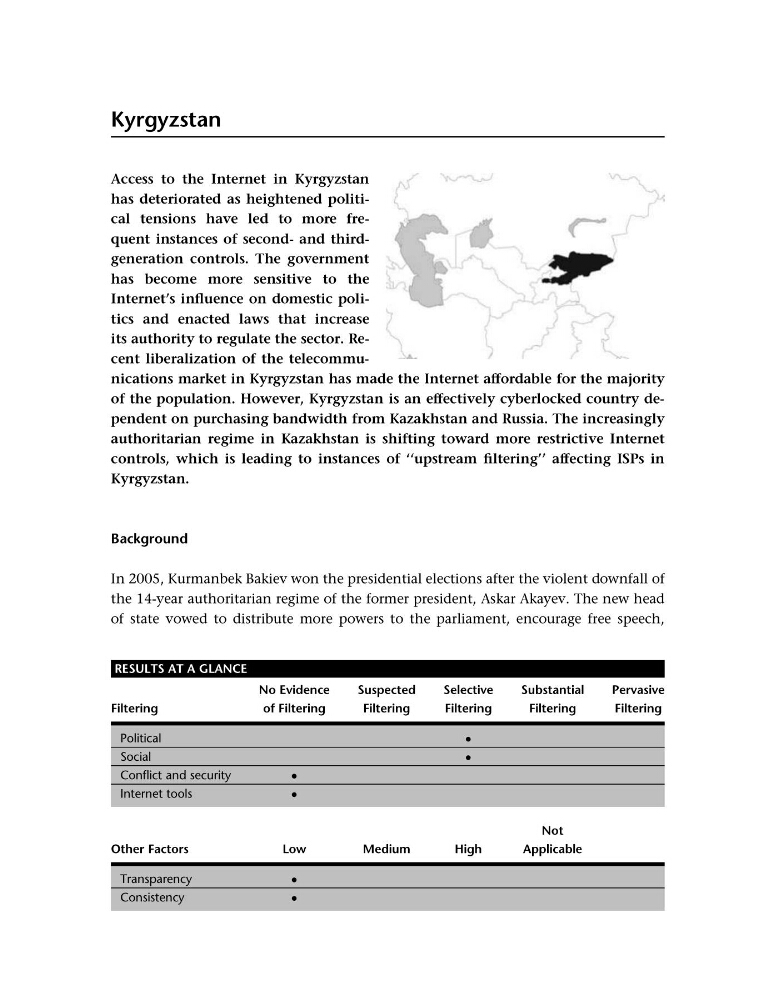
Access to the Internet in Kyrgyzstan
has deteriorated as heightened political tensions have led to more frequent instances of second- and thirdgeneration controls. The government
has become more sensitive to the
Internet’s influence on domestic politics and enacted laws that increase
its authority to regulate the sector. Recent liberalization of the telecommunications market in Kyrgyzstan has made the Internet affordable for the majority
of the population. However, Kyrgyzstan is an effectively cyberlocked country dependent on purchasing bandwidth from Kazakhstan and Russia. The increasingly
authoritarian regime in Kazakhstan is shifting toward more restrictive Internet
controls, which is leading to instances of ‘‘upstream filtering’’ affecting ISPs in
Kyrgyzstan.
Background
In 2005, Kurmanbek Bakiev won the presidential elections after the violent downfall of
the 14-year authoritarian regime of the former president, Askar Akayev. The new head
of state vowed to distribute more powers to the parliament, encourage free speech,
RESULTS AT A GLANCE
Filtering
No Evidence
of Filtering
Suspected
Filtering
Selective
Filtering
Substantial
Filtering
Pervasive
Filtering
Political
Social
Conflict and security
Internet tools
Other Factors
Low
Medium
High
Not
Applicable
Transparency
Consistency
Access to the Internet in Kyrgyzstan
has deteriorated as heightened political tensions have led to more frequent instances of second- and thirdgeneration controls. The government
has become more sensitive to the
Internet’s influence on domestic politics and enacted laws that increase
its authority to regulate the sector. Recent liberalization of the telecommunications market in Kyrgyzstan has made the Internet affordable for the majority
of the population. However, Kyrgyzstan is an effectively cyberlocked country dependent on purchasing bandwidth from Kazakhstan and Russia. The increasingly
authoritarian regime in Kazakhstan is shifting toward more restrictive Internet
controls, which is leading to instances of ‘‘upstream filtering’’ affecting ISPs in
Kyrgyzstan.
Background
In 2005, Kurmanbek Bakiev won the presidential elections after the violent downfall of
the 14-year authoritarian regime of the former president, Askar Akayev. The new head
of state vowed to distribute more powers to the parliament, encourage free speech,
RESULTS AT A GLANCE
Filtering
No Evidence
of Filtering
Suspected
Filtering
Selective
Filtering
Substantial
Filtering
Pervasive
Filtering
Political
Social
Conflict and security
Internet tools
Other Factors
Low
Medium
High
Not
Applicable
Transparency
Consistency