

practicing self-censorship for fear of prosecution by the state under highly restrictive
defamation laws.
Pressed by growing domestic discontent and international criticism, President Nazarbayev agreed to a constitutional reform. In May 2007, the Parliament adopted amendments to the Constitution, including cutting the presidential mandate from seven to
five years and increasing the role of Parliament. These changes are not expected
to enter into force until the next presidential elections in 2012. The proposed reforms
remove restrictions on how many terms a head of state may serve. Consequently, President Nazarbayev can stay in power indefinitely.
Internet in Kazakhstan
The Kazakh Internet community is growing rapidly. Between 2001 and 2005, the
number of Internet users increased from 200,000 to 1 million. By 2007, Kazakhstan
reported Internet penetration levels of 8.5 percent, rising to 12.4 percent in 2008. 3
The National Statistical Agency reports that 73 percent of users access the Internet by
dial-up, 15 percent by means of ADSL, and 6 percent using satellite access. Over 50 percent of users accessed the Internet from home in 2008. 4 Forty-two percent of families
living in towns with populations of at least 70,000 people have a personal computer.
KazakhTelekom (KT) reported an increase in its broadband subscriber base from
270,000 to 456,000 in 2008. 5 Despite these increases, Internet usage is concentrated
in urban centers, while outside those centers access remains beyond the reach of most
Kazakhs. 6
The official language in the country is Kazakh, spoken by 64 percent of the population. Russian, spoken by 95 percent, is recognized as the official language of international communication. Russian is the most popular language used on the Internet
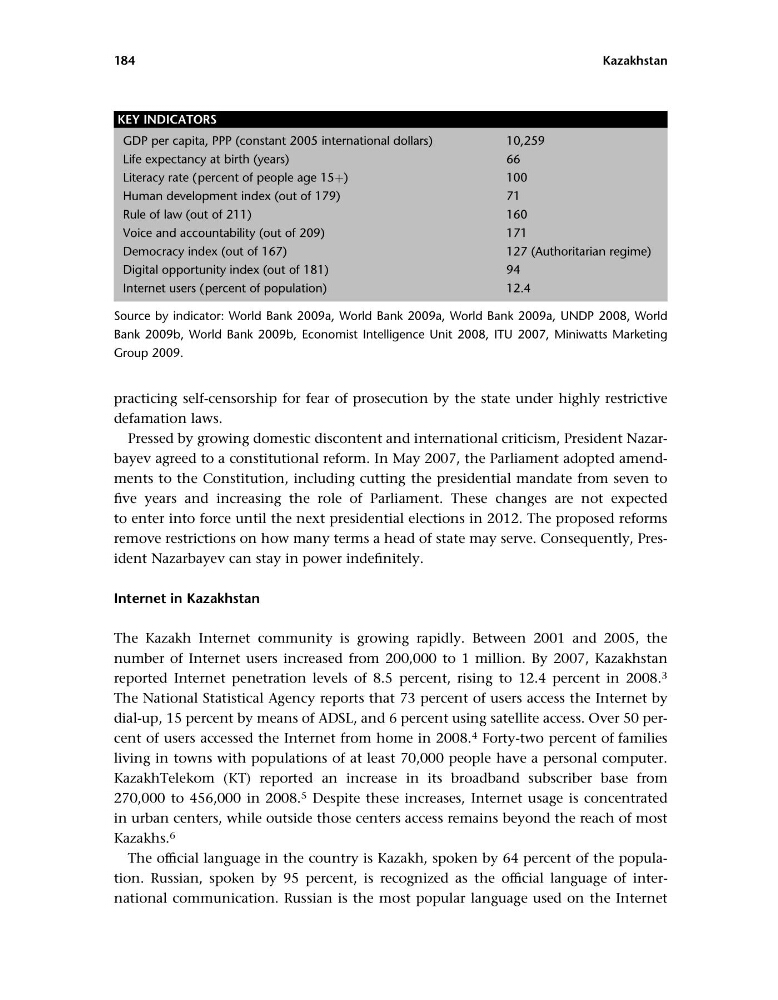
KEY INDICATORS
GDP per capita, PPP (constant 2005 international dollars)
10,259
Life expectancy at birth (years)
66
Literacy rate (percent of people age 15þ)
100
Human development index (out of 179)
71
Rule of law (out of 211)
160
Voice and accountability (out of 209)
171
Democracy index (out of 167)
127 (Authoritarian regime)
Digital opportunity index (out of 181)
94
Internet users (percent of population)
12.4
Source by indicator: World Bank 2009a, World Bank 2009a, World Bank 2009a, UNDP 2008, World
Bank 2009b, World Bank 2009b, Economist Intelligence Unit 2008, ITU 2007, Miniwatts Marketing
Group 2009.
184
Kazakhstan
defamation laws.
Pressed by growing domestic discontent and international criticism, President Nazarbayev agreed to a constitutional reform. In May 2007, the Parliament adopted amendments to the Constitution, including cutting the presidential mandate from seven to
five years and increasing the role of Parliament. These changes are not expected
to enter into force until the next presidential elections in 2012. The proposed reforms
remove restrictions on how many terms a head of state may serve. Consequently, President Nazarbayev can stay in power indefinitely.
Internet in Kazakhstan
The Kazakh Internet community is growing rapidly. Between 2001 and 2005, the
number of Internet users increased from 200,000 to 1 million. By 2007, Kazakhstan
reported Internet penetration levels of 8.5 percent, rising to 12.4 percent in 2008. 3
The National Statistical Agency reports that 73 percent of users access the Internet by
dial-up, 15 percent by means of ADSL, and 6 percent using satellite access. Over 50 percent of users accessed the Internet from home in 2008. 4 Forty-two percent of families
living in towns with populations of at least 70,000 people have a personal computer.
KazakhTelekom (KT) reported an increase in its broadband subscriber base from
270,000 to 456,000 in 2008. 5 Despite these increases, Internet usage is concentrated
in urban centers, while outside those centers access remains beyond the reach of most
Kazakhs. 6
The official language in the country is Kazakh, spoken by 64 percent of the population. Russian, spoken by 95 percent, is recognized as the official language of international communication. Russian is the most popular language used on the Internet
KEY INDICATORS
GDP per capita, PPP (constant 2005 international dollars)
10,259
Life expectancy at birth (years)
66
Literacy rate (percent of people age 15þ)
100
Human development index (out of 179)
71
Rule of law (out of 211)
160
Voice and accountability (out of 209)
171
Democracy index (out of 167)
127 (Authoritarian regime)
Digital opportunity index (out of 181)
94
Internet users (percent of population)
12.4
Source by indicator: World Bank 2009a, World Bank 2009a, World Bank 2009a, UNDP 2008, World
Bank 2009b, World Bank 2009b, Economist Intelligence Unit 2008, ITU 2007, Miniwatts Marketing
Group 2009.
184
Kazakhstan