

Georgia
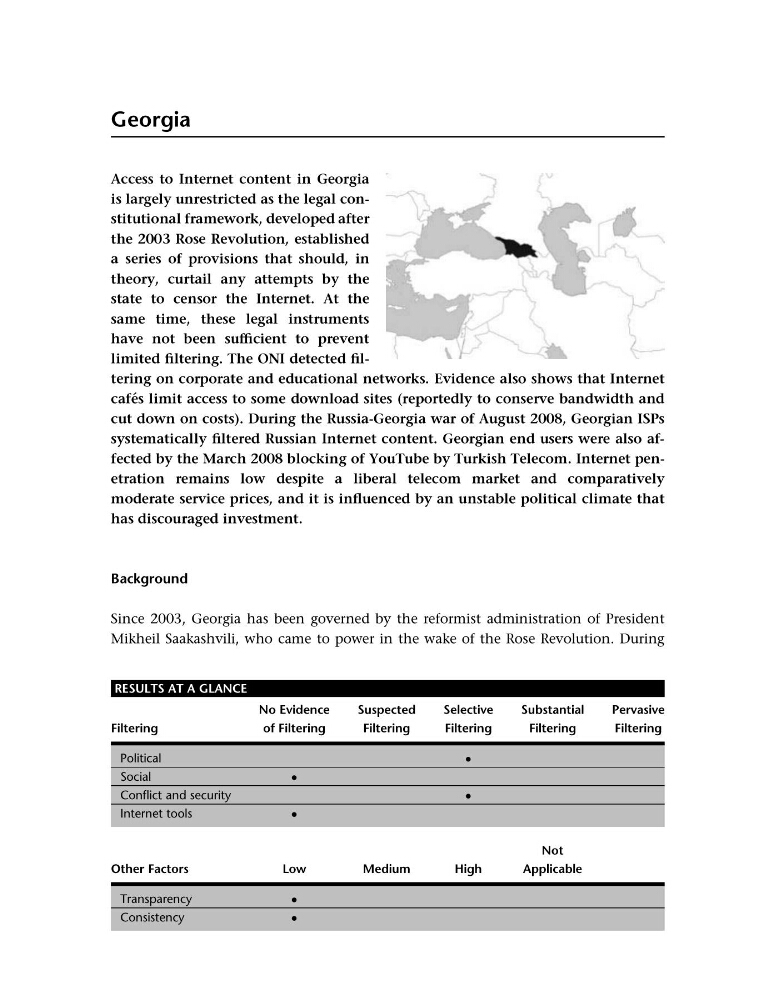
Access to Internet content in Georgia
is largely unrestricted as the legal constitutional framework, developed after
the 2003 Rose Revolution, established
a series of provisions that should, in
theory, curtail any attempts by the
state to censor the Internet. At the
same time, these legal instruments
have not been sufficient to prevent
limited filtering. The ONI detected filtering on corporate and educational networks. Evidence also shows that Internet
cafe ´s limit access to some download sites (reportedly to conserve bandwidth and
cut down on costs). During the Russia-Georgia war of August 2008, Georgian ISPs
systematically filtered Russian Internet content. Georgian end users were also affected by the March 2008 blocking of YouTube by Turkish Telecom. Internet penetration remains low despite a liberal telecom market and comparatively
moderate service prices, and it is influenced by an unstable political climate that
has discouraged investment.
Background
Since 2003, Georgia has been governed by the reformist administration of President
Mikheil Saakashvili, who came to power in the wake of the Rose Revolution. During
RESULTS AT A GLANCE
Filtering
No Evidence
of Filtering
Suspected
Filtering
Selective
Filtering
Substantial
Filtering
Pervasive
Filtering
Political
Social
Conflict and security
Internet tools
Other Factors
Low
Medium
High
Not
Applicable
Transparency
Consistency
Access to Internet content in Georgia
is largely unrestricted as the legal constitutional framework, developed after
the 2003 Rose Revolution, established
a series of provisions that should, in
theory, curtail any attempts by the
state to censor the Internet. At the
same time, these legal instruments
have not been sufficient to prevent
limited filtering. The ONI detected filtering on corporate and educational networks. Evidence also shows that Internet
cafe ´s limit access to some download sites (reportedly to conserve bandwidth and
cut down on costs). During the Russia-Georgia war of August 2008, Georgian ISPs
systematically filtered Russian Internet content. Georgian end users were also affected by the March 2008 blocking of YouTube by Turkish Telecom. Internet penetration remains low despite a liberal telecom market and comparatively
moderate service prices, and it is influenced by an unstable political climate that
has discouraged investment.
Background
Since 2003, Georgia has been governed by the reformist administration of President
Mikheil Saakashvili, who came to power in the wake of the Rose Revolution. During
RESULTS AT A GLANCE
Filtering
No Evidence
of Filtering
Suspected
Filtering
Selective
Filtering
Substantial
Filtering
Pervasive
Filtering
Political
Social
Conflict and security
Internet tools
Other Factors
Low
Medium
High
Not
Applicable
Transparency
Consistency