

the president. Charges of election fraud have also been widespread. Human rights
organizations have been extremely critical of the current regime, including its steadily
increasing control over information during the last several years. Nevertheless, Lukashenka remains genuinely popular with many, particularly the middle-aged and rural
populations who have benefited most from his protectionist economic policies and
the overall stability that Belarus has enjoyed 2 (which contrasts with political instability
in Ukraine, Georgia, and other CIS countries). Market analysts predict that economic
hardship will force the privatization of state assets, but such a move would most likely
benefit top Belarusian officials. 3
Internet in Belarus
Steady economic growth in Belarus has stimulated the development of telecommunications in recent years. However, because of excessive regulation and state control
of major participants in the telecommunications industry, the development of telecommunications remains low compared to the rest of the region. The state retains a
dominant position over the telecommunications sector, with all external fixed-line
connections passing through the state-owned operator Beltelecom. Taking into account both the increase in Internet users and the potential of the Internet to spread
political ideas, the government is adopting restrictive policies, monitoring content,
and placing temporary limitations on access to politically sensitive Web sites, particularly during times of public protest.
The cost of Internet access in Belarus has decreased in recent years prompting a
notable rise in Internet usage and a growing ISP market. As of 2008, Belarus had an
Internet penetration rate of approximately 29 percent. 4 Prices for Internet access remain higher than those of neighboring countries. In 2008, the cost of dial-up Internet
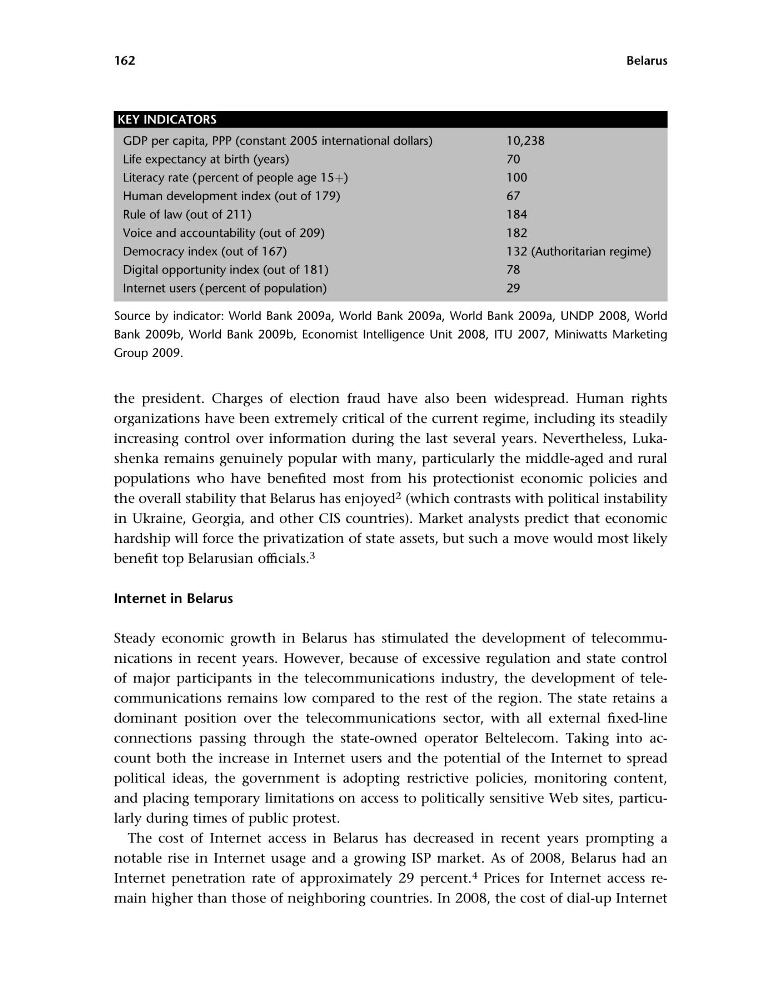
KEY INDICATORS
GDP per capita, PPP (constant 2005 international dollars)
10,238
Life expectancy at birth (years)
70
Literacy rate (percent of people age 15þ)
100
Human development index (out of 179)
67
Rule of law (out of 211)
184
Voice and accountability (out of 209)
182
Democracy index (out of 167)
132 (Authoritarian regime)
Digital opportunity index (out of 181)
78
Internet users (percent of population)
29
Source by indicator: World Bank 2009a, World Bank 2009a, World Bank 2009a, UNDP 2008, World
Bank 2009b, World Bank 2009b, Economist Intelligence Unit 2008, ITU 2007, Miniwatts Marketing
Group 2009.
162
Belarus
organizations have been extremely critical of the current regime, including its steadily
increasing control over information during the last several years. Nevertheless, Lukashenka remains genuinely popular with many, particularly the middle-aged and rural
populations who have benefited most from his protectionist economic policies and
the overall stability that Belarus has enjoyed 2 (which contrasts with political instability
in Ukraine, Georgia, and other CIS countries). Market analysts predict that economic
hardship will force the privatization of state assets, but such a move would most likely
benefit top Belarusian officials. 3
Internet in Belarus
Steady economic growth in Belarus has stimulated the development of telecommunications in recent years. However, because of excessive regulation and state control
of major participants in the telecommunications industry, the development of telecommunications remains low compared to the rest of the region. The state retains a
dominant position over the telecommunications sector, with all external fixed-line
connections passing through the state-owned operator Beltelecom. Taking into account both the increase in Internet users and the potential of the Internet to spread
political ideas, the government is adopting restrictive policies, monitoring content,
and placing temporary limitations on access to politically sensitive Web sites, particularly during times of public protest.
The cost of Internet access in Belarus has decreased in recent years prompting a
notable rise in Internet usage and a growing ISP market. As of 2008, Belarus had an
Internet penetration rate of approximately 29 percent. 4 Prices for Internet access remain higher than those of neighboring countries. In 2008, the cost of dial-up Internet
KEY INDICATORS
GDP per capita, PPP (constant 2005 international dollars)
10,238
Life expectancy at birth (years)
70
Literacy rate (percent of people age 15þ)
100
Human development index (out of 179)
67
Rule of law (out of 211)
184
Voice and accountability (out of 209)
182
Democracy index (out of 167)
132 (Authoritarian regime)
Digital opportunity index (out of 181)
78
Internet users (percent of population)
29
Source by indicator: World Bank 2009a, World Bank 2009a, World Bank 2009a, UNDP 2008, World
Bank 2009b, World Bank 2009b, Economist Intelligence Unit 2008, ITU 2007, Miniwatts Marketing
Group 2009.
162
Belarus