

The Struggle for Digital Freedom of Speech
55
ally, these unaffi liated bloggers located the original undoctored photograph from a
newspaper clipping, concluding the debate over its authenticity.
Synthesis The fi nal stage of peer production in the blogosphere lies in synthesizing the
material into blog posts. The stability of this stage depends on bloggers abiding by the
norms of verifi cation and the expectation of bias. Additionally, the concrete norm of
granularity and heterogeneity is triggered at this stage, when bloggers delve into as
much depth as they want on a particular topic or take a particular spin on it. Note also
the continuing responsibility of bloggers to monitor comments and remove racist slurs.
Cycling back to the two questions I asked at the outset of this discussion (How does
the Malaysian sociopolitical blogosphere successfully coordinate pushback against
linear, unidirectional regulatory attempts and fulfi ll the wider roles ascribed to it?),
we must recall the relevant baseline. The Malaysian mainstream media suffer two
major weaknesses; they are heavily censored and are divided by language. Unlike the
mainstream media, the blogosphere emerged free from licensing regimes and thus has
not been forced to adopt a similarly strong norm of self-censorship. Also, while multilingual columns in Malaysian daily papers are rare, a majority of the top Malaysian
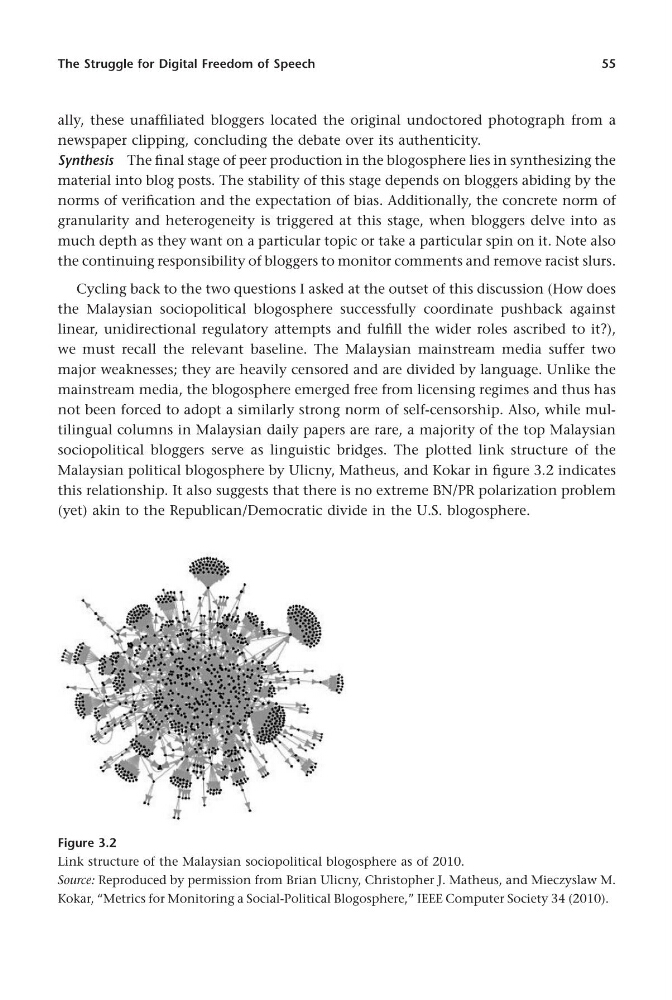
sociopolitical bloggers serve as linguistic bridges. The plotted link structure of the
Malaysian political blogosphere by Ulicny, Matheus, and Kokar in fi gure 3.2 indicates
this relationship. It also suggests that there is no extreme BN/PR polarization problem
(yet) akin to the Republican/Democratic divide in the U.S. blogosphere.
Figure 3.2
Link structure of the Malaysian sociopolitical blogosphere as of 2010.
Source: Reproduced by permission from Brian Ulicny, Christopher J. Matheus, and Mieczyslaw M.
Kokar, “ Metrics for Monitoring a Social-Political Blogosphere, ” IEEE Computer Society 34 (2010).
55
ally, these unaffi liated bloggers located the original undoctored photograph from a
newspaper clipping, concluding the debate over its authenticity.
Synthesis The fi nal stage of peer production in the blogosphere lies in synthesizing the
material into blog posts. The stability of this stage depends on bloggers abiding by the
norms of verifi cation and the expectation of bias. Additionally, the concrete norm of
granularity and heterogeneity is triggered at this stage, when bloggers delve into as
much depth as they want on a particular topic or take a particular spin on it. Note also
the continuing responsibility of bloggers to monitor comments and remove racist slurs.
Cycling back to the two questions I asked at the outset of this discussion (How does
the Malaysian sociopolitical blogosphere successfully coordinate pushback against
linear, unidirectional regulatory attempts and fulfi ll the wider roles ascribed to it?),
we must recall the relevant baseline. The Malaysian mainstream media suffer two
major weaknesses; they are heavily censored and are divided by language. Unlike the
mainstream media, the blogosphere emerged free from licensing regimes and thus has
not been forced to adopt a similarly strong norm of self-censorship. Also, while multilingual columns in Malaysian daily papers are rare, a majority of the top Malaysian
sociopolitical bloggers serve as linguistic bridges. The plotted link structure of the
Malaysian political blogosphere by Ulicny, Matheus, and Kokar in fi gure 3.2 indicates
this relationship. It also suggests that there is no extreme BN/PR polarization problem
(yet) akin to the Republican/Democratic divide in the U.S. blogosphere.
Figure 3.2
Link structure of the Malaysian sociopolitical blogosphere as of 2010.
Source: Reproduced by permission from Brian Ulicny, Christopher J. Matheus, and Mieczyslaw M.
Kokar, “ Metrics for Monitoring a Social-Political Blogosphere, ” IEEE Computer Society 34 (2010).