

386
Vietnam
Background
Vietnam is a one-party state governed by the Communist Party of Vietnam. The party
does not maintain a strict adherence to ideological orthodoxy.
1 Today, Vietnam is
making a transition from a centrally planned economy to a market-oriented mixed
economy. Since opening up its economy there has been an increased socioeconomic
gap, which the government sees as a potential source of political instability.
2 The party
maintains a tight grip on the Internet and information fl ows, and is sensitive to
content that can cause social instability.
As a part of the country ’ s development project, the government is promoting information and communication technologies (ICTs) and e-commerce. The government ’ s
commitment to ICTs can be seen in the country ’ s Master Plan for ICT Development
for 2005 – 2010, the creation of a National Steering Committee for ICT, and the creation
of the Ministry of Information and Communication. However, the Communist Party
of Vietnam sees the Internet as a threat to stability and actively seeks to monitor
Internet content. After a period of relative openness and tolerance of independent
voices and criticism in 2006 when liberal publications were established, the government clamped down on what it considers unlawful usage of the Internet. Because the
ICT sector in Vietnam is changing constantly, it is diffi cult to describe the situation
“ on the ground ” with complete accuracy.
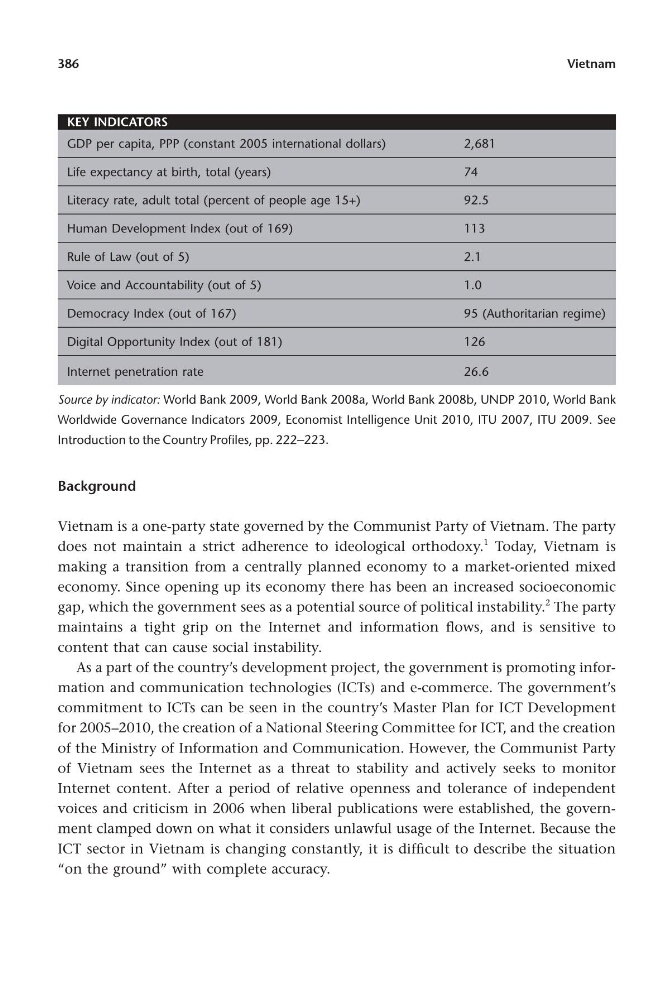
KEY INDICATORS
GDP per capita, PPP (constant 2005 international dollars)
2,681
Life expectancy at birth, total (years)
74
Literacy rate, adult total (percent of people age 15+)
92.5
Human Development Index (out of 169)
113
Rule of Law (out of 5)
2.1
Voice and Accountability (out of 5)
1.0
Democracy Index (out of 167)
95 (Authoritarian regime)
Digital Opportunity Index (out of 181)
126
Internet penetration rate
26.6
Source by indicator: World Bank 2009, World Bank 2008a, World Bank 2008b, UNDP 2010, World Bank
Worldwide Governance Indicators 2009, Economist Intelligence Unit 2010, ITU 2007, ITU 2009. See
Introduction to the Country Profi les, pp. 222 – 223.
Vietnam
Background
Vietnam is a one-party state governed by the Communist Party of Vietnam. The party
does not maintain a strict adherence to ideological orthodoxy.
1 Today, Vietnam is
making a transition from a centrally planned economy to a market-oriented mixed
economy. Since opening up its economy there has been an increased socioeconomic
gap, which the government sees as a potential source of political instability.
2 The party
maintains a tight grip on the Internet and information fl ows, and is sensitive to
content that can cause social instability.
As a part of the country ’ s development project, the government is promoting information and communication technologies (ICTs) and e-commerce. The government ’ s
commitment to ICTs can be seen in the country ’ s Master Plan for ICT Development
for 2005 – 2010, the creation of a National Steering Committee for ICT, and the creation
of the Ministry of Information and Communication. However, the Communist Party
of Vietnam sees the Internet as a threat to stability and actively seeks to monitor
Internet content. After a period of relative openness and tolerance of independent
voices and criticism in 2006 when liberal publications were established, the government clamped down on what it considers unlawful usage of the Internet. Because the
ICT sector in Vietnam is changing constantly, it is diffi cult to describe the situation
“ on the ground ” with complete accuracy.
KEY INDICATORS
GDP per capita, PPP (constant 2005 international dollars)
2,681
Life expectancy at birth, total (years)
74
Literacy rate, adult total (percent of people age 15+)
92.5
Human Development Index (out of 169)
113
Rule of Law (out of 5)
2.1
Voice and Accountability (out of 5)
1.0
Democracy Index (out of 167)
95 (Authoritarian regime)
Digital Opportunity Index (out of 181)
126
Internet penetration rate
26.6
Source by indicator: World Bank 2009, World Bank 2008a, World Bank 2008b, UNDP 2010, World Bank
Worldwide Governance Indicators 2009, Economist Intelligence Unit 2010, ITU 2007, ITU 2009. See
Introduction to the Country Profi les, pp. 222 – 223.