

372
Thailand
Background
Thai politics, long famous for coups and military dominance, shifted course in 2001
with the emergence of a single-party civilian government led by Prime Minister Thaksin
Shinawatra and his Thai Rak Thai (TRT) Party. The TRT Party won landslide victories
in two general elections in 2001 and 2005, becoming the second party in 73 years to
form a single-party government. Thaksin, a former telecommunications tycoon who
made his fortune from monopoly government concessions, was also the fi rst prime
minister to have completed a full four-year term in offi ce. Despite his popularity,
Thaksin is widely criticized for his authoritarian traits, outspokenness, and confl ict of
interest over his family business — Shin Corporation. A deal to sell a major stake in
Shin Corporation to an investment fi rm owned by the Singaporean government mobilized a large number of the urban middle class to rally for Thaksin ’ s resignation,
1
culminating in the formation of a royalist anti-Thaksin movement called the People ’ s
Alliance for Democracy (PAD), or the “ yellow shirts. ” This public anger and protest
was a prelude to the military coup that toppled Thaksin on September 19, 2006.
2
Years of political turmoil followed the coup, and Thailand ’ s political situation
remains volatile. The rift between the United Front for Democracy against Dictatorship
(UDD), or the “ red shirts, ” which supports the ousted Thaksin, and the Yellow Shirts
has deepened into a social divide. The opposing forces have become a refl ection of
the clash between an urban middle class on one side and the rural poor on the other.
3
Demands by the UDD for fresh elections resulted in a series of protests in Bangkok,
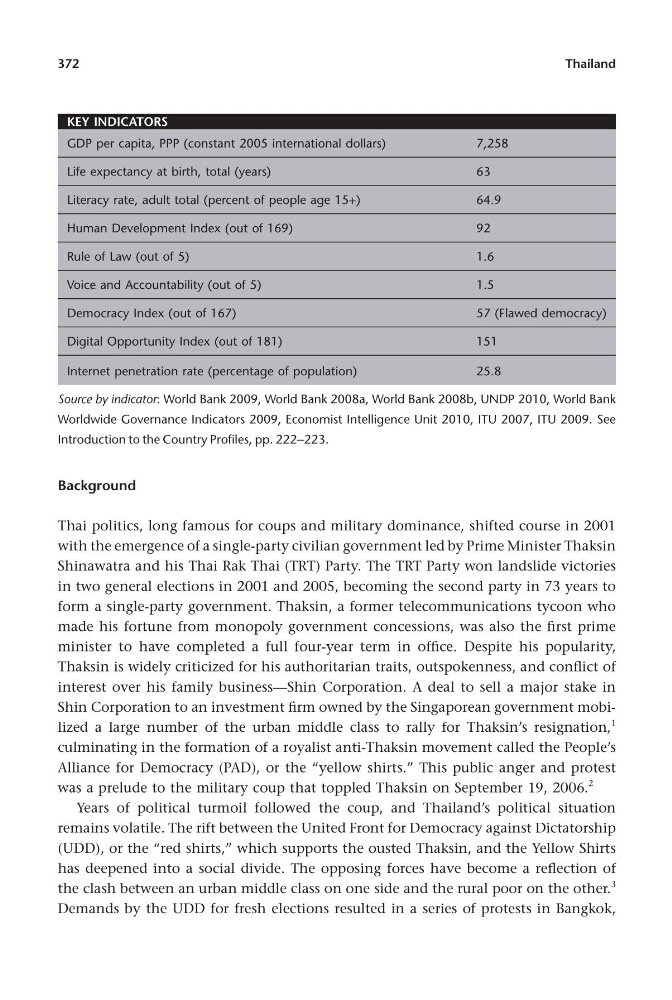
KEY INDICATORS
GDP per capita, PPP (constant 2005 international dollars)
7,258
Life expectancy at birth, total (years)
63
Literacy rate, adult total (percent of people age 15+)
64.9
Human Development Index (out of 169)
92
Rule of Law (out of 5)
1.6
Voice and Accountability (out of 5)
1.5
Democracy Index (out of 167)
57 (Flawed democracy)
Digital Opportunity Index (out of 181)
151
Internet penetration rate (percentage of population)
25.8
Source by indicator : World Bank 2009, World Bank 2008a, World Bank 2008b, UNDP 2010, World Bank
Worldwide Governance Indicators 2009, Economist Intelligence Unit 2010, ITU 2007, ITU 2009. See
Introduction to the Country Profi les, pp. 222 – 223.
Thailand
Background
Thai politics, long famous for coups and military dominance, shifted course in 2001
with the emergence of a single-party civilian government led by Prime Minister Thaksin
Shinawatra and his Thai Rak Thai (TRT) Party. The TRT Party won landslide victories
in two general elections in 2001 and 2005, becoming the second party in 73 years to
form a single-party government. Thaksin, a former telecommunications tycoon who
made his fortune from monopoly government concessions, was also the fi rst prime
minister to have completed a full four-year term in offi ce. Despite his popularity,
Thaksin is widely criticized for his authoritarian traits, outspokenness, and confl ict of
interest over his family business — Shin Corporation. A deal to sell a major stake in
Shin Corporation to an investment fi rm owned by the Singaporean government mobilized a large number of the urban middle class to rally for Thaksin ’ s resignation,
1
culminating in the formation of a royalist anti-Thaksin movement called the People ’ s
Alliance for Democracy (PAD), or the “ yellow shirts. ” This public anger and protest
was a prelude to the military coup that toppled Thaksin on September 19, 2006.
2
Years of political turmoil followed the coup, and Thailand ’ s political situation
remains volatile. The rift between the United Front for Democracy against Dictatorship
(UDD), or the “ red shirts, ” which supports the ousted Thaksin, and the Yellow Shirts
has deepened into a social divide. The opposing forces have become a refl ection of
the clash between an urban middle class on one side and the rural poor on the other.
3
Demands by the UDD for fresh elections resulted in a series of protests in Bangkok,
KEY INDICATORS
GDP per capita, PPP (constant 2005 international dollars)
7,258
Life expectancy at birth, total (years)
63
Literacy rate, adult total (percent of people age 15+)
64.9
Human Development Index (out of 169)
92
Rule of Law (out of 5)
1.6
Voice and Accountability (out of 5)
1.5
Democracy Index (out of 167)
57 (Flawed democracy)
Digital Opportunity Index (out of 181)
151
Internet penetration rate (percentage of population)
25.8
Source by indicator : World Bank 2009, World Bank 2008a, World Bank 2008b, UNDP 2010, World Bank
Worldwide Governance Indicators 2009, Economist Intelligence Unit 2010, ITU 2007, ITU 2009. See
Introduction to the Country Profi les, pp. 222 – 223.