

352
South Korea
Background
The Republic of Korea (commonly referred to as South Korea) was established in 1948
and spent most of its fi rst four decades under authoritarian rule. In response to massive
protests in 1987, the government eventually enacted a democratic constitution that
has endured to this day. South Korea has become one of the most vibrant democracies
in the eastern hemisphere, and its human rights record has markedly improved since
the 1990s. Today, South Korean citizens enjoy universal suffrage and broad constitutional freedoms, and they choose their leaders in free and fair multiparty elections.
The diplomatic policies of South Korea are heavily infl uenced by its relationship
with the Democratic People ’ s Republic of Korea (commonly referred to as North
Korea). South Korea has been technically at war since the two sides fought to a stalemate in 1953. Since then the government has often been intolerant of dissident views,
particularly from supporters of communism or of North Korea.
1 The National Security
Law (NSL) is the epitome of the government ’ s stance — thousands of South Koreans
have been arrested under the anticommunist law since its enactment in 1948.
2
Although prosecutions under the NSL have signifi cantly decreased since the late 20th
century, there have been a few recent high-profi le investigations using the law. At the
start of the 21st century, South Korea attempted a new policy of engagement with
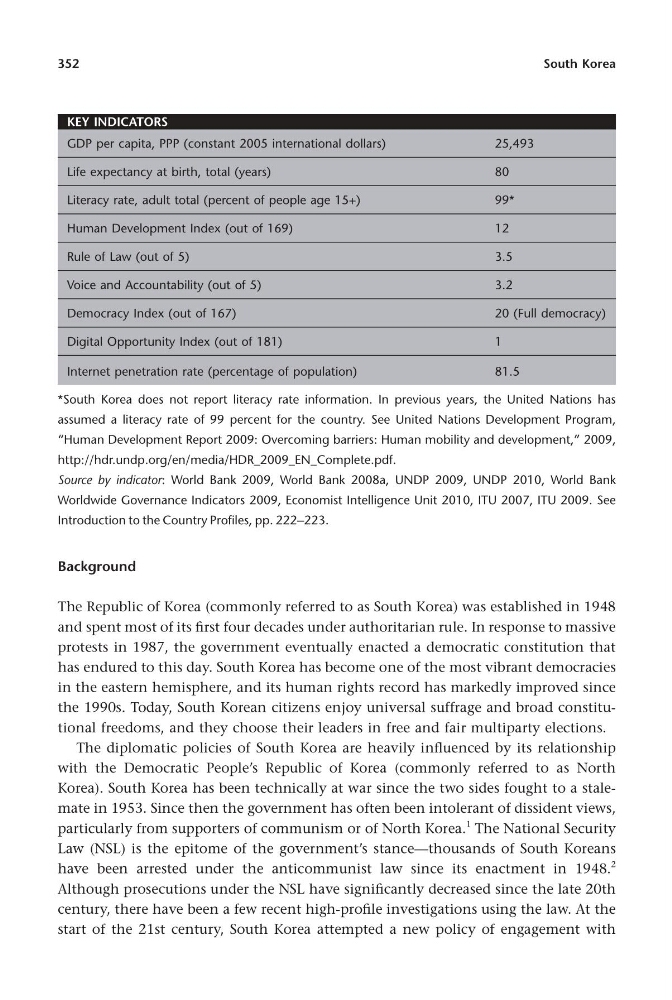
KEY INDICATORS
GDP per capita, PPP (constant 2005 international dollars)
25,493
Life expectancy at birth, total (years)
80
Literacy rate, adult total (percent of people age 15+)
99*
Human Development Index (out of 169)
12
Rule of Law (out of 5)
3.5
Voice and Accountability (out of 5)
3.2
Democracy Index (out of 167)
20 (Full democracy)
Digital Opportunity Index (out of 181)
1
Internet penetration rate (percentage of population)
81.5
*South Korea does not report literacy rate information. In previous years, the United Nations has
assumed a literacy rate of 99 percent for the country. See United Nations Development Program,
“ Human Development Report 2009: Overcoming barriers: Human mobility and development, ” 2009,
http://hdr.undp.org/en/media/HDR_2009_EN_Complete.pdf .
Source by indicator : World Bank 2009, World Bank 2008a, UNDP 2009, UNDP 2010, World Bank
Worldwide Governance Indicators 2009, Economist Intelligence Unit 2010, ITU 2007, ITU 2009. See
Introduction to the Country Profi les, pp. 222 – 223.
South Korea
Background
The Republic of Korea (commonly referred to as South Korea) was established in 1948
and spent most of its fi rst four decades under authoritarian rule. In response to massive
protests in 1987, the government eventually enacted a democratic constitution that
has endured to this day. South Korea has become one of the most vibrant democracies
in the eastern hemisphere, and its human rights record has markedly improved since
the 1990s. Today, South Korean citizens enjoy universal suffrage and broad constitutional freedoms, and they choose their leaders in free and fair multiparty elections.
The diplomatic policies of South Korea are heavily infl uenced by its relationship
with the Democratic People ’ s Republic of Korea (commonly referred to as North
Korea). South Korea has been technically at war since the two sides fought to a stalemate in 1953. Since then the government has often been intolerant of dissident views,
particularly from supporters of communism or of North Korea.
1 The National Security
Law (NSL) is the epitome of the government ’ s stance — thousands of South Koreans
have been arrested under the anticommunist law since its enactment in 1948.
2
Although prosecutions under the NSL have signifi cantly decreased since the late 20th
century, there have been a few recent high-profi le investigations using the law. At the
start of the 21st century, South Korea attempted a new policy of engagement with
KEY INDICATORS
GDP per capita, PPP (constant 2005 international dollars)
25,493
Life expectancy at birth, total (years)
80
Literacy rate, adult total (percent of people age 15+)
99*
Human Development Index (out of 169)
12
Rule of Law (out of 5)
3.5
Voice and Accountability (out of 5)
3.2
Democracy Index (out of 167)
20 (Full democracy)
Digital Opportunity Index (out of 181)
1
Internet penetration rate (percentage of population)
81.5
*South Korea does not report literacy rate information. In previous years, the United Nations has
assumed a literacy rate of 99 percent for the country. See United Nations Development Program,
“ Human Development Report 2009: Overcoming barriers: Human mobility and development, ” 2009,
http://hdr.undp.org/en/media/HDR_2009_EN_Complete.pdf .
Source by indicator : World Bank 2009, World Bank 2008a, UNDP 2009, UNDP 2010, World Bank
Worldwide Governance Indicators 2009, Economist Intelligence Unit 2010, ITU 2007, ITU 2009. See
Introduction to the Country Profi les, pp. 222 – 223.