

340
Pakistan
Background
Under General Pervez Musharraf ’ s leadership (1999 – 2008), print and electronic media
were often censored in cases where content was deemed to be antigovernment or
anti-Islam. Government repression of media was particularly acute with regard to
Baluchi and Sindhi political autonomy, as well as with content considered blasphemous or subversive.
In October 2007, Musharraf won an indirect, widely boycotted presidential election
held while his two major political opponents were in exile.
1 Musharraf ’ s eligibility to
serve as president while still serving as army chief was challenged in court, to which
Musharraf responded by suspending the constitution and placing the country under
a state of emergency on November 3, 2007 — shutting down all privately owned television and media outlets, arresting lawyers and judges, and jamming cell phone and
Internet connections.
2 On August 18, 2008, Musharraf resigned from the presidency
in order to avoid impeachment.
3 Elections were held on September 6, 2008, and Asif
Ali Zardari, the husband of assassinated Pakistan People ’ s Party (PPP) chair Benazir
Bhutto, was elected Pakistan ’ s new president.
4
Pakistan is home to a vibrant civil society, including a large movement opposing
and monitoring Internet and other censorship.
5 International human rights groups
frequently report on persecution of journalists at the hands of Pakistani military and
extremist groups. According to the Committee to Protect Journalists, at least fi ve
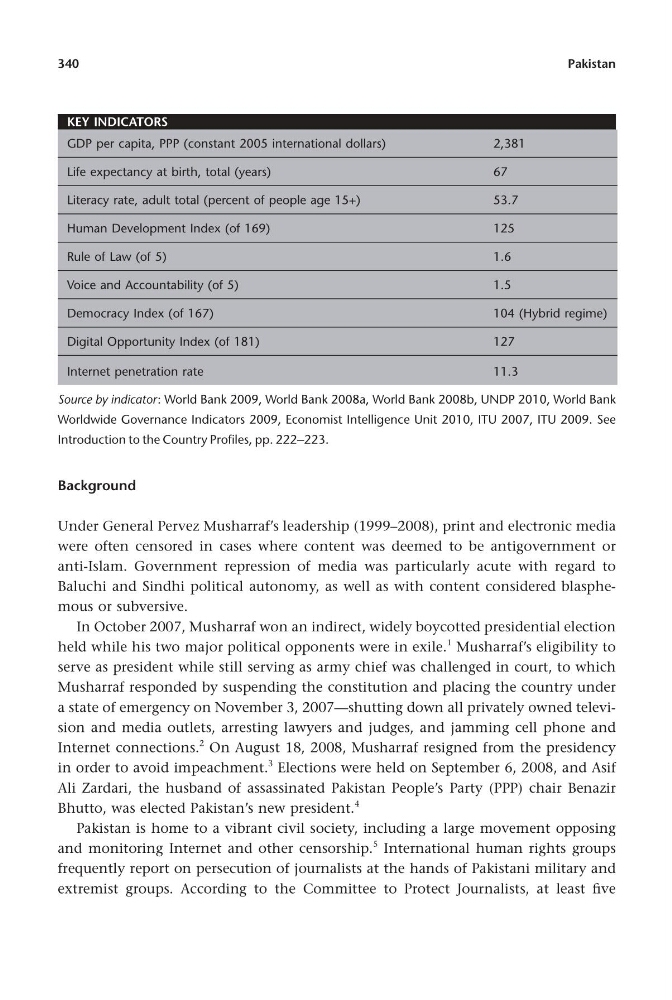
KEY INDICATORS
GDP per capita, PPP (constant 2005 international dollars)
2,381
Life expectancy at birth, total (years)
67
Literacy rate, adult total (percent of people age 15+)
53.7
Human Development Index (of 169)
125
Rule of Law (of 5)
1.6
Voice and Accountability (of 5)
1.5
Democracy Index (of 167)
104 (Hybrid regime)
Digital Opportunity Index (of 181)
127
Internet penetration rate
11.3
Source by indicator : World Bank 2009, World Bank 2008a, World Bank 2008b, UNDP 2010, World Bank
Worldwide Governance Indicators 2009, Economist Intelligence Unit 2010, ITU 2007, ITU 2009. See
Introduction to the Country Profi les, pp. 222 – 223.
Pakistan
Background
Under General Pervez Musharraf ’ s leadership (1999 – 2008), print and electronic media
were often censored in cases where content was deemed to be antigovernment or
anti-Islam. Government repression of media was particularly acute with regard to
Baluchi and Sindhi political autonomy, as well as with content considered blasphemous or subversive.
In October 2007, Musharraf won an indirect, widely boycotted presidential election
held while his two major political opponents were in exile.
1 Musharraf ’ s eligibility to
serve as president while still serving as army chief was challenged in court, to which
Musharraf responded by suspending the constitution and placing the country under
a state of emergency on November 3, 2007 — shutting down all privately owned television and media outlets, arresting lawyers and judges, and jamming cell phone and
Internet connections.
2 On August 18, 2008, Musharraf resigned from the presidency
in order to avoid impeachment.
3 Elections were held on September 6, 2008, and Asif
Ali Zardari, the husband of assassinated Pakistan People ’ s Party (PPP) chair Benazir
Bhutto, was elected Pakistan ’ s new president.
4
Pakistan is home to a vibrant civil society, including a large movement opposing
and monitoring Internet and other censorship.
5 International human rights groups
frequently report on persecution of journalists at the hands of Pakistani military and
extremist groups. According to the Committee to Protect Journalists, at least fi ve
KEY INDICATORS
GDP per capita, PPP (constant 2005 international dollars)
2,381
Life expectancy at birth, total (years)
67
Literacy rate, adult total (percent of people age 15+)
53.7
Human Development Index (of 169)
125
Rule of Law (of 5)
1.6
Voice and Accountability (of 5)
1.5
Democracy Index (of 167)
104 (Hybrid regime)
Digital Opportunity Index (of 181)
127
Internet penetration rate
11.3
Source by indicator : World Bank 2009, World Bank 2008a, World Bank 2008b, UNDP 2010, World Bank
Worldwide Governance Indicators 2009, Economist Intelligence Unit 2010, ITU 2007, ITU 2009. See
Introduction to the Country Profi les, pp. 222 – 223.