

310
Indonesia
Background
The Asian Financial Crisis of 1997 – 1998 had a major effect on Indonesia ’ s economy —
the drying up of foreign direct investment, the collapse of the rupiah, mass unemployment, and rising infl ation brought about major socioeconomic problems. Citizens
demonstrated their discontent through major uprisings, which eventually led to the
resignation of General Suharto in May 1998 and the end of three decades of United
States – backed authoritarian rule.
1 Under Suharto, Indonesia was known as one of the
“ Asian Tigers ” for its strong economic growth (with an annual average growth rate of 8
percent in the last decade of his regime).
2 However, government policies exacerbated
socioeconomic cleavages and inequalities, and created tensions that were suppressed
through repressive military measures.
3 The majority of people were excluded from
political life in a climate in which social confl ict, corruption, and repression of dissent
were widespread. Some analysts suggest that although the fi nancial crisis was the catalyst that triggered the breaking point of Suharto ’ s rule, it was not the underlying cause.
4
The end of the Suharto regime marked the beginning of rapid change and democratization in Indonesia. Although social unrest, separatist movements, corruption,
terrorism, and political and economic instability hindered progress initially, conditions have since improved. The country experienced its fi rst free parliamentary election in 1999 and its fi rst directed presidential election in 2004.
One important outcome of democratization is the relative press freedom that
Indonesian media and citizens enjoy today. However, although freedom of speech
and of the press are protected by the constitution and Indonesia ’ s press is considered
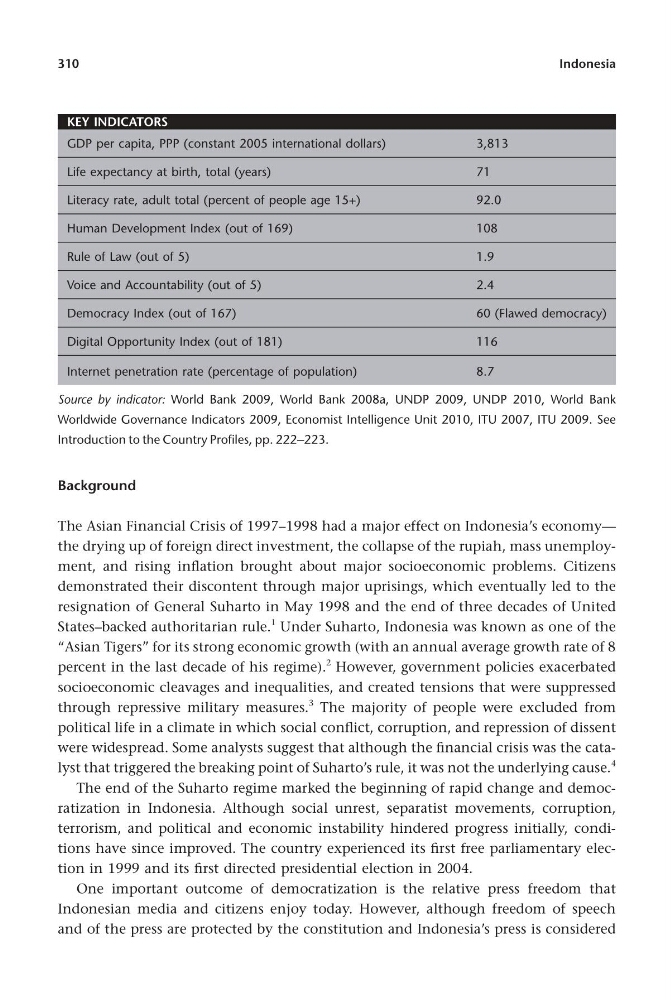
KEY INDICATORS
GDP per capita, PPP (constant 2005 international dollars)
3,813
Life expectancy at birth, total (years)
71
Literacy rate, adult total (percent of people age 15+)
92.0
Human Development Index (out of 169)
108
Rule of Law (out of 5)
1.9
Voice and Accountability (out of 5)
2.4
Democracy Index (out of 167)
60 (Flawed democracy)
Digital Opportunity Index (out of 181)
116
Internet penetration rate (percentage of population)
8.7
Source by indicator: World Bank 2009, World Bank 2008a, UNDP 2009, UNDP 2010, World Bank
Worldwide Governance Indicators 2009, Economist Intelligence Unit 2010, ITU 2007, ITU 2009. See
Introduction to the Country Profi les, pp. 222 – 223.
Indonesia
Background
The Asian Financial Crisis of 1997 – 1998 had a major effect on Indonesia ’ s economy —
the drying up of foreign direct investment, the collapse of the rupiah, mass unemployment, and rising infl ation brought about major socioeconomic problems. Citizens
demonstrated their discontent through major uprisings, which eventually led to the
resignation of General Suharto in May 1998 and the end of three decades of United
States – backed authoritarian rule.
1 Under Suharto, Indonesia was known as one of the
“ Asian Tigers ” for its strong economic growth (with an annual average growth rate of 8
percent in the last decade of his regime).
2 However, government policies exacerbated
socioeconomic cleavages and inequalities, and created tensions that were suppressed
through repressive military measures.
3 The majority of people were excluded from
political life in a climate in which social confl ict, corruption, and repression of dissent
were widespread. Some analysts suggest that although the fi nancial crisis was the catalyst that triggered the breaking point of Suharto ’ s rule, it was not the underlying cause.
4
The end of the Suharto regime marked the beginning of rapid change and democratization in Indonesia. Although social unrest, separatist movements, corruption,
terrorism, and political and economic instability hindered progress initially, conditions have since improved. The country experienced its fi rst free parliamentary election in 1999 and its fi rst directed presidential election in 2004.
One important outcome of democratization is the relative press freedom that
Indonesian media and citizens enjoy today. However, although freedom of speech
and of the press are protected by the constitution and Indonesia ’ s press is considered
KEY INDICATORS
GDP per capita, PPP (constant 2005 international dollars)
3,813
Life expectancy at birth, total (years)
71
Literacy rate, adult total (percent of people age 15+)
92.0
Human Development Index (out of 169)
108
Rule of Law (out of 5)
1.9
Voice and Accountability (out of 5)
2.4
Democracy Index (out of 167)
60 (Flawed democracy)
Digital Opportunity Index (out of 181)
116
Internet penetration rate (percentage of population)
8.7
Source by indicator: World Bank 2009, World Bank 2008a, UNDP 2009, UNDP 2010, World Bank
Worldwide Governance Indicators 2009, Economist Intelligence Unit 2010, ITU 2007, ITU 2009. See
Introduction to the Country Profi les, pp. 222 – 223.