

252
Burma
Background
The State Peace and Development Council (SPDC), the military government that
rules the Union of Myanmar, maintains a tight stranglehold on the country ’ s economic and political developments. The government polices Internet content through
one of the most severe regimes of information control in the world. Despite barriers
to access and very low connectivity, however, Internet users in Burma have managed
to communicate valuable information to the outside world during explosive political
events.
On August 19, 2007, precipitating what would become known as the Saffron Revolution, leaders of the 88 Generation student group organized a rally to protest a sudden
sharp increase in fuel prices in Rangoon (Yangon).
1 Because the Burmese spend up to
70 percent of their monthly income on food alone,
2 the fuel-price hikes amid chronic
infl ation — which reached 30 percent in 2006 and 2007 — were untenable.
3 Over the
next month, leadership of the protests passed from former student leaders and a
number of female activists to Buddhist monks, with participation swelling to an estimated crowd of 150,000 protesters on September 23.
4 Throughout the crisis, citizen
journalists and bloggers continued to feed raw, graphic footage and eyewitness
accounts to the outside world through the Internet. The violent crackdown that began
on September 26 ultimately left up to 200 dead,
5 including a Japanese journalist whose
death by gunshot was caught on video.
6 Burmese security forces raided monasteries,
detaining and disrobing thousands of monks. Despite claims by offi cial state media
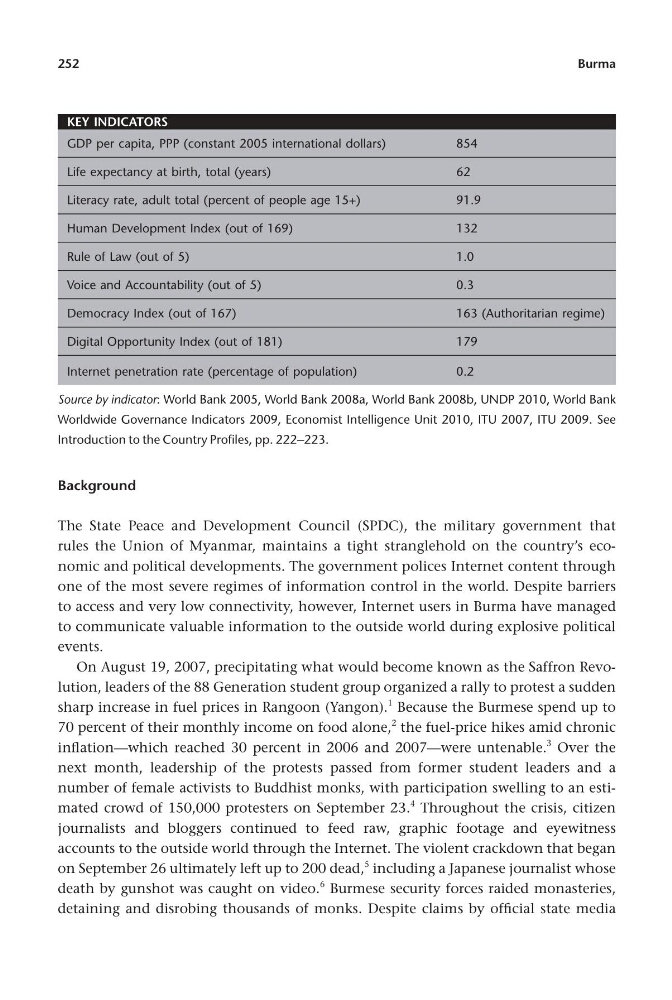
KEY INDICATORS
GDP per capita, PPP (constant 2005 international dollars)
854
Life expectancy at birth, total (years)
62
Literacy rate, adult total (percent of people age 15+)
91.9
Human Development Index (out of 169)
132
Rule of Law (out of 5)
1.0
Voice and Accountability (out of 5)
0.3
Democracy Index (out of 167)
163 (Authoritarian regime)
Digital Opportunity Index (out of 181)
179
Internet penetration rate (percentage of population)
0.2
Source by indicator : World Bank 2005, World Bank 2008a, World Bank 2008b, UNDP 2010, World Bank
Worldwide Governance Indicators 2009, Economist Intelligence Unit 2010, ITU 2007, ITU 2009. See
Introduction to the Country Profi les, pp. 222 – 223.
Burma
Background
The State Peace and Development Council (SPDC), the military government that
rules the Union of Myanmar, maintains a tight stranglehold on the country ’ s economic and political developments. The government polices Internet content through
one of the most severe regimes of information control in the world. Despite barriers
to access and very low connectivity, however, Internet users in Burma have managed
to communicate valuable information to the outside world during explosive political
events.
On August 19, 2007, precipitating what would become known as the Saffron Revolution, leaders of the 88 Generation student group organized a rally to protest a sudden
sharp increase in fuel prices in Rangoon (Yangon).
1 Because the Burmese spend up to
70 percent of their monthly income on food alone,
2 the fuel-price hikes amid chronic
infl ation — which reached 30 percent in 2006 and 2007 — were untenable.
3 Over the
next month, leadership of the protests passed from former student leaders and a
number of female activists to Buddhist monks, with participation swelling to an estimated crowd of 150,000 protesters on September 23.
4 Throughout the crisis, citizen
journalists and bloggers continued to feed raw, graphic footage and eyewitness
accounts to the outside world through the Internet. The violent crackdown that began
on September 26 ultimately left up to 200 dead,
5 including a Japanese journalist whose
death by gunshot was caught on video.
6 Burmese security forces raided monasteries,
detaining and disrobing thousands of monks. Despite claims by offi cial state media
KEY INDICATORS
GDP per capita, PPP (constant 2005 international dollars)
854
Life expectancy at birth, total (years)
62
Literacy rate, adult total (percent of people age 15+)
91.9
Human Development Index (out of 169)
132
Rule of Law (out of 5)
1.0
Voice and Accountability (out of 5)
0.3
Democracy Index (out of 167)
163 (Authoritarian regime)
Digital Opportunity Index (out of 181)
179
Internet penetration rate (percentage of population)
0.2
Source by indicator : World Bank 2005, World Bank 2008a, World Bank 2008b, UNDP 2010, World Bank
Worldwide Governance Indicators 2009, Economist Intelligence Unit 2010, ITU 2007, ITU 2009. See
Introduction to the Country Profi les, pp. 222 – 223.