

242
Bangladesh
Background
The modern Bangladesh state (formerly East Pakistan) was created after the 1971
Bangladesh Liberation War when East Pakistan separated from West Pakistan. Following the independence movement, the new Bangladesh state was governed under military rule. In 1990 it reverted back to a democracy, but remained a volatile state.
In October 2006 a military-backed interim caretaker government was established
in Bangladesh and remained in power until December 2008. On January 11, 2007, the
military government declared a state of emergency and enacted the Special Powers
Act, banning all political activism. Law-enforcement agencies, including the armed
forces and the intelligence agencies, were given the right to preemptively detain
anybody who they felt was going to violate the law. The political situation on the
ground was tense, confrontational, and chaotic. Fundamental human rights were
curtailed during the state of emergency, and at least 319 people died at the hands of
legally constituted forces.
1
The country returned to democratic rule after an alliance led by the Awami League
gained a majority of seats in the December 29, 2008, national election. Since then the
situation in Bangladesh has improved, although there was a brief return to instability
in February 2009 when the Bangladesh Rifl es (BDR), a paramilitary law-enforcement
agency, staged a two-day mutiny over pay and work conditions and killed more than
70 people — primarily offi cers.
2 The BDR surrendered after Prime Minister Sheikh
Hasina sent tanks to surround the force ’ s headquarters in Dhaka.
3
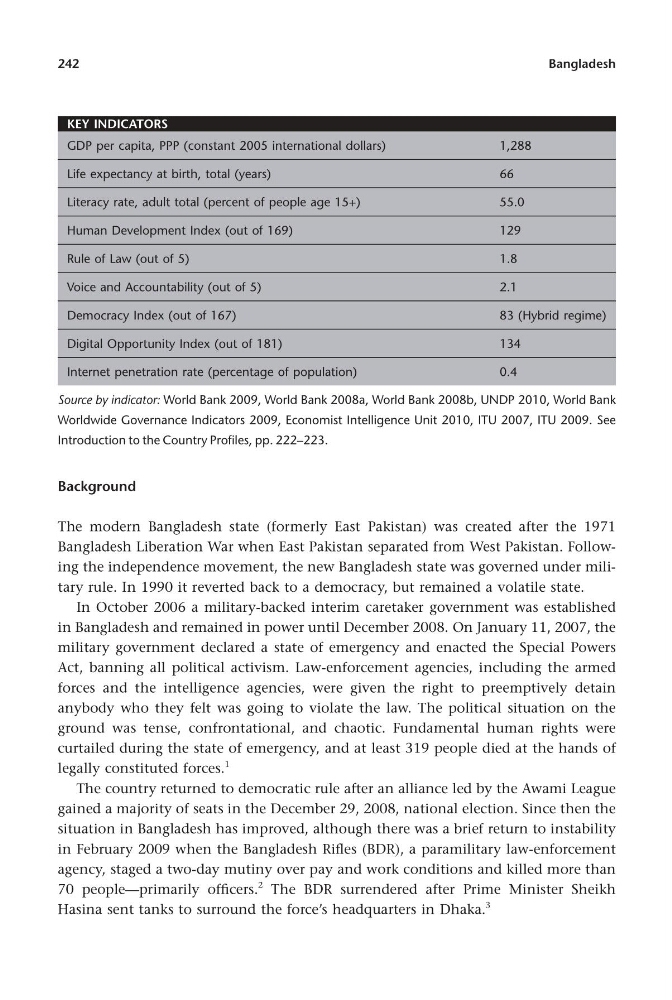
KEY INDICATORS
GDP per capita, PPP (constant 2005 international dollars)
1,288
Life expectancy at birth, total (years)
66
Literacy rate, adult total (percent of people age 15+)
55.0
Human Development Index (out of 169)
129
Rule of Law (out of 5)
1.8
Voice and Accountability (out of 5)
2.1
Democracy Index (out of 167)
83 (Hybrid regime)
Digital Opportunity Index (out of 181)
134
Internet penetration rate (percentage of population)
0.4
Source by indicator: World Bank 2009, World Bank 2008a, World Bank 2008b, UNDP 2010, World Bank
Worldwide Governance Indicators 2009, Economist Intelligence Unit 2010, ITU 2007, ITU 2009. See
Introduction to the Country Profi les, pp. 222 – 223.
Bangladesh
Background
The modern Bangladesh state (formerly East Pakistan) was created after the 1971
Bangladesh Liberation War when East Pakistan separated from West Pakistan. Following the independence movement, the new Bangladesh state was governed under military rule. In 1990 it reverted back to a democracy, but remained a volatile state.
In October 2006 a military-backed interim caretaker government was established
in Bangladesh and remained in power until December 2008. On January 11, 2007, the
military government declared a state of emergency and enacted the Special Powers
Act, banning all political activism. Law-enforcement agencies, including the armed
forces and the intelligence agencies, were given the right to preemptively detain
anybody who they felt was going to violate the law. The political situation on the
ground was tense, confrontational, and chaotic. Fundamental human rights were
curtailed during the state of emergency, and at least 319 people died at the hands of
legally constituted forces.
1
The country returned to democratic rule after an alliance led by the Awami League
gained a majority of seats in the December 29, 2008, national election. Since then the
situation in Bangladesh has improved, although there was a brief return to instability
in February 2009 when the Bangladesh Rifl es (BDR), a paramilitary law-enforcement
agency, staged a two-day mutiny over pay and work conditions and killed more than
70 people — primarily offi cers.
2 The BDR surrendered after Prime Minister Sheikh
Hasina sent tanks to surround the force ’ s headquarters in Dhaka.
3
KEY INDICATORS
GDP per capita, PPP (constant 2005 international dollars)
1,288
Life expectancy at birth, total (years)
66
Literacy rate, adult total (percent of people age 15+)
55.0
Human Development Index (out of 169)
129
Rule of Law (out of 5)
1.8
Voice and Accountability (out of 5)
2.1
Democracy Index (out of 167)
83 (Hybrid regime)
Digital Opportunity Index (out of 181)
134
Internet penetration rate (percentage of population)
0.4
Source by indicator: World Bank 2009, World Bank 2008a, World Bank 2008b, UNDP 2010, World Bank
Worldwide Governance Indicators 2009, Economist Intelligence Unit 2010, ITU 2007, ITU 2009. See
Introduction to the Country Profi les, pp. 222 – 223.