

6. Discussion
The study of EEG signals using empirical mode decomposition (EMD) gives an
insight into the effectiveness of EMD method to analyze EEG signal for seizure
classification. The features (includes four types of entropy features, three types of
fractal dimensions, statistical features and exponential energy) considered in this
work, produces better classification accuracy when it is extracted from decomposed
IMFs.
Empirical mode decomposition method decomposes the signals into various
intrinsic mode functions (IMFs). Since, IMFs carries more detailed information of a
signal, the features extracted from these IMFs leads to better classification.
Similar to EMD, discrete wavelet transformation (DWT) is a method, which
decomposes the signal into various sub-bands [38–40, 42]. Many EEG related
studies used DWT method for various analysis. Li et al. [41] combined DWT
method with envelope analysis for the effective feature extraction to classify epileptic signal. In another work, Kumar et al. [42] extracted fuzzy entropy from the
sub-bands of DWT for seizure detection. Similarly Liu et al. [43], Mohammadi et al.
[44] and Silveira et al. [45] also used DWT method to analyze EEG signals for
various purposes. Though, EMD is more better than the DWT method.
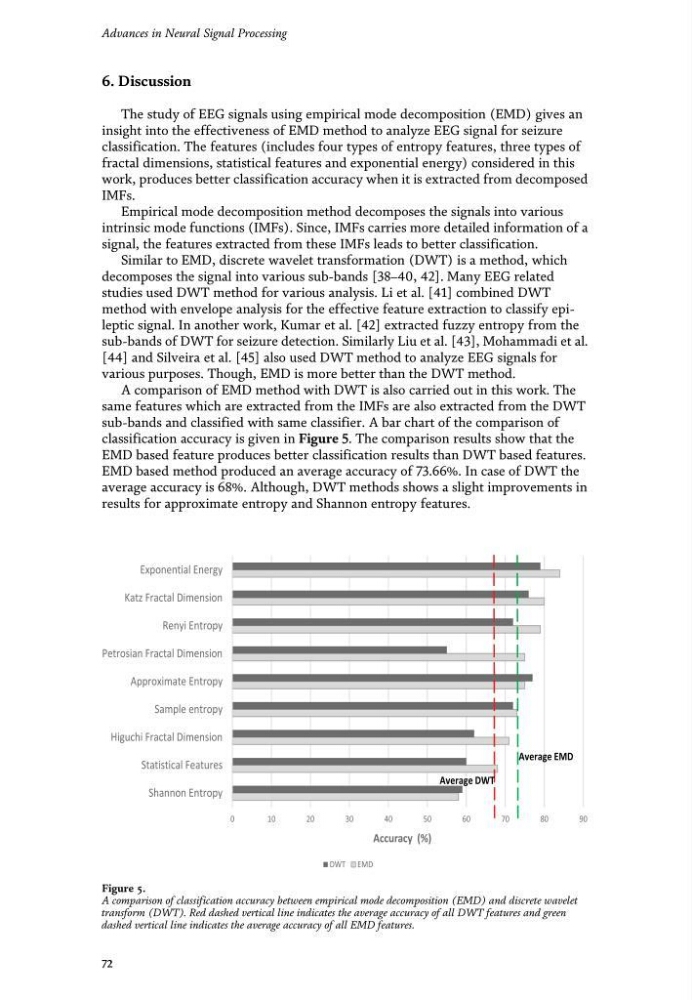
A comparison of EMD method with DWT is also carried out in this work. The
same features which are extracted from the IMFs are also extracted from the DWT
sub-bands and classified with same classifier. A bar chart of the comparison of
classification accuracy is given in Figure 5. The comparison results show that the
EMD based feature produces better classification results than DWT based features.
EMD based method produced an average accuracy of 73.66%. In case of DWT the
average accuracy is 68%. Although, DWT methods shows a slight improvements in
results for approximate entropy and Shannon entropy features.
Figure 5.
A comparison of classification accuracy between empirical mode decomposition (EMD) and discrete wavelet
transform (DWT). Red dashed vertical line indicates the average accuracy of all DWT features and green
dashed vertical line indicates the average accuracy of all EMD features.
72
Advances in Neural Signal Processing
The study of EEG signals using empirical mode decomposition (EMD) gives an
insight into the effectiveness of EMD method to analyze EEG signal for seizure
classification. The features (includes four types of entropy features, three types of
fractal dimensions, statistical features and exponential energy) considered in this
work, produces better classification accuracy when it is extracted from decomposed
IMFs.
Empirical mode decomposition method decomposes the signals into various
intrinsic mode functions (IMFs). Since, IMFs carries more detailed information of a
signal, the features extracted from these IMFs leads to better classification.
Similar to EMD, discrete wavelet transformation (DWT) is a method, which
decomposes the signal into various sub-bands [38–40, 42]. Many EEG related
studies used DWT method for various analysis. Li et al. [41] combined DWT
method with envelope analysis for the effective feature extraction to classify epileptic signal. In another work, Kumar et al. [42] extracted fuzzy entropy from the
sub-bands of DWT for seizure detection. Similarly Liu et al. [43], Mohammadi et al.
[44] and Silveira et al. [45] also used DWT method to analyze EEG signals for
various purposes. Though, EMD is more better than the DWT method.
A comparison of EMD method with DWT is also carried out in this work. The
same features which are extracted from the IMFs are also extracted from the DWT
sub-bands and classified with same classifier. A bar chart of the comparison of
classification accuracy is given in Figure 5. The comparison results show that the
EMD based feature produces better classification results than DWT based features.
EMD based method produced an average accuracy of 73.66%. In case of DWT the
average accuracy is 68%. Although, DWT methods shows a slight improvements in
results for approximate entropy and Shannon entropy features.
Figure 5.
A comparison of classification accuracy between empirical mode decomposition (EMD) and discrete wavelet
transform (DWT). Red dashed vertical line indicates the average accuracy of all DWT features and green
dashed vertical line indicates the average accuracy of all EMD features.
72
Advances in Neural Signal Processing