

4. Check whether d(t) is satisfying the IMFs basic conditions. Repeat step 1 to 3
until d(t) satisfying the IMFs conditions.
5. if d(t) satisfies IMFs condition once, define the first IMF as IMF 1 = d(t).
6. The next IMFs can be obtained by generating residue r(t) as rt ðÞ¼xt ðÞ�IMF 1
and use these residue as the original data for the next iteration.
7. Iteration will stop when final residue is a function which cannot produce any
more IMFs or final residue is constant/monotonic function.
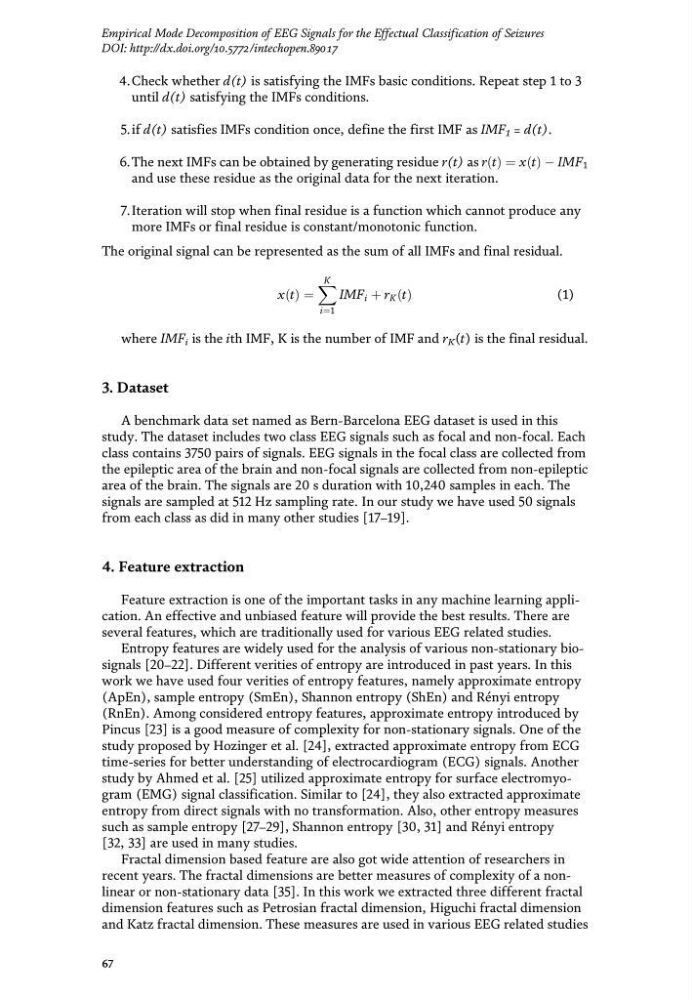
The original signal can be represented as the sum of all IMFs and final residual.
xt ðÞ¼
X K
i¼1
IMF i þ r K t
ðÞ
(1)
where IMF i is the ith IMF, K is the number of IMF and r K (t) is the final residual.
3. Dataset
A benchmark data set named as Bern-Barcelona EEG dataset is used in this
study. The dataset includes two class EEG signals such as focal and non-focal. Each
class contains 3750 pairs of signals. EEG signals in the focal class are collected from
the epileptic area of the brain and non-focal signals are collected from non-epileptic
area of the brain. The signals are 20 s duration with 10,240 samples in each. The
signals are sampled at 512 Hz sampling rate. In our study we have used 50 signals
from each class as did in many other studies [17–19].
4. Feature extraction
Feature extraction is one of the important tasks in any machine learning application. An effective and unbiased feature will provide the best results. There are
several features, which are traditionally used for various EEG related studies.
Entropy features are widely used for the analysis of various non-stationary biosignals [20–22]. Different verities of entropy are introduced in past years. In this
work we have used four verities of entropy features, namely approximate entropy
(ApEn), sample entropy (SmEn), Shannon entropy (ShEn) and Rényi entropy
(RnEn). Among considered entropy features, approximate entropy introduced by
Pincus [23] is a good measure of complexity for non-stationary signals. One of the
study proposed by Hozinger et al. [24], extracted approximate entropy from ECG
time-series for better understanding of electrocardiogram (ECG) signals. Another
study by Ahmed et al. [25] utilized approximate entropy for surface electromyogram (EMG) signal classification. Similar to [24], they also extracted approximate
entropy from direct signals with no transformation. Also, other entropy measures
such as sample entropy [27–29], Shannon entropy [30, 31] and Rényi entropy
[32, 33] are used in many studies.
Fractal dimension based feature are also got wide attention of researchers in
recent years. The fractal dimensions are better measures of complexity of a nonlinear or non-stationary data [35]. In this work we extracted three different fractal
dimension features such as Petrosian fractal dimension, Higuchi fractal dimension
and Katz fractal dimension. These measures are used in various EEG related studies
67
Empirical Mode Decomposition of EEG Signals for the Effectual Classification of Seizures
DOI: http://dx.doi.org/10.5772/intechopen.89017
until d(t) satisfying the IMFs conditions.
5. if d(t) satisfies IMFs condition once, define the first IMF as IMF 1 = d(t).
6. The next IMFs can be obtained by generating residue r(t) as rt ðÞ¼xt ðÞ�IMF 1
and use these residue as the original data for the next iteration.
7. Iteration will stop when final residue is a function which cannot produce any
more IMFs or final residue is constant/monotonic function.
The original signal can be represented as the sum of all IMFs and final residual.
xt ðÞ¼
X K
i¼1
IMF i þ r K t
ðÞ
(1)
where IMF i is the ith IMF, K is the number of IMF and r K (t) is the final residual.
3. Dataset
A benchmark data set named as Bern-Barcelona EEG dataset is used in this
study. The dataset includes two class EEG signals such as focal and non-focal. Each
class contains 3750 pairs of signals. EEG signals in the focal class are collected from
the epileptic area of the brain and non-focal signals are collected from non-epileptic
area of the brain. The signals are 20 s duration with 10,240 samples in each. The
signals are sampled at 512 Hz sampling rate. In our study we have used 50 signals
from each class as did in many other studies [17–19].
4. Feature extraction
Feature extraction is one of the important tasks in any machine learning application. An effective and unbiased feature will provide the best results. There are
several features, which are traditionally used for various EEG related studies.
Entropy features are widely used for the analysis of various non-stationary biosignals [20–22]. Different verities of entropy are introduced in past years. In this
work we have used four verities of entropy features, namely approximate entropy
(ApEn), sample entropy (SmEn), Shannon entropy (ShEn) and Rényi entropy
(RnEn). Among considered entropy features, approximate entropy introduced by
Pincus [23] is a good measure of complexity for non-stationary signals. One of the
study proposed by Hozinger et al. [24], extracted approximate entropy from ECG
time-series for better understanding of electrocardiogram (ECG) signals. Another
study by Ahmed et al. [25] utilized approximate entropy for surface electromyogram (EMG) signal classification. Similar to [24], they also extracted approximate
entropy from direct signals with no transformation. Also, other entropy measures
such as sample entropy [27–29], Shannon entropy [30, 31] and Rényi entropy
[32, 33] are used in many studies.
Fractal dimension based feature are also got wide attention of researchers in
recent years. The fractal dimensions are better measures of complexity of a nonlinear or non-stationary data [35]. In this work we extracted three different fractal
dimension features such as Petrosian fractal dimension, Higuchi fractal dimension
and Katz fractal dimension. These measures are used in various EEG related studies
67
Empirical Mode Decomposition of EEG Signals for the Effectual Classification of Seizures
DOI: http://dx.doi.org/10.5772/intechopen.89017