

considered in this study was designed to obtain estimates of the dynamic behavior
of the zinc complexes formed with the mentioned mechanisms [12], assuming
previously reported resting and site zinc concentrations and binding constants,
which are summarized in Table 1. The formation of the complexes was triggered by
three assumed types of stimuli, corresponding to single, short, and long release
events, with the maximum and time to peak values, based also on existing experimental findings, indicated in Table 2. In most cases, where the on and off-rate
constants were not known, the dissociation constant K D (or the corresponding IC 50
or EC 50 ) values were considered in the equations. In these cases the complexes were
considered to attain very rapidly the equilibrium concentration, following each free
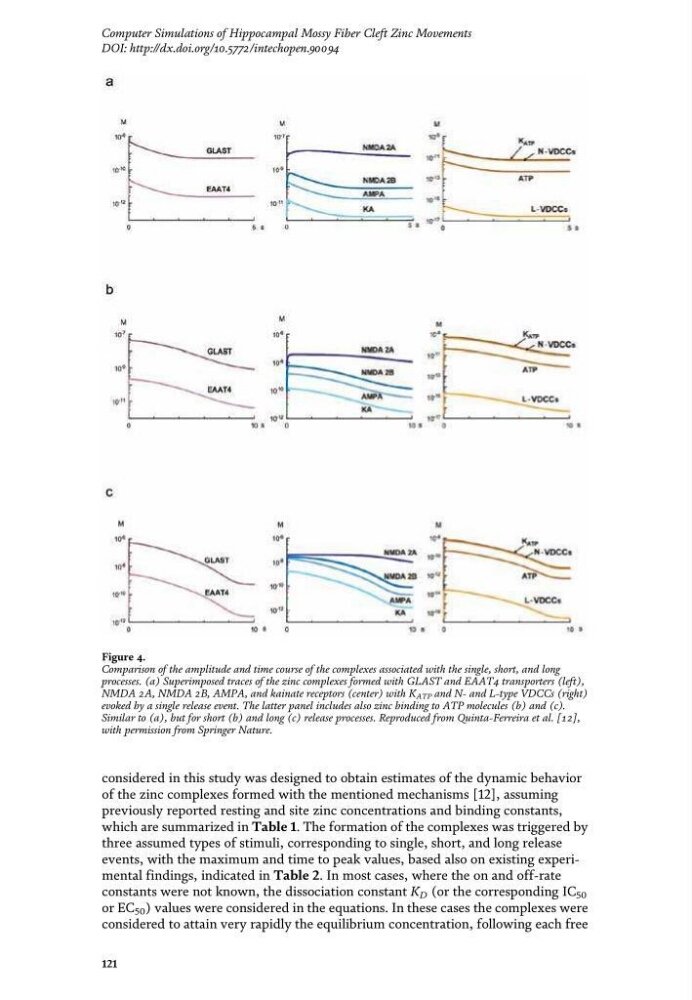
Figure 4.
Comparison of the amplitude and time course of the complexes associated with the single, short, and long
processes. (a) Superimposed traces of the zinc complexes formed with GLAST and EAAT4 transporters (left),
NMDA 2A, NMDA 2B, AMPA, and kainate receptors (center) with K ATP and N- and L-type VDCCs (right)
evoked by a single release event. The latter panel includes also zinc binding to ATP molecules (b) and (c).
Similar to (a), but for short (b) and long (c) release processes. Reproduced from Quinta-Ferreira et al. [12],
with permission from Springer Nature.
121
Computer Simulations of Hippocampal Mossy Fiber Cleft Zinc Movements
DOI: http://dx.doi.org/10.5772/intechopen.90094
of the zinc complexes formed with the mentioned mechanisms [12], assuming
previously reported resting and site zinc concentrations and binding constants,
which are summarized in Table 1. The formation of the complexes was triggered by
three assumed types of stimuli, corresponding to single, short, and long release
events, with the maximum and time to peak values, based also on existing experimental findings, indicated in Table 2. In most cases, where the on and off-rate
constants were not known, the dissociation constant K D (or the corresponding IC 50
or EC 50 ) values were considered in the equations. In these cases the complexes were
considered to attain very rapidly the equilibrium concentration, following each free
Figure 4.
Comparison of the amplitude and time course of the complexes associated with the single, short, and long
processes. (a) Superimposed traces of the zinc complexes formed with GLAST and EAAT4 transporters (left),
NMDA 2A, NMDA 2B, AMPA, and kainate receptors (center) with K ATP and N- and L-type VDCCs (right)
evoked by a single release event. The latter panel includes also zinc binding to ATP molecules (b) and (c).
Similar to (a), but for short (b) and long (c) release processes. Reproduced from Quinta-Ferreira et al. [12],
with permission from Springer Nature.
121
Computer Simulations of Hippocampal Mossy Fiber Cleft Zinc Movements
DOI: http://dx.doi.org/10.5772/intechopen.90094