

synapse is positioned at the top of a spine which is considered by many authors as a
separate electrical compartment with a high input impedance [61–67]. The general
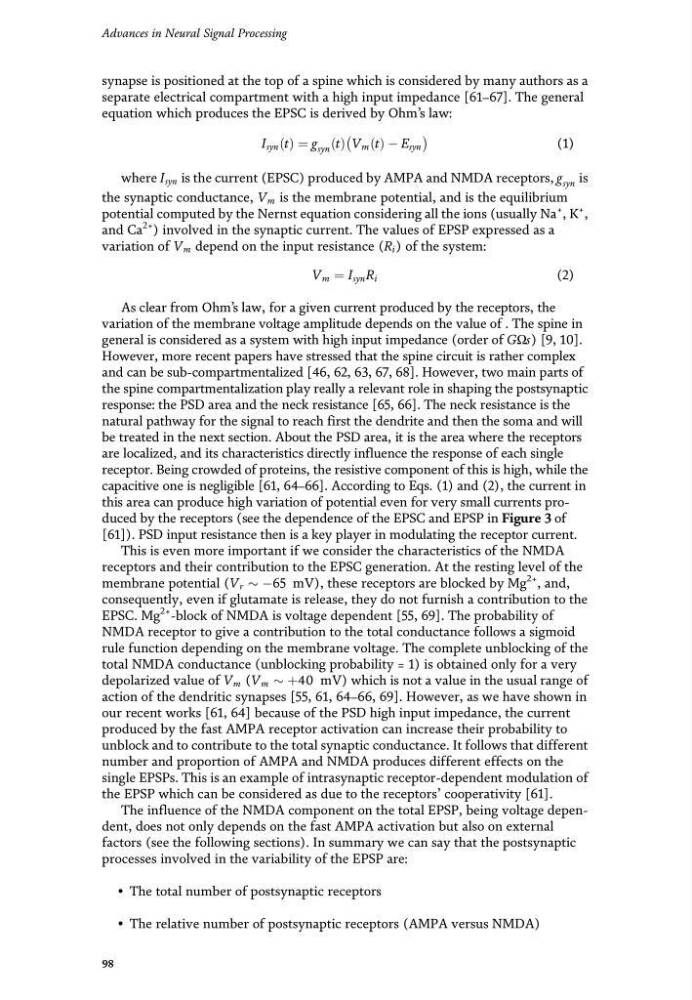
equation which produces the EPSC is derived by Ohm’s law:
I syn t
ðÞ¼g syn t
ðÞ V m t
ðÞ�E syn
ÀÁ
(1)
where I syn is the current (EPSC) produced by AMPA and NMDA receptors, g syn is
the synaptic conductance, V m is the membrane potential, and is the equilibrium
potential computed by the Nernst equation considering all the ions (usually Na
+ ,K
+ ,
and Ca
2+ ) involved in the synaptic current. The values of EPSP expressed as a
variation of V m depend on the input resistance (R i ) of the system:
V m ¼ I syn R i
(2)
As clear from Ohm’s law, for a given current produced by the receptors, the
variation of the membrane voltage amplitude depends on the value of . The spine in
general is considered as a system with high input impedance (order of GΩs) [9, 10].
However, more recent papers have stressed that the spine circuit is rather complex
and can be sub-compartmentalized [46, 62, 63, 67, 68]. However, two main parts of
the spine compartmentalization play really a relevant role in shaping the postsynaptic
response: the PSD area and the neck resistance [65, 66]. The neck resistance is the
natural pathway for the signal to reach first the dendrite and then the soma and will
be treated in the next section. About the PSD area, it is the area where the receptors
are localized, and its characteristics directly influence the response of each single
receptor. Being crowded of proteins, the resistive component of this is high, while the
capacitive one is negligible [61, 64–66]. According to Eqs. (1) and (2), the current in
this area can produce high variation of potential even for very small currents produced by the receptors (see the dependence of the EPSC and EPSP in Figure 3 of
[61]). PSD input resistance then is a key player in modulating the receptor current.
This is even more important if we consider the characteristics of the NMDA
receptors and their contribution to the EPSC generation. At the resting level of the
membrane potential (V r ��65 mV), these receptors are blocked by Mg
2+ , and,
consequently, even if glutamate is release, they do not furnish a contribution to the
EPSC. Mg
2+ -block of NMDA is voltage dependent [55, 69]. The probability of
NMDA receptor to give a contribution to the total conductance follows a sigmoid
rule function depending on the membrane voltage. The complete unblocking of the
total NMDA conductance (unblocking probability = 1) is obtained only for a very
depolarized value of V m (V m �þ40 mV) which is not a value in the usual range of
action of the dendritic synapses [55, 61, 64–66, 69]. However, as we have shown in
our recent works [61, 64] because of the PSD high input impedance, the current
produced by the fast AMPA receptor activation can increase their probability to
unblock and to contribute to the total synaptic conductance. It follows that different
number and proportion of AMPA and NMDA produces different effects on the
single EPSPs. This is an example of intrasynaptic receptor-dependent modulation of
the EPSP which can be considered as due to the receptors’ cooperativity [61].
The influence of the NMDA component on the total EPSP, being voltage dependent, does not only depends on the fast AMPA activation but also on external
factors (see the following sections). In summary we can say that the postsynaptic
processes involved in the variability of the EPSP are:
• The total number of postsynaptic receptors
• The relative number of postsynaptic receptors (AMPA versus NMDA)
98
Advances in Neural Signal Processing
separate electrical compartment with a high input impedance [61–67]. The general
equation which produces the EPSC is derived by Ohm’s law:
I syn t
ðÞ¼g syn t
ðÞ V m t
ðÞ�E syn
ÀÁ
(1)
where I syn is the current (EPSC) produced by AMPA and NMDA receptors, g syn is
the synaptic conductance, V m is the membrane potential, and is the equilibrium
potential computed by the Nernst equation considering all the ions (usually Na
+ ,K
+ ,
and Ca
2+ ) involved in the synaptic current. The values of EPSP expressed as a
variation of V m depend on the input resistance (R i ) of the system:
V m ¼ I syn R i
(2)
As clear from Ohm’s law, for a given current produced by the receptors, the
variation of the membrane voltage amplitude depends on the value of . The spine in
general is considered as a system with high input impedance (order of GΩs) [9, 10].
However, more recent papers have stressed that the spine circuit is rather complex
and can be sub-compartmentalized [46, 62, 63, 67, 68]. However, two main parts of
the spine compartmentalization play really a relevant role in shaping the postsynaptic
response: the PSD area and the neck resistance [65, 66]. The neck resistance is the
natural pathway for the signal to reach first the dendrite and then the soma and will
be treated in the next section. About the PSD area, it is the area where the receptors
are localized, and its characteristics directly influence the response of each single
receptor. Being crowded of proteins, the resistive component of this is high, while the
capacitive one is negligible [61, 64–66]. According to Eqs. (1) and (2), the current in
this area can produce high variation of potential even for very small currents produced by the receptors (see the dependence of the EPSC and EPSP in Figure 3 of
[61]). PSD input resistance then is a key player in modulating the receptor current.
This is even more important if we consider the characteristics of the NMDA
receptors and their contribution to the EPSC generation. At the resting level of the
membrane potential (V r ��65 mV), these receptors are blocked by Mg
2+ , and,
consequently, even if glutamate is release, they do not furnish a contribution to the
EPSC. Mg
2+ -block of NMDA is voltage dependent [55, 69]. The probability of
NMDA receptor to give a contribution to the total conductance follows a sigmoid
rule function depending on the membrane voltage. The complete unblocking of the
total NMDA conductance (unblocking probability = 1) is obtained only for a very
depolarized value of V m (V m �þ40 mV) which is not a value in the usual range of
action of the dendritic synapses [55, 61, 64–66, 69]. However, as we have shown in
our recent works [61, 64] because of the PSD high input impedance, the current
produced by the fast AMPA receptor activation can increase their probability to
unblock and to contribute to the total synaptic conductance. It follows that different
number and proportion of AMPA and NMDA produces different effects on the
single EPSPs. This is an example of intrasynaptic receptor-dependent modulation of
the EPSP which can be considered as due to the receptors’ cooperativity [61].
The influence of the NMDA component on the total EPSP, being voltage dependent, does not only depends on the fast AMPA activation but also on external
factors (see the following sections). In summary we can say that the postsynaptic
processes involved in the variability of the EPSP are:
• The total number of postsynaptic receptors
• The relative number of postsynaptic receptors (AMPA versus NMDA)
98
Advances in Neural Signal Processing