

fluorescence, electrochemical, and mass spectrometry. The electrophoretic mobility
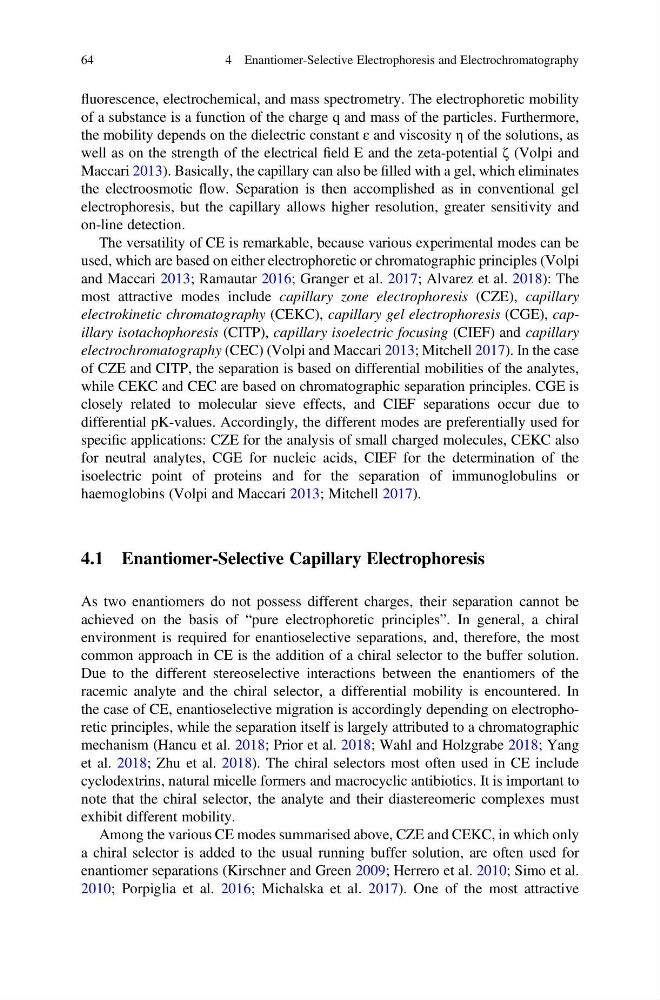
of a substance is a function of the charge q and mass of the particles. Furthermore,
the mobility depends on the dielectric constant ε and viscosity η of the solutions, as
well as on the strength of the electrical field E and the zeta-potential ζ (Volpi and
Maccari 2013). Basically, the capillary can also be filled with a gel, which eliminates
the electroosmotic flow. Separation is then accomplished as in conventional gel
electrophoresis, but the capillary allows higher resolution, greater sensitivity and
on-line detection.
The versatility of CE is remarkable, because various experimental modes can be
used, which are based on either electrophoretic or chromatographic principles (Volpi
and Maccari 2013; Ramautar 2016; Granger et al. 2017; Alvarez et al. 2018): The
most attractive modes include capillary zone electrophoresis (CZE), capillary
electrokinetic chromatography (CEKC), capillary gel electrophoresis (CGE), capillary isotachophoresis (CITP), capillary isoelectric focusing (CIEF) and capillary
electrochromatography (CEC) (Volpi and Maccari 2013; Mitchell 2017). In the case
of CZE and CITP, the separation is based on differential mobilities of the analytes,
while CEKC and CEC are based on chromatographic separation principles. CGE is
closely related to molecular sieve effects, and CIEF separations occur due to
differential pK-values. Accordingly, the different modes are preferentially used for
specific applications: CZE for the analysis of small charged molecules, CEKC also
for neutral analytes, CGE for nucleic acids, CIEF for the determination of the
isoelectric point of proteins and for the separation of immunoglobulins or
haemoglobins (Volpi and Maccari 2013; Mitchell 2017).
4.1 Enantiomer-Selective Capillary Electrophoresis
As two enantiomers do not possess different charges, their separation cannot be
achieved on the basis of “pure electrophoretic principles”. In general, a chiral
environment is required for enantioselective separations, and, therefore, the most
common approach in CE is the addition of a chiral selector to the buffer solution.
Due to the different stereoselective interactions between the enantiomers of the
racemic analyte and the chiral selector, a differential mobility is encountered. In
the case of CE, enantioselective migration is accordingly depending on electrophoretic principles, while the separation itself is largely attributed to a chromatographic
mechanism (Hancu et al. 2018; Prior et al. 2018; Wahl and Holzgrabe 2018; Yang
et al. 2018; Zhu et al. 2018). The chiral selectors most often used in CE include
cyclodextrins, natural micelle formers and macrocyclic antibiotics. It is important to
note that the chiral selector, the analyte and their diastereomeric complexes must
exhibit different mobility.
Among the various CE modes summarised above, CZE and CEKC, in which only
a chiral selector is added to the usual running buffer solution, are often used for
enantiomer separations (Kirschner and Green 2009; Herrero et al. 2010; Simo et al.
2010; Porpiglia et al. 2016; Michalska et al. 2017). One of the most attractive
64
4 Enantiomer-Selective Electrophoresis and Electrochromatography
of a substance is a function of the charge q and mass of the particles. Furthermore,
the mobility depends on the dielectric constant ε and viscosity η of the solutions, as
well as on the strength of the electrical field E and the zeta-potential ζ (Volpi and
Maccari 2013). Basically, the capillary can also be filled with a gel, which eliminates
the electroosmotic flow. Separation is then accomplished as in conventional gel
electrophoresis, but the capillary allows higher resolution, greater sensitivity and
on-line detection.
The versatility of CE is remarkable, because various experimental modes can be
used, which are based on either electrophoretic or chromatographic principles (Volpi
and Maccari 2013; Ramautar 2016; Granger et al. 2017; Alvarez et al. 2018): The
most attractive modes include capillary zone electrophoresis (CZE), capillary
electrokinetic chromatography (CEKC), capillary gel electrophoresis (CGE), capillary isotachophoresis (CITP), capillary isoelectric focusing (CIEF) and capillary
electrochromatography (CEC) (Volpi and Maccari 2013; Mitchell 2017). In the case
of CZE and CITP, the separation is based on differential mobilities of the analytes,
while CEKC and CEC are based on chromatographic separation principles. CGE is
closely related to molecular sieve effects, and CIEF separations occur due to
differential pK-values. Accordingly, the different modes are preferentially used for
specific applications: CZE for the analysis of small charged molecules, CEKC also
for neutral analytes, CGE for nucleic acids, CIEF for the determination of the
isoelectric point of proteins and for the separation of immunoglobulins or
haemoglobins (Volpi and Maccari 2013; Mitchell 2017).
4.1 Enantiomer-Selective Capillary Electrophoresis
As two enantiomers do not possess different charges, their separation cannot be
achieved on the basis of “pure electrophoretic principles”. In general, a chiral
environment is required for enantioselective separations, and, therefore, the most
common approach in CE is the addition of a chiral selector to the buffer solution.
Due to the different stereoselective interactions between the enantiomers of the
racemic analyte and the chiral selector, a differential mobility is encountered. In
the case of CE, enantioselective migration is accordingly depending on electrophoretic principles, while the separation itself is largely attributed to a chromatographic
mechanism (Hancu et al. 2018; Prior et al. 2018; Wahl and Holzgrabe 2018; Yang
et al. 2018; Zhu et al. 2018). The chiral selectors most often used in CE include
cyclodextrins, natural micelle formers and macrocyclic antibiotics. It is important to
note that the chiral selector, the analyte and their diastereomeric complexes must
exhibit different mobility.
Among the various CE modes summarised above, CZE and CEKC, in which only
a chiral selector is added to the usual running buffer solution, are often used for
enantiomer separations (Kirschner and Green 2009; Herrero et al. 2010; Simo et al.
2010; Porpiglia et al. 2016; Michalska et al. 2017). One of the most attractive
64
4 Enantiomer-Selective Electrophoresis and Electrochromatography