

3.7 Liquid Chromatography as a Measurement Tool
for Chiral Interactions
In an early review article, Ringo and Evans (Ringo and Evans 1998) elucidated the
potential of liquid chromatography beyond simple applications toward the strategic
implementation of HPLC as a tool for examining interaction chemistry for the
investigation of inherent chemical properties. This paradigm shift results from the
basic insight that a significant amount of quantitative and qualitative information is
contained in a separation, that is, the same physical–chemical interactions that
produce a separation in the spatial domain can be measured using that spatial
resolution as a parameter. HPLC can be tailored to interaction measurements of
practical and fundamental interest.
Today chromatographic methods are strategically applied to the elucidation of a
broad range of physicochemical properties of single compounds and mixtures.
Physical and chemical parameters such as binding constants, partition coefficients
and diffusional parameters, as well as interaction and reaction kinetics, are investigated (Perisic-Janjic et al. 2011; Wang et al. 2015; Russo et al. 2017; Giaginis et al.
2018; Ravindran et al. 2018; Uysal et al. 2018). HPLC-based simulation methods are
often used for the prediction of specific properties favourable to drug development
(Milosevic et al. 2017; Ravindran et al. 2018).
Although enantiomers have identical chemical and physical properties in an
isotropic environment, they usually exhibit significantly different interactions with
other chiral species. These enantioselective interactions form the cornerstone for
many processes of biological and technological importance and have profound
implications for pharmacology, molecular biology and bioengineering. In many
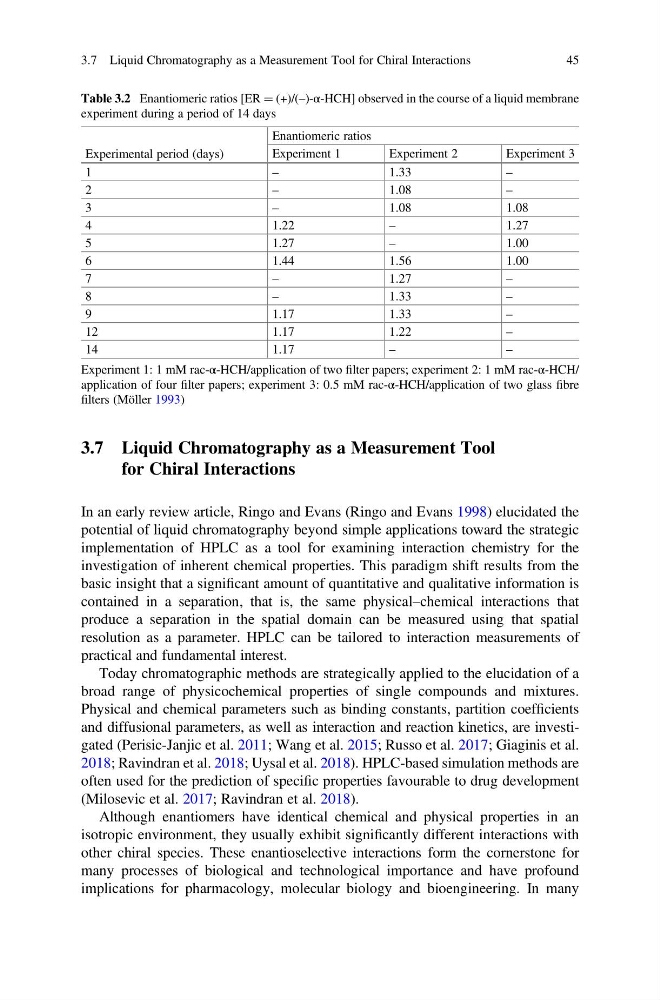
Table 3.2 Enantiomeric ratios [ER ¼ (+)/(–)-α-HCH] observed in the course of a liquid membrane
experiment during a period of 14 days
Experimental period (days)
Enantiomeric ratios
Experiment 1
Experiment 2
Experiment 3
1
–
1.33
–
2
–
1.08
–
3
–
1.08
1.08
4
1.22
–
1.27
5
1.27
–
1.00
6
1.44
1.56
1.00
7
–
1.27
–
8
–
1.33
–
9
1.17
1.33
–
12
1.17
1.22
–
14
1.17
–
–
Experiment 1: 1 mM rac-α-HCH/application of two filter papers; experiment 2: 1 mM rac-α-HCH/
application of four filter papers; experiment 3: 0.5 mM rac-α-HCH/application of two glass fibre
filters (Möller 1993)
3.7 Liquid Chromatography as a Measurement Tool for Chiral Interactions
45
for Chiral Interactions
In an early review article, Ringo and Evans (Ringo and Evans 1998) elucidated the
potential of liquid chromatography beyond simple applications toward the strategic
implementation of HPLC as a tool for examining interaction chemistry for the
investigation of inherent chemical properties. This paradigm shift results from the
basic insight that a significant amount of quantitative and qualitative information is
contained in a separation, that is, the same physical–chemical interactions that
produce a separation in the spatial domain can be measured using that spatial
resolution as a parameter. HPLC can be tailored to interaction measurements of
practical and fundamental interest.
Today chromatographic methods are strategically applied to the elucidation of a
broad range of physicochemical properties of single compounds and mixtures.
Physical and chemical parameters such as binding constants, partition coefficients
and diffusional parameters, as well as interaction and reaction kinetics, are investigated (Perisic-Janjic et al. 2011; Wang et al. 2015; Russo et al. 2017; Giaginis et al.
2018; Ravindran et al. 2018; Uysal et al. 2018). HPLC-based simulation methods are
often used for the prediction of specific properties favourable to drug development
(Milosevic et al. 2017; Ravindran et al. 2018).
Although enantiomers have identical chemical and physical properties in an
isotropic environment, they usually exhibit significantly different interactions with
other chiral species. These enantioselective interactions form the cornerstone for
many processes of biological and technological importance and have profound
implications for pharmacology, molecular biology and bioengineering. In many
Table 3.2 Enantiomeric ratios [ER ¼ (+)/(–)-α-HCH] observed in the course of a liquid membrane
experiment during a period of 14 days
Experimental period (days)
Enantiomeric ratios
Experiment 1
Experiment 2
Experiment 3
1
–
1.33
–
2
–
1.08
–
3
–
1.08
1.08
4
1.22
–
1.27
5
1.27
–
1.00
6
1.44
1.56
1.00
7
–
1.27
–
8
–
1.33
–
9
1.17
1.33
–
12
1.17
1.22
–
14
1.17
–
–
Experiment 1: 1 mM rac-α-HCH/application of two filter papers; experiment 2: 1 mM rac-α-HCH/
application of four filter papers; experiment 3: 0.5 mM rac-α-HCH/application of two glass fibre
filters (Möller 1993)
3.7 Liquid Chromatography as a Measurement Tool for Chiral Interactions
45