

different types of diastereomeric complexes, which in turn can be separated on
standard chromatographic columns.
It has to be taken into account that such quantitative methods are no simple
chemical procedures. The success to a large part depends on the preparative experience of the conducting researcher. Inadequate routines or unwanted enantiomeric
contamination can easily lead to additional errors or false determination (Ermer and
Vogel 2000; Toyo’oka 2002). Therefore, these methods have never achieved a
predominant role in enantioselective trace analysis. In addition, limitations like
complexation efficiency, detection limits, matrix effects etc. are obvious. Thus, we
will not focus in detail on these methods. For readers, who are interested in more
details, we recommend selected textbooks and comprehensive reviews (Beesley and
Scott 1998; Subramanian 2001, 2007; Aboul-Enein and Ali 2003; Ali and AboulEnein 2004; Klein 2012; Schurig and Ciogli 2013; Scriba 2013) for a comprehensive
introduction into the field of chiral pre-chromatographic derivatisation techniques.
3.2 Enantiomer-Selective HPLC Columns
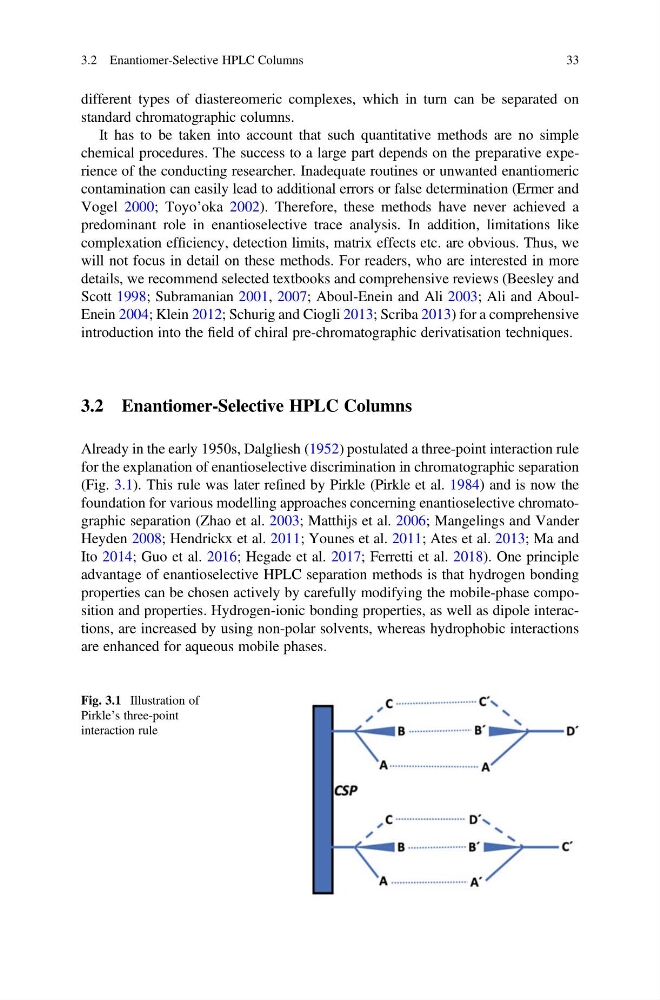
Already in the early 1950s, Dalgliesh (1952) postulated a three-point interaction rule
for the explanation of enantioselective discrimination in chromatographic separation
(Fig. 3.1). This rule was later refined by Pirkle (Pirkle et al. 1984) and is now the
foundation for various modelling approaches concerning enantioselective chromatographic separation (Zhao et al. 2003; Matthijs et al. 2006; Mangelings and Vander
Heyden 2008; Hendrickx et al. 2011; Younes et al. 2011; Ates et al. 2013; Ma and
Ito 2014; Guo et al. 2016; Hegade et al. 2017; Ferretti et al. 2018). One principle
advantage of enantioselective HPLC separation methods is that hydrogen bonding
properties can be chosen actively by carefully modifying the mobile-phase composition and properties. Hydrogen-ionic bonding properties, as well as dipole interactions, are increased by using non-polar solvents, whereas hydrophobic interactions
are enhanced for aqueous mobile phases.
Fig. 3.1 Illustration of
Pirkle’s three-point
interaction rule
3.2 Enantiomer-Selective HPLC Columns
33
standard chromatographic columns.
It has to be taken into account that such quantitative methods are no simple
chemical procedures. The success to a large part depends on the preparative experience of the conducting researcher. Inadequate routines or unwanted enantiomeric
contamination can easily lead to additional errors or false determination (Ermer and
Vogel 2000; Toyo’oka 2002). Therefore, these methods have never achieved a
predominant role in enantioselective trace analysis. In addition, limitations like
complexation efficiency, detection limits, matrix effects etc. are obvious. Thus, we
will not focus in detail on these methods. For readers, who are interested in more
details, we recommend selected textbooks and comprehensive reviews (Beesley and
Scott 1998; Subramanian 2001, 2007; Aboul-Enein and Ali 2003; Ali and AboulEnein 2004; Klein 2012; Schurig and Ciogli 2013; Scriba 2013) for a comprehensive
introduction into the field of chiral pre-chromatographic derivatisation techniques.
3.2 Enantiomer-Selective HPLC Columns
Already in the early 1950s, Dalgliesh (1952) postulated a three-point interaction rule
for the explanation of enantioselective discrimination in chromatographic separation
(Fig. 3.1). This rule was later refined by Pirkle (Pirkle et al. 1984) and is now the
foundation for various modelling approaches concerning enantioselective chromatographic separation (Zhao et al. 2003; Matthijs et al. 2006; Mangelings and Vander
Heyden 2008; Hendrickx et al. 2011; Younes et al. 2011; Ates et al. 2013; Ma and
Ito 2014; Guo et al. 2016; Hegade et al. 2017; Ferretti et al. 2018). One principle
advantage of enantioselective HPLC separation methods is that hydrogen bonding
properties can be chosen actively by carefully modifying the mobile-phase composition and properties. Hydrogen-ionic bonding properties, as well as dipole interactions, are increased by using non-polar solvents, whereas hydrophobic interactions
are enhanced for aqueous mobile phases.
Fig. 3.1 Illustration of
Pirkle’s three-point
interaction rule
3.2 Enantiomer-Selective HPLC Columns
33