

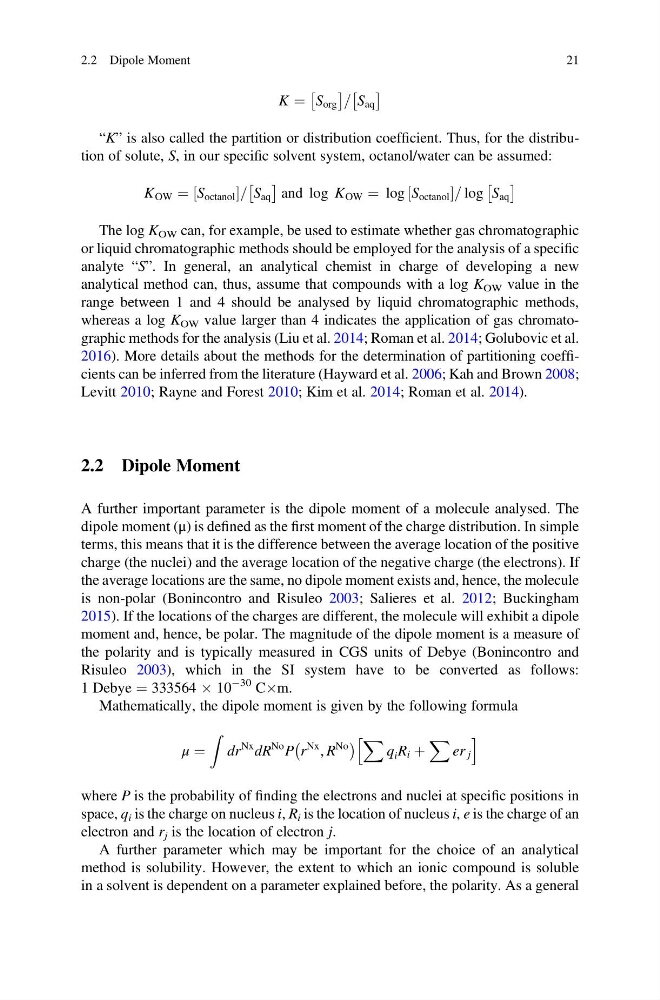
K ¼ S org
 Ã
= S aq
 Ã
“K” is also called the partition or distribution coefficient. Thus, for the distribution of solute, S, in our specific solvent system, octanol/water can be assumed:
K OW ¼ S octanol
½
= S aq
 Ã
and log K OW ¼ log S octanol
½
= log S aq
 Ã
The log K OW can, for example, be used to estimate whether gas chromatographic
or liquid chromatographic methods should be employed for the analysis of a specific
analyte “S”. In general, an analytical chemist in charge of developing a new
analytical method can, thus, assume that compounds with a log K OW value in the
range between 1 and 4 should be analysed by liquid chromatographic methods,
whereas a log K OW value larger than 4 indicates the application of gas chromatographic methods for the analysis (Liu et al. 2014; Roman et al. 2014; Golubovic et al.
2016). More details about the methods for the determination of partitioning coefficients can be inferred from the literature (Hayward et al. 2006; Kah and Brown 2008;
Levitt 2010; Rayne and Forest 2010; Kim et al. 2014; Roman et al. 2014).
2.2 Dipole Moment
A further important parameter is the dipole moment of a molecule analysed. The
dipole moment (μ) is defined as the first moment of the charge distribution. In simple
terms, this means that it is the difference between the average location of the positive
charge (the nuclei) and the average location of the negative charge (the electrons). If
the average locations are the same, no dipole moment exists and, hence, the molecule
is non-polar (Bonincontro and Risuleo 2003; Salieres et al. 2012; Buckingham
2015). If the locations of the charges are different, the molecule will exhibit a dipole
moment and, hence, be polar. The magnitude of the dipole moment is a measure of
the polarity and is typically measured in CGS units of Debye (Bonincontro and
Risuleo 2003), which in the SI system have to be converted as follows:
1 Debye ¼ 333564 Â 10
À30 CÂm.
Mathematically, the dipole moment is given by the following formula
μ ¼
Z
dr
Nx dR
No P r
Nx , R
No
À
Á X
q i R i þ
X
er j
h
i
where P is the probability of finding the electrons and nuclei at specific positions in
space, q i is the charge on nucleus i, R i is the location of nucleus i, e is the charge of an
electron and r j is the location of electron j.
A further parameter which may be important for the choice of an analytical
method is solubility. However, the extent to which an ionic compound is soluble
in a solvent is dependent on a parameter explained before, the polarity. As a general
2.2 Dipole Moment
21
 Ã
= S aq
 Ã
“K” is also called the partition or distribution coefficient. Thus, for the distribution of solute, S, in our specific solvent system, octanol/water can be assumed:
K OW ¼ S octanol
½
= S aq
 Ã
and log K OW ¼ log S octanol
½
= log S aq
 Ã
The log K OW can, for example, be used to estimate whether gas chromatographic
or liquid chromatographic methods should be employed for the analysis of a specific
analyte “S”. In general, an analytical chemist in charge of developing a new
analytical method can, thus, assume that compounds with a log K OW value in the
range between 1 and 4 should be analysed by liquid chromatographic methods,
whereas a log K OW value larger than 4 indicates the application of gas chromatographic methods for the analysis (Liu et al. 2014; Roman et al. 2014; Golubovic et al.
2016). More details about the methods for the determination of partitioning coefficients can be inferred from the literature (Hayward et al. 2006; Kah and Brown 2008;
Levitt 2010; Rayne and Forest 2010; Kim et al. 2014; Roman et al. 2014).
2.2 Dipole Moment
A further important parameter is the dipole moment of a molecule analysed. The
dipole moment (μ) is defined as the first moment of the charge distribution. In simple
terms, this means that it is the difference between the average location of the positive
charge (the nuclei) and the average location of the negative charge (the electrons). If
the average locations are the same, no dipole moment exists and, hence, the molecule
is non-polar (Bonincontro and Risuleo 2003; Salieres et al. 2012; Buckingham
2015). If the locations of the charges are different, the molecule will exhibit a dipole
moment and, hence, be polar. The magnitude of the dipole moment is a measure of
the polarity and is typically measured in CGS units of Debye (Bonincontro and
Risuleo 2003), which in the SI system have to be converted as follows:
1 Debye ¼ 333564 Â 10
À30 CÂm.
Mathematically, the dipole moment is given by the following formula
μ ¼
Z
dr
Nx dR
No P r
Nx , R
No
À
Á X
q i R i þ
X
er j
h
i
where P is the probability of finding the electrons and nuclei at specific positions in
space, q i is the charge on nucleus i, R i is the location of nucleus i, e is the charge of an
electron and r j is the location of electron j.
A further parameter which may be important for the choice of an analytical
method is solubility. However, the extent to which an ionic compound is soluble
in a solvent is dependent on a parameter explained before, the polarity. As a general
2.2 Dipole Moment
21