

The pesticides analysed in this study include HCB, aldrin, dieldrin, endrin, p,
p
0 -DDT, o,p
0 -DDT, p,p
0 -DDE, o,p
0 -DDE, p,p
0 -DDD, o,p
0 -DDD, trans-chlordane,
cis-chlordane, trans-nonachlor, cis-nonachlor, oxychlordane, heptachlor and heptachlor epoxide. Lin et al. (2012) described the presence of HCH, DDT, HCH and
DDE in the atmosphere. The source of these pesticides was water–air exchange.
Wang et al. (2013) reported DDT and HCH in human blood samples in Hong
Kong residents. The authors identified fish products as the main source of human
blood contamination. The authors reported that the concentrations of these pesticides
were higher in comparison to the residents of other developing countries. Sultana
et al. (2014) reported the contamination of the Indus Basin, Pakistan, by α-endosulfan, β-HCH and o,p
0 -DDD. The authors described agriculture runoff as the source of
pollution. Li et al. (2015) reported the presence of DDT and HCH in Chaohu Lake.
The concentrations of organochlorine pesticides were in the range of
2.17–18.61 ng g
À1 in the surface sediments and 28–86.27 ng g
À1 in the inflowing
river. The authors reported sources of pollution as anthropogenic activities, that is,
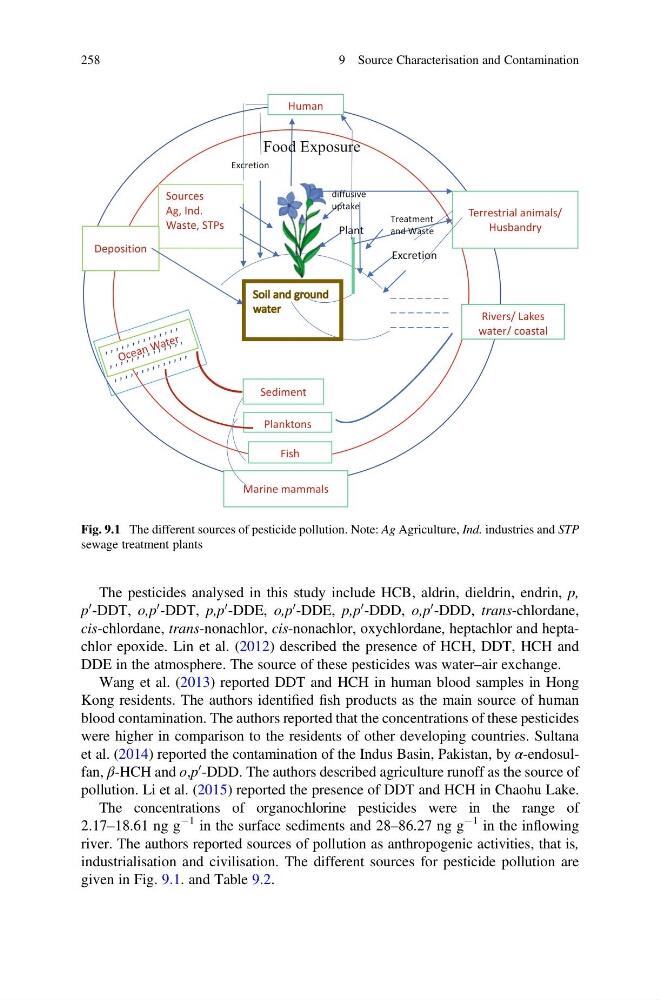
industrialisation and civilisation. The different sources for pesticide pollution are
given in Fig. 9.1. and Table 9.2.
Human
Sources
Ag, Ind.
Waste, STPs
Plant
_ _ _ _ _ _ _
_ _ _ _ _ _ _
_ _ _ _ _ _ _
Rivers/ Lakes
water
Terrestrial animals/
Husbandry
Planktons
Fish
Marine mammals
Deposition
diffusive
uptake
Excretion
Excretion
Treatment
and Waste
Rivers/ Lakes
water/ coastal
Food Exposure
Sediment
Fig. 9.1 The different sources of pesticide pollution. Note: Ag Agriculture, Ind. industries and STP
sewage treatment plants
258
9 Source Characterisation and Contamination
p
0 -DDT, o,p
0 -DDT, p,p
0 -DDE, o,p
0 -DDE, p,p
0 -DDD, o,p
0 -DDD, trans-chlordane,
cis-chlordane, trans-nonachlor, cis-nonachlor, oxychlordane, heptachlor and heptachlor epoxide. Lin et al. (2012) described the presence of HCH, DDT, HCH and
DDE in the atmosphere. The source of these pesticides was water–air exchange.
Wang et al. (2013) reported DDT and HCH in human blood samples in Hong
Kong residents. The authors identified fish products as the main source of human
blood contamination. The authors reported that the concentrations of these pesticides
were higher in comparison to the residents of other developing countries. Sultana
et al. (2014) reported the contamination of the Indus Basin, Pakistan, by α-endosulfan, β-HCH and o,p
0 -DDD. The authors described agriculture runoff as the source of
pollution. Li et al. (2015) reported the presence of DDT and HCH in Chaohu Lake.
The concentrations of organochlorine pesticides were in the range of
2.17–18.61 ng g
À1 in the surface sediments and 28–86.27 ng g
À1 in the inflowing
river. The authors reported sources of pollution as anthropogenic activities, that is,
industrialisation and civilisation. The different sources for pesticide pollution are
given in Fig. 9.1. and Table 9.2.
Human
Sources
Ag, Ind.
Waste, STPs
Plant
_ _ _ _ _ _ _
_ _ _ _ _ _ _
_ _ _ _ _ _ _
Rivers/ Lakes
water
Terrestrial animals/
Husbandry
Planktons
Fish
Marine mammals
Deposition
diffusive
uptake
Excretion
Excretion
Treatment
and Waste
Rivers/ Lakes
water/ coastal
Food Exposure
Sediment
Fig. 9.1 The different sources of pesticide pollution. Note: Ag Agriculture, Ind. industries and STP
sewage treatment plants
258
9 Source Characterisation and Contamination