

The point sources comprise fixed starting points of contamination. These include
sites of industries, supply units, home lawns, ornaments, pest control, household
activities, sewage treatment plants, etc. The point sources of contamination have
decreased recently due to federal and state laws (Rubin and Graham 1982; Ringbom
1997; Organisation for Economic Co-operation and Development. SecretaryGeneral 2009; Plater and Plater 2010). The enforcement of these laws tends to be
clear cut because the source of pollution can be determined (Feldstein 1974; Pechan
2011; Carlson and Burtraw 2019). Contrarily, the non-point sources include forestry,
agriculture, transportation and other activities. Generally, contamination from
non-point sources culminates during the rainy season and snow precipitation
(Almetwally et al. 2020; Chen et al. 2020; Olisah et al. 2020; Potapowicz et al.
2020; Saleh et al. 2020; Sun et al. 2020). The most common chiral pollutants from
non-point sources include pharmaceuticals and personal care products, fertilisers,
pesticides, industrial chemicals, naturally occurring bioactive substances and nutrients from animal waste and others (Petrović et al. 2013; Xu et al. 2018; Zhou et al.
2018). Aerosols and atmospheric contaminants are also considered as a major
non-point source of pollution in ambient air (Bidleman and Leone 2004; Li et al.
2012; Zhu et al. 2017). Besides, dust of ploughing and pollens may carry chiral
pollutants from one place to another. By considering all these sources, agriculture is
considered as the leading non-point source of chiral pollution (Bidleman and Leone
2004; Niu et al. 2014; Qi et al. 2015; You et al. 2019; Zhao et al. 2019). In general,
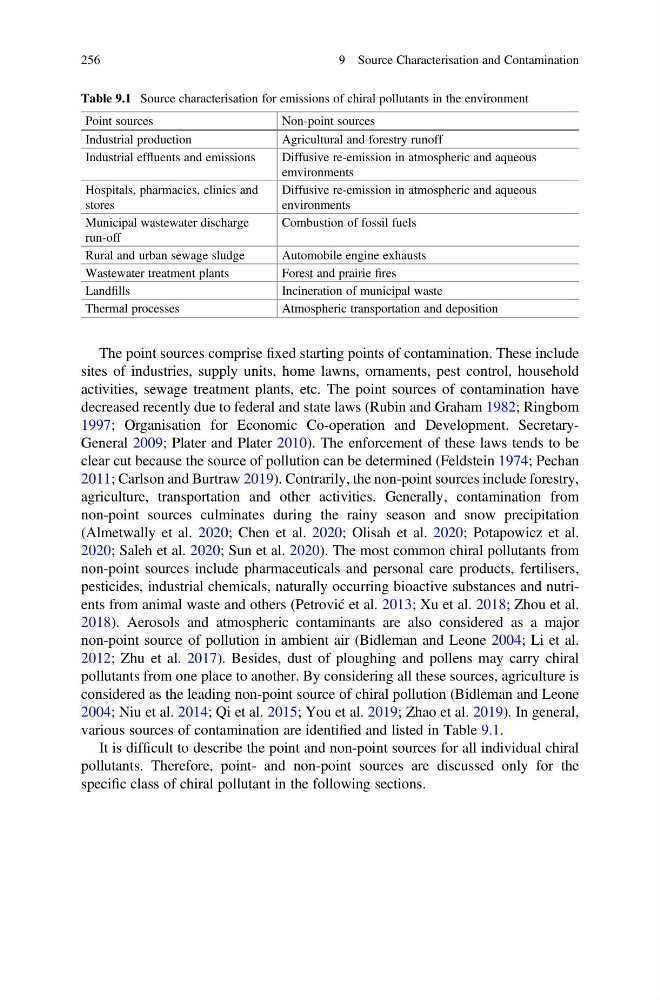
various sources of contamination are identified and listed in Table 9.1.
It is difficult to describe the point and non-point sources for all individual chiral
pollutants. Therefore, point- and non-point sources are discussed only for the
specific class of chiral pollutant in the following sections.
Table 9.1 Source characterisation for emissions of chiral pollutants in the environment
Point sources
Non-point sources
Industrial production
Agricultural and forestry runoff
Industrial effluents and emissions
Diffusive re-emission in atmospheric and aqueous
emvironments
Hospitals, pharmacies, clinics and
stores
Diffusive re-emission in atmospheric and aqueous
environments
Municipal wastewater discharge
run-off
Combustion of fossil fuels
Rural and urban sewage sludge
Automobile engine exhausts
Wastewater treatment plants
Forest and prairie fires
Landfills
Incineration of municipal waste
Thermal processes
Atmospheric transportation and deposition
256
9 Source Characterisation and Contamination
sites of industries, supply units, home lawns, ornaments, pest control, household
activities, sewage treatment plants, etc. The point sources of contamination have
decreased recently due to federal and state laws (Rubin and Graham 1982; Ringbom
1997; Organisation for Economic Co-operation and Development. SecretaryGeneral 2009; Plater and Plater 2010). The enforcement of these laws tends to be
clear cut because the source of pollution can be determined (Feldstein 1974; Pechan
2011; Carlson and Burtraw 2019). Contrarily, the non-point sources include forestry,
agriculture, transportation and other activities. Generally, contamination from
non-point sources culminates during the rainy season and snow precipitation
(Almetwally et al. 2020; Chen et al. 2020; Olisah et al. 2020; Potapowicz et al.
2020; Saleh et al. 2020; Sun et al. 2020). The most common chiral pollutants from
non-point sources include pharmaceuticals and personal care products, fertilisers,
pesticides, industrial chemicals, naturally occurring bioactive substances and nutrients from animal waste and others (Petrović et al. 2013; Xu et al. 2018; Zhou et al.
2018). Aerosols and atmospheric contaminants are also considered as a major
non-point source of pollution in ambient air (Bidleman and Leone 2004; Li et al.
2012; Zhu et al. 2017). Besides, dust of ploughing and pollens may carry chiral
pollutants from one place to another. By considering all these sources, agriculture is
considered as the leading non-point source of chiral pollution (Bidleman and Leone
2004; Niu et al. 2014; Qi et al. 2015; You et al. 2019; Zhao et al. 2019). In general,
various sources of contamination are identified and listed in Table 9.1.
It is difficult to describe the point and non-point sources for all individual chiral
pollutants. Therefore, point- and non-point sources are discussed only for the
specific class of chiral pollutant in the following sections.
Table 9.1 Source characterisation for emissions of chiral pollutants in the environment
Point sources
Non-point sources
Industrial production
Agricultural and forestry runoff
Industrial effluents and emissions
Diffusive re-emission in atmospheric and aqueous
emvironments
Hospitals, pharmacies, clinics and
stores
Diffusive re-emission in atmospheric and aqueous
environments
Municipal wastewater discharge
run-off
Combustion of fossil fuels
Rural and urban sewage sludge
Automobile engine exhausts
Wastewater treatment plants
Forest and prairie fires
Landfills
Incineration of municipal waste
Thermal processes
Atmospheric transportation and deposition
256
9 Source Characterisation and Contamination